
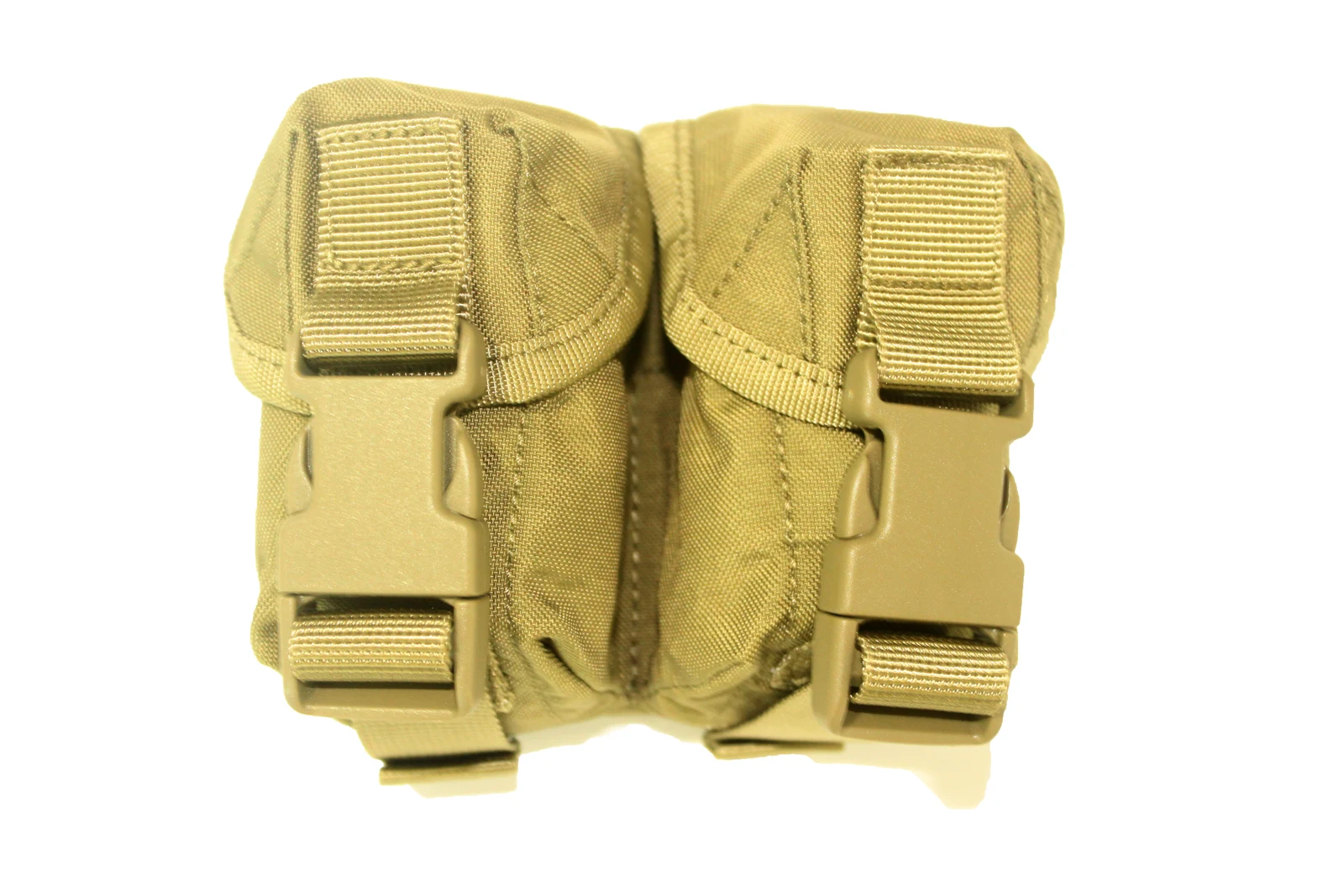
A double-cell pouch is useful when an item can be removed from one side while the other side stays in its intended storage state. Develop the usable space, flap movement and finger path together. Doubling the width of a single pouch and adding a central seam does not define that interaction.
Identify what each cell carries and where the user grasps it. Separate closures are a starting point; independent access also depends on the objects, the spacing between entrances and the pouch’s mounted position.
01
Define each cell around its intended contents
Start by deciding whether the two cells carry matching items or perform different jobs. A proposed flashlight-and-tool arrangement needs separate reference shapes, including protruding ends and the intended direction of removal. The corporate library labels the pictured product as a double magazine pouch. It is used here as a reference for two-cell construction, without claiming confirmed fit for those alternative objects.
Identical allowance is not automatically appropriate for both cells. A wider object may need a different side panel, while a shorter one may need a revised depth or grasping position. Establish each cell’s usable space from the reference objects before deciding whether the finished appearance should remain symmetrical.
02
Leave room to reach beside the divider
The central area affects both entrances. With two broad objects side by side, check whether fingers can reach the intended grasping points independently. An empty-pocket review can miss changes caused when both contents spread the side panels outward.
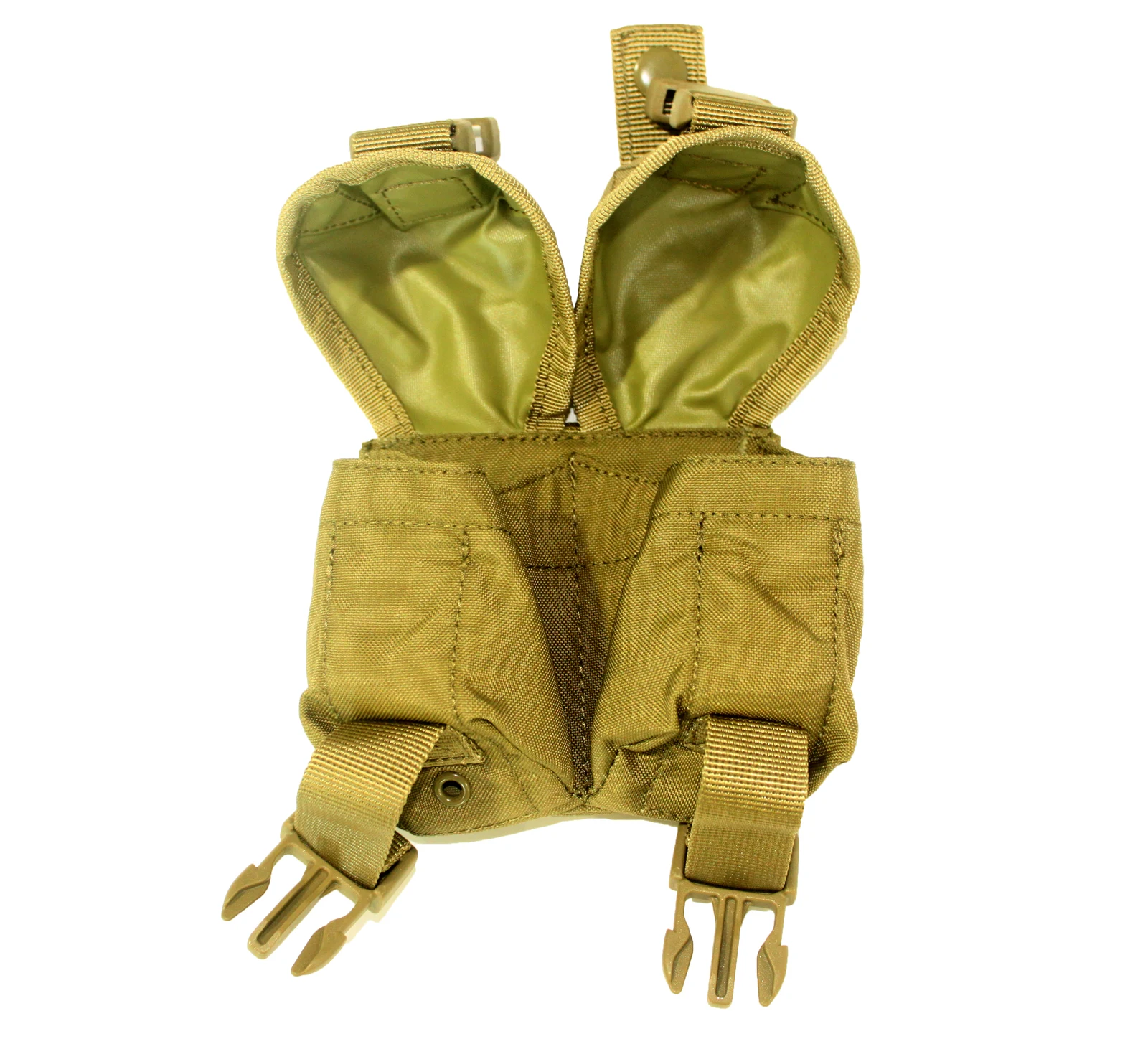
The open photograph shows two entrances and their central connection area, but not the complete internal depth. Confirm on the sample whether the separation continues to the bottom and whether there is any communication below it. A narrow object should not migrate into an unintended position. Show this internal construction directly rather than inferring it from the presence of two flaps.
03
Give the raised flap a place to stay
Keep one cell closed while observing the other flap’s path as it lifts, stays open and returns. The raised fabric needs a clear resting position. It should not cover the adjacent entrance or force the hand to reach around it. If the pouch mounts against a curved bag surface, review this interaction on that surface.
The front photograph shows two separate buckle assemblies. These provide visible components for separate closure, but a photograph does not establish one-handed use or retention performance. Continue through buckle release, flap lifting and grasping the item on the development sample before deciding whether the component positions need revision.
04
Balance coverage with a useful grasping area
Deeper flap coverage changes how much of the stored object remains available to hold. Shallower coverage requires a separate decision about how the contents stay retained. Adjust flap length and buckle location around the upper edge of the reference item, leaving a recognizable place to grasp it.
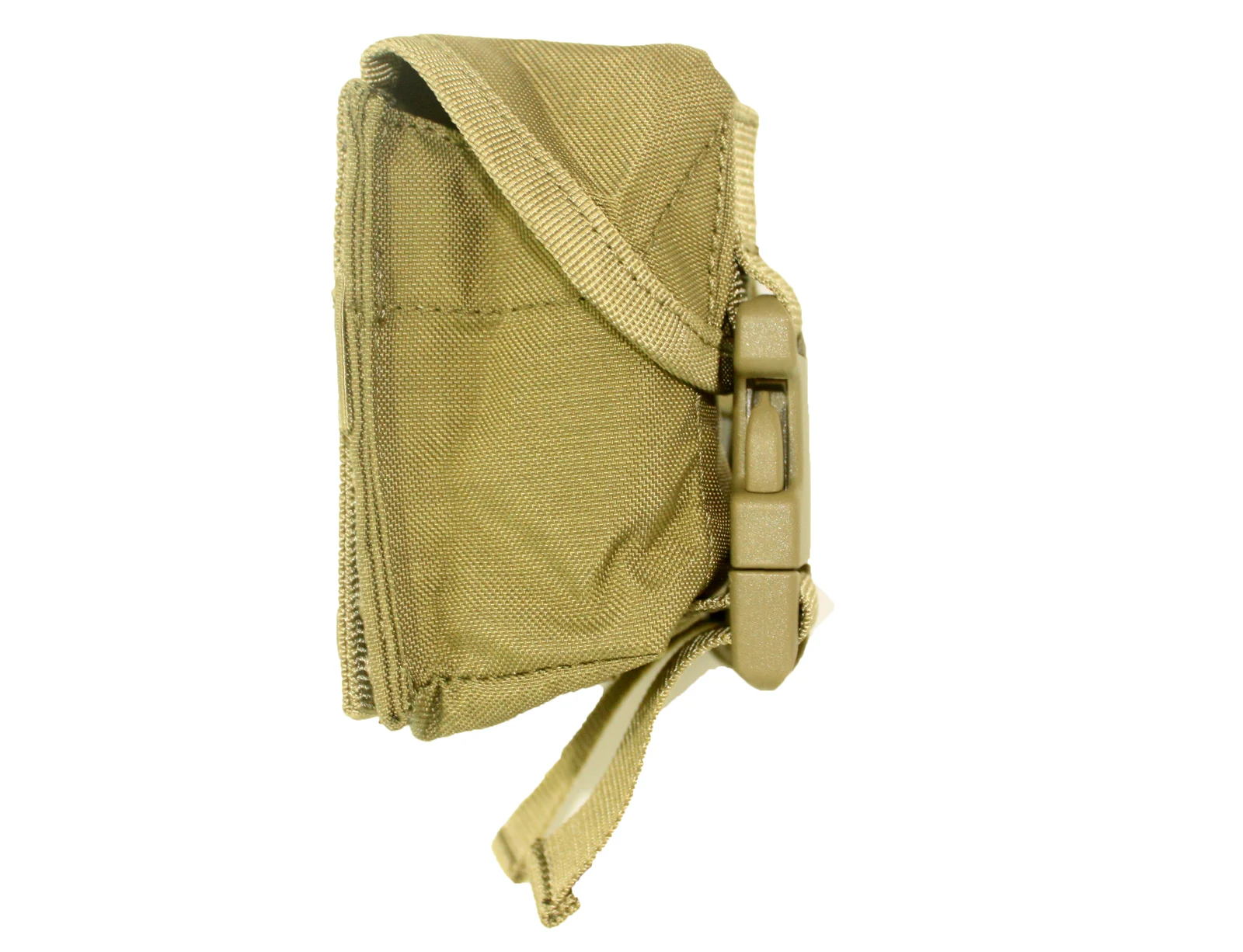
The side photograph illustrates coverage and the adjustment tail. After adjusting, look at whether the tail reaches the neighboring cell or a body-contact area. Match the useful adjustment range to the intended variation in item height. A very long tail should not substitute for a clear decision about pocket depth.
05
Review the pouch with one side empty
Loading just one cell can change the shape and relative direction of the two sides, especially on a flexible backing or belt. Compare both loaded, left loaded and right loaded under the intended arrangement. Use those conditions to decide the shared backing and mounting locations.
The practical question is whether each entrance remains recognizable and reachable. An empty cell does not need to retain the full photographic shape unless that is an explicit requirement. If additional structure is proposed to maintain it, consider the resulting thickness, folded volume and fit against the mounting surface together.
06
Specify the mechanism rather than the cell count
Keep the approved sample identifiable
The Maxpedition DES manufacturer description presents another approach: a webbing pull raises the contents, with lateral elastic retention. That operating mechanism differs from the buckle-flap arrangement in these photographs. A shared cell count does not make their extraction methods or fit descriptions interchangeable.
Give procurement separate references for both cells, their entrances, flap coverage, adjustment ranges and mounted position. Sample comments should identify a particular cell and action, so the next revision has a defined target. More product-development topics are available in the JKPD blog.
Related: bag plastic buckle pom pa materials. See the JKPD product reference.
Discuss your bag development project
ANSON XIE
General Manager & Founder
Quanzhou Junkai Pengda Special Equipment Co., Ltd.
Email: ansonxie@jkpdtime.com
Phone: +86 177 5095 3355
WhatsApp: +86 177 5095 3355
Factory address: Floors 2–4, Building 1, Phase I, Huixin Intelligent Manufacturing Industrial Park, Hui'an County, Quanzhou, Fujian, China