
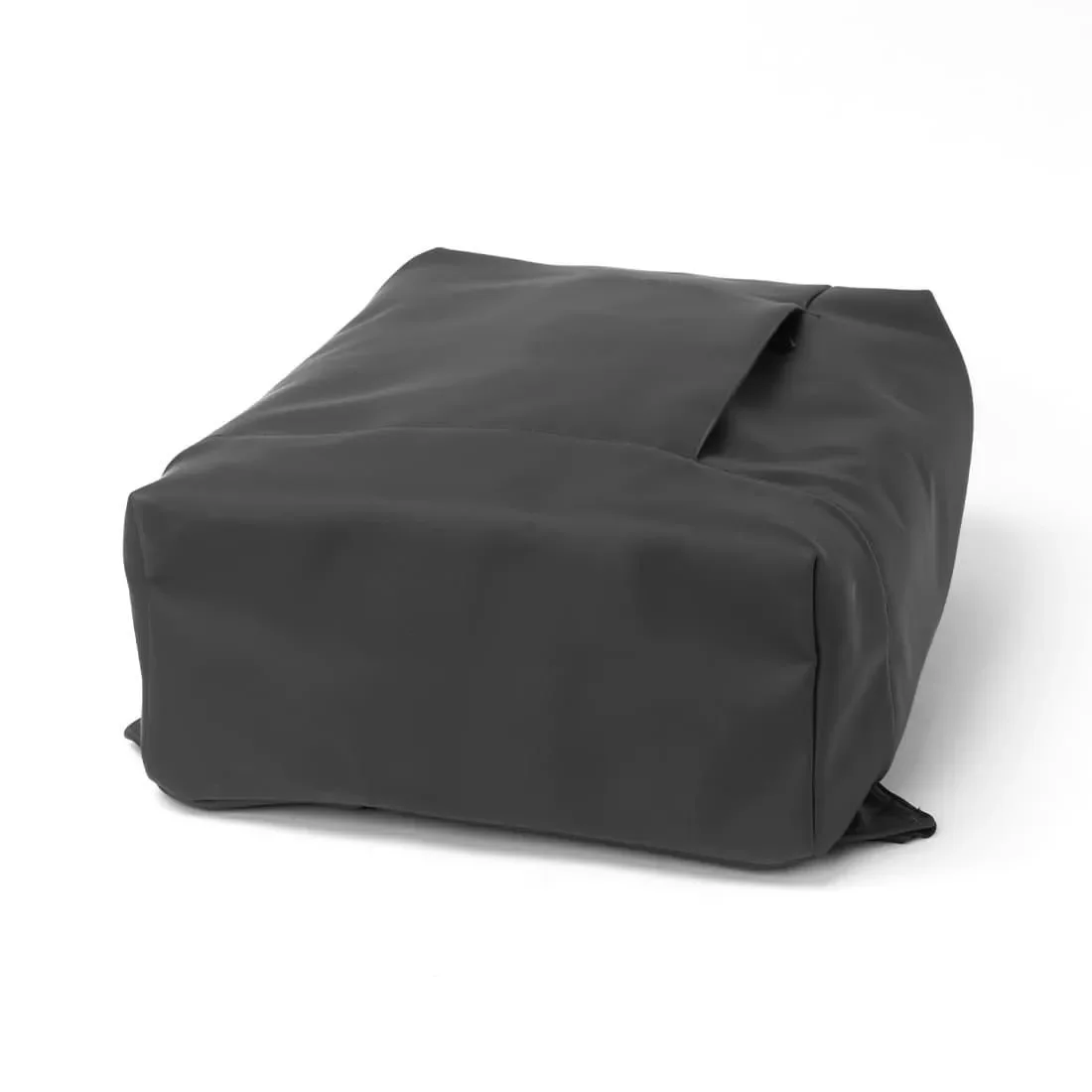
A business backpack buyer receives a seam-strength result and asks whether the bag is ready for approval. The number alone is not enough. It needs a traceable seam construction, a suitable test method and an explanation of what failed. It also needs a clear boundary: a seam specimen is not the same thing as a loaded backpack being carried repeatedly.
Start with one identified panel join in the development drawing. The objective is to decide whether the report supports that join and that revision, not to turn every fabric or thread certificate into a whole-bag claim. The following checks are a proposed buyer review process; they do not describe testing performed on the pictured backpack.
01
Establish whether the method fits the seam
The public scope of ISO 13935-2:2026 describes a grab method for seam maximum force with loading perpendicular to the seam. It applies to straight seams, not curved seams, and covers woven fabrics while normally excluding coated fabrics. The published scope also limits the method to constant-rate-of-extension equipment.
Those boundaries matter in a backpack specification. A straight join made from an uncoated woven material is a different starting point from a coated shell, a shaped corner or a padded multi-layer junction. Ask the laboratory to confirm applicability before choosing a familiar standard number. If a modified procedure is needed, identify the modification and avoid presenting it as an unqualified standard result.
The public scope is not the complete test procedure. The laboratory needs the applicable full method for specimen preparation, execution and reporting. Purchasing should not reconstruct those details from a web summary or impose an improvised specimen size because it is convenient to cut from a sample bag.
02
Connect the specimen to a real construction
Give the seam a reference that appears on the pattern or assembly drawing. Record which panels meet, their material references and orientations, the seam arrangement and the relevant sewing specification. Include the sample revision and material lot where available. A report for “black polyester bag fabric” is difficult to connect reliably to a later production sample.
For a development comparison, distinguish specimens prepared specifically for testing from seams removed from a sewn article. Both can provide useful information under a suitable method, but they answer different traceability questions. A laboratory-made specimen does not establish that the factory reproduced the same construction throughout a finished bag.
Keep photographs of the specimen before assessment and an identifiable reference for the approved seam. The purpose is not to document every decorative detail. It is to preserve enough information to find an unintended change in seam allowance, material pairing, stitch arrangement or assembly direction when a later result differs.
Use material direction labels that survive handover
“Vertical seam” is ambiguous after a specimen has been rotated on a bench. Identify the panel reference and the relevant fabric direction or cut orientation. Ask the laboratory how that orientation is represented in the report. The production team should be able to recreate the intended specimen without guessing from a cropped photograph.
03
Read the outcome and the failure description together
First establish what the numerical result represents and which units are used. Confirm whether the displayed figure is an individual result, a summary or another reported value. Ask for the underlying results required by the agreed method and contract. Do not compare an isolated peak from one submission with a summary from another as though they were interchangeable.
Then read what happened to the specimen. Was there thread rupture, fabric damage near the seam, yarn movement, or a fixture-related issue identified by the laboratory? Use the laboratory's classification and photographs rather than inventing a diagnosis from the force number. A result that needs qualification should remain qualified in the purchasing record.
The distinction affects corrective action. Changing thread is not a reliable response to every weak result, especially if the evidence points to the fabric or construction. Conversely, a fabric supplier's tensile report does not establish the strength of a seam sewn with the selected thread and settings. For the component-selection side of that discussion, use the separate business-backpack sewing-thread review.
04
Compare revisions without changing the question
Suppose a hypothetical development team is comparing two straight panel joins. One revision changes the seam allowance; the other changes both the allowance and material orientation. Even if both results are obtained correctly, the second comparison cannot isolate the effect of the allowance alone. Record all intentional changes before drawing a conclusion.
Where the objective is to investigate one variable, keep the other relevant construction and assessment conditions controlled with the laboratory and sample room. Where the objective is to approve a complete new construction, say so explicitly. That avoids a misleading story that one sewing detail caused an improvement when several things changed together.
Do not set a universal pass value from an unrelated backpack report. Agree the requirement and decision rule for the actual project before testing, including how to handle individual results, incomplete evidence and exceptions. A supplier should know whether the exercise is exploratory development or a formal release assessment.
05
Keep seam evidence separate from carrying claims
A laboratory seam specimen does not reproduce every load path in a backpack. Shoulder-strap attachments, a handle junction, curved corners and the surrounding panel assembly may require separate evaluation. The finished product also has repeated handling and contents arrangements that a single seam-force result does not describe.
Do not convert the reported force into a kilogram carrying recommendation. That shortcut ignores the specimen, fixture and distribution of load in the actual article. If a product load or durability claim is required, define the complete-product assessment and the claim conditions separately with qualified support.
Likewise, a satisfactory rupture result does not settle every appearance concern. A buyer may still need to assess visible opening, distortion or other agreed seam behavior during use. Keep those requirements named rather than hiding them under one broad “strong stitching” acceptance line.
06
Build a report-to-production release record
At handover, link the seam reference, construction revision, material identification, laboratory report and approval decision. Record unresolved qualifications explicitly. The sample room, purchasing team and production inspector should be looking at the same approved arrangement, not three similar-looking examples.
List the changes that require reassessment: material substitution, altered seam construction, changed thread specification or a different relevant production operation. The needed review may differ by change, but someone must own that decision. Retaining an old report is useful only when its relationship to the current construction remains clear.
The JKPD business backpack product reference illustrates the product category, not a disclosed seam composition or certified result. Bring the intended panel join, material details and applicable report to the development discussion. A traceable answer about one seam is more useful than an impressive number with no connection to the bag being ordered.
Discuss your bag development project
ANSON XIE
General Manager & Founder
Quanzhou Junkai Pengda Special Equipment Co., Ltd.
Email: ansonxie@jkpdtime.com
Phone: +86 177 5095 3355
WhatsApp: +86 177 5095 3355
Factory address: Floors 2–4, Building 1, Phase I, Huixin Intelligent Manufacturing Industrial Park, Hui'an County, Quanzhou, Fujian, China