
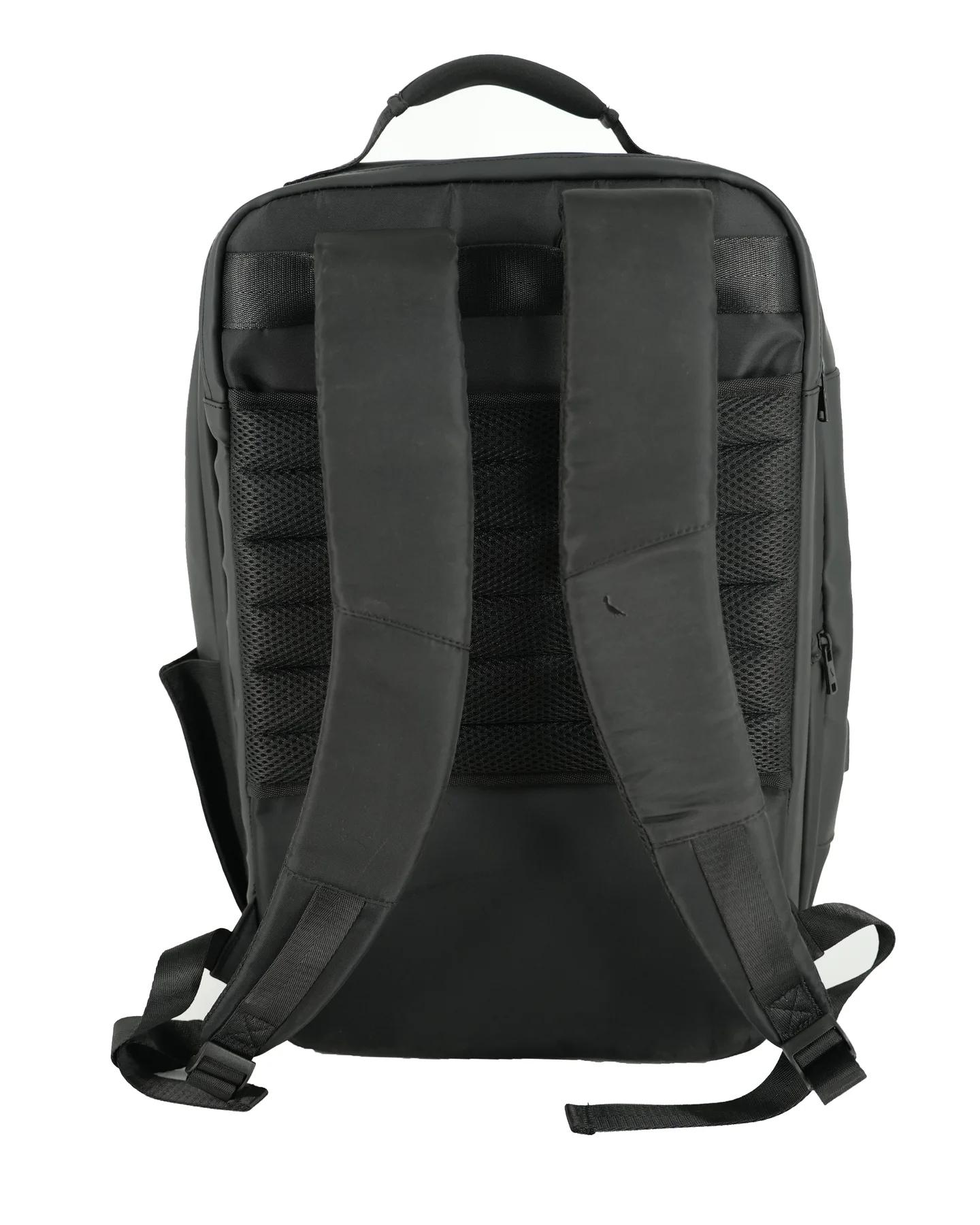
A business backpack needs some panels to hold an outline and others to move out of the way. Asking every panel to be “more structured” can make the opening awkward without improving the area that looked unsupported. Begin with the motion and shape required at each location, then evaluate bending stiffness in the proposed material and assembly.
The JK-039 business backpack provides a product context with broad panels, bound edges and an opening system. Its photograph does not identify hidden stiffeners or establish a measured stiffness. The review steps below are development recommendations, not a report of experiments on the pictured bag.
- Define the panel's job before asking for a stiffer material.
- Separate bending behavior from thickness, compression and bond strength.
- Compare identified directions and representative layer stacks.
- Keep the opening and packed-use review alongside material measurements.
01
Name the panel behavior that needs to change
Describe a location and an unwanted behavior instead of requesting a general increase in rigidity. Is an empty front panel folding inward, is a divider too difficult to move, or does a zipper surround resist opening? These are different development questions and may call for different changes.
Mark the affected region on the pattern or sample photograph. Include whether the bag is empty, partially packed or carrying the planned contents. If the complaint appears only with a particular object inside, identify that object before changing the full panel stack.
For a professional-looking commuter pack, a tidy empty silhouette may matter, but it should not silently override access. Ask which appearance is actually being approved: standing on a surface, hanging by the handle or worn. A single presentation photograph cannot specify all three conditions.
02
Distinguish bending from other material properties
The public ASTM D1388 description addresses fabric stiffness through bending-length measurement and calculated flexural rigidity. It identifies cantilever and heart-loop options. Ask the laboratory which approach suits the candidate and require the method and option on the report.
That is a different question from measuring thickness or pressing a padded surface. A thick, compressible layer and a thin, resistant layer can serve different panel functions. Do not use a caliper reading or a hand squeeze as a substitute for the bending evidence you requested.
Likewise, attachment between layers is its own issue. A laminate that bends as desired still needs a suitable bond for its application. Keep the panel bond review separate from stiffness approval rather than treating one favorable observation as proof of both.
Use careful language on the comparison sheet
Replace labels such as “premium firmness” with the material reference, test result where available, and intended panel role. Keep informal hand-feel comments in a separate field. They can help communication, but different reviewers should not mistake them for a controlled measurement.
03
Compare the directions that enter the pattern
Identify how each specimen relates to the material roll and how the proposed panel will be cut. Review the relevant directions separately instead of keeping only whichever feels firmer. A pattern rotation can change the relationship between the material and the direction in which the panel needs to bend.
For a broad front panel, examine both the overall shape and the movement near the opening. For a narrow internal divider, review its intended hinge region and the space available for the user's hand. These are application observations to make on samples, not universal outcomes for every woven fabric.
Keep specimen size, conditioning and test procedure with the laboratory result. If the laboratory identifies curling, twisting or another limitation, preserve the observation instead of hiding it in a footnote on a separate document. Ask how it affects the comparison before issuing a purchase requirement.
A useful sample label includes the face, roll direction and proposed location. Avoid unmarked loose pieces passed between the buyer, supplier and pattern maker. If the direction becomes uncertain, replace the specimen rather than reconstructing its identity from the surface appearance.
04
Review the stack, not only the face fabric
Request a loose-material reference and a representative sewn assembly. The latter should identify every proposed layer, its orientation and how the layers are connected. A shell swatch alone cannot show what an edge seam, lining, foam or insert contributes to the finished region.
Compare one planned change at a time when possible. If both the face fabric and insert change, the sample can still be useful, but it will not isolate which change caused the observed behavior. Record that limitation when deciding the next development step.
For a removable insert, evaluate it in its actual pocket or locating arrangement. Check whether it remains in position and whether its edges create unwanted projections. For a permanently attached stack, retain a section or construction record that makes later substitutions traceable.
The following is a proposed review checklist, not a standardized test:
- Identify the complete stack and the changed component.
- Inspect the empty panel in the agreed presentation condition.
- Pack the intended contents using a recorded arrangement.
- Open, reach and close without forcing the sample beyond its intended use.
- Note local folds, displaced layers and access problems by location.
05
Keep stiffness changes compatible with the opening
Review access before deciding that the firmest candidate is the best candidate. A panel may hold its outline while making it difficult to move a zipper path or reach an internal pocket. Check the actual interaction rather than approving isolated material pieces and assuming the assembly will follow.
Consider a hypothetical front panel that looks acceptable when empty but obstructs access when the organizer is filled. A useful next sample might change only the region near the opening, rather than stiffening or softening the entire bag. That is a development option to evaluate, not a verified solution for the photographed product.
Keep the packed contents and adjustment state consistent between comparisons. Otherwise, a changed notebook arrangement may be mistaken for a material improvement. Refer to the laptop compartment development guide when the panel also defines device storage or retrieval space.
Do not translate easier bending into impact protection, or a firmer surface into a load-bearing claim. Those objectives need their own suitable assessment. The material choice should state the intended function without promising unrelated performance.
06
Approve a repeatable reference, including storage state
ASTM's public D1388 notes that fabric stiffness may change with storage. For purchasing, record when and how comparison samples were held and ask the supplier about relevant storage limits. A newly prepared reference and a long-stored piece should not be assumed equivalent without review.
Retain the accepted material identification, direction, assembly details and observed opening behavior together. If quantitative limits are required, agree them with the buyer and laboratory for the specific application; this article provides no universal stiffness target. The approval should also name any unresolved product checks.
Finally, state what requires a fresh sample: a different backing, insert, adhesive arrangement, layer order or cutting direction may change the approved construction. Send the panel drawing, target behavior and candidate stack through the project inquiry page to scope the next iteration. A clear request such as “retain this outline while allowing this opening movement” is more actionable than “make it rigid.”
Discuss your bag development project
ANSON XIE
General Manager & Founder
Quanzhou Junkai Pengda Special Equipment Co., Ltd.
Email: ansonxie@jkpdtime.com
Phone: +86 177 5095 3355
WhatsApp: +86 177 5095 3355
Factory address: Floors 2–4, Building 1, Phase I, Huixin Intelligent Manufacturing Industrial Park, Hui'an County, Quanzhou, Fujian, China