
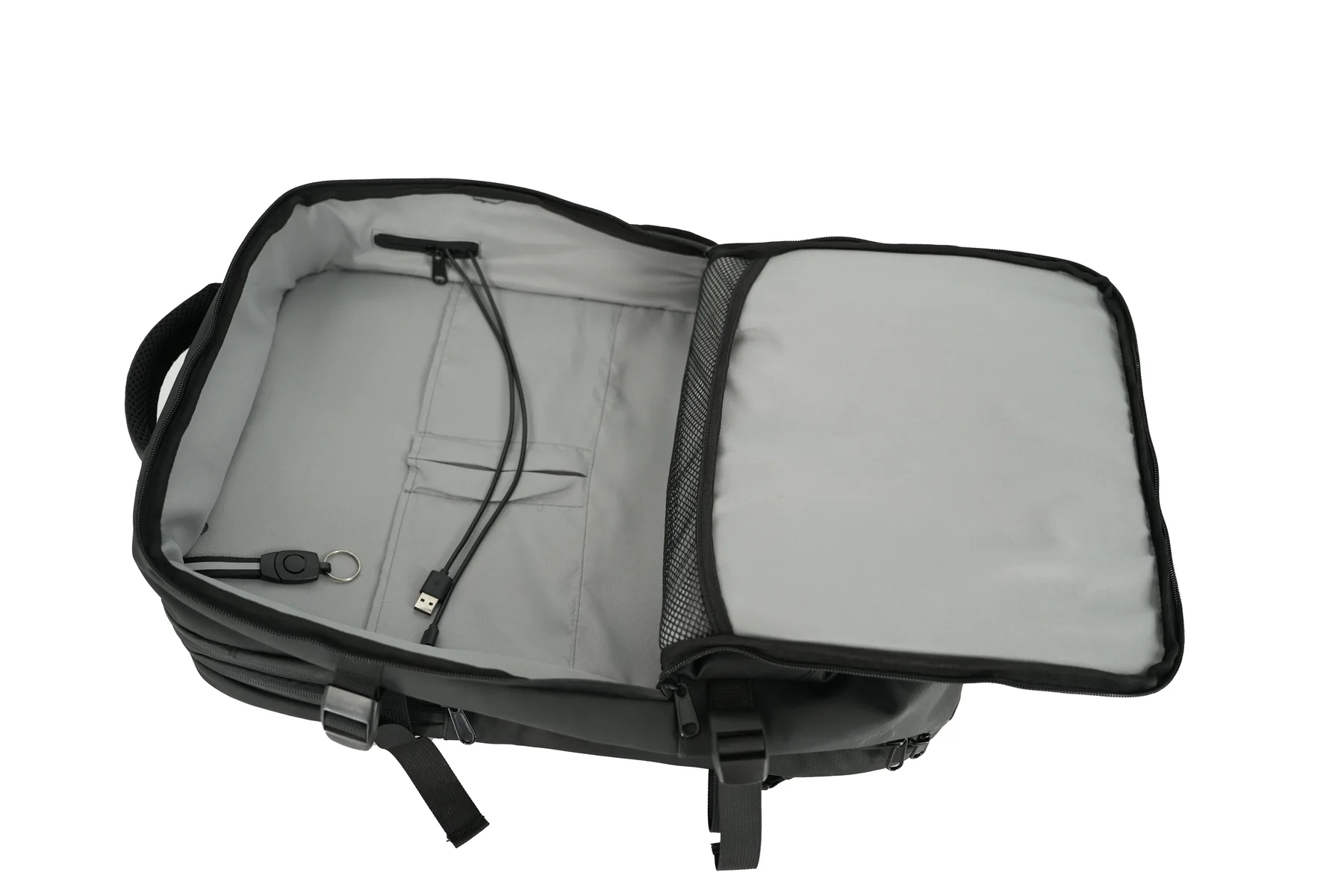
A pulled thread inside a business backpack does not automatically mean the lining needs to be heavier. First identify what caught it, where the contact occurred and whether the same damage appears on a flat fabric sample. A rough accessory edge, exposed hook tape or an awkward loading path can keep damaging a replacement fabric if the contact remains unchanged.
For a laptop-and-accessories backpack, review snagging at two levels: screen the candidate textile using an appropriate laboratory method, then review the finished compartment with representative contents. The first comparison concerns fabric behaviour. The second concerns the design that brings fabric and objects together. This guide proposes a development workflow; it does not report a test result for the photographed JKPD product.
01
Record the defect before calling it abrasion
Start with an undisturbed photograph and a location mark on the pattern or sample. Describe whether a yarn projects above the surface, the weave has distorted, a seam has opened, or material has worn away. These observations lead to different investigations. Do not trim the loose yarn before documenting it, because that removes useful evidence about the original damage.
A lining tear beside a pocket seam should not be grouped with a loop pulled from the middle of a panel. Nor should a stain be classified as a snag simply because both make the interior look damaged. Keep this review separate from lining colour-transfer checks and seam-opening evaluations. Otherwise, a supplier may improve the wrong property while the buyer believes the original complaint has been addressed.
Make the first record repeatable
- Photograph the whole compartment, then the defect with a scale beside it.
- Identify the panel face, fabric lot, sample revision and suspected contact item.
- Record whether the bag was empty, loosely packed or filled to the proposed working configuration.
- Retain an unaffected area or matching fabric piece for comparison.
The scale is for documenting the visible feature, not for creating a universal acceptance limit. Agree any limit with the buyer before evaluating the next sample.
02
Map what can touch the lining
Lay out the intended laptop, charger, cable pouch, notebook and other approved packing references. Inspect the surfaces that actually travel past the lining during insertion and removal. Include protruding plugs, damaged accessory casings and exposed fastener edges, while distinguishing normal intended contents from deliberately abusive objects.
Review the bag itself as well. Open hook tape, a cut zipper end, a rough trim edge or an unsecured seam allowance may be close enough to touch the facing panel. Do not assume the internal component is responsible merely because it looks rough; reproduce the contact under a documented access movement. Conversely, a smooth-looking photograph cannot establish that a component is free from a catching point.
In a clamshell business backpack, examine both the open loading position and the closed, packed position. A divider that lies flat while open may bow into another component when the compartment is filled. Mark each plausible contact on a simple panel drawing and rank the locations by how frequently the intended loading route passes them.
03
Choose a fabric screen that fits the construction
ASTM D3939/D3939M describes a mace snagging method for a range of woven and knitted fabrics. Its public scope excludes open constructions such as nets, very heavy or stiff fabrics that cannot fit the apparatus properly, and tufted or nonwoven materials. Ask the laboratory to confirm suitability for the actual lining, not just accept a method number copied from another specification.
The same ASTM overview cautions about between-laboratory precision and commercial-shipment acceptance. Use that limitation when planning comparisons: identify the laboratory, method edition, specimen condition and evaluation approach, and investigate differences before treating results from different laboratories as directly interchangeable. Obtain the full applicable method through the laboratory; this article is not an operating procedure.
Submit the finished lining construction intended for production, with its relevant finish and backing identified. A supplier's result for a similar-looking textile is background information unless the specimen can be connected to the proposed material. Keep the sample label with the report so that a later substitution is visible.
04
Separate material sensitivity from a design contact
Compare two questions without merging them. Does the candidate fabric show unacceptable surface disturbance in the agreed fabric screen? Does the assembled bag repeatedly catch at one defined location during the intended access movement? A material-only change is a weak answer when the second problem remains obvious.
Consider a hypothetical charger pocket: the lining catches as a plug passes an exposed hook patch beside the opening. A practical trial would first cover or relocate that patch while retaining the same lining. A separate trial could retain the original geometry with a different lining. Label both as development trials, not production approvals. Changing the patch, opening shape and textile together may remove the symptom, but it does not identify which change was necessary.
Possible design responses include shielding an exposed edge, relocating a fastening area, controlling a loose allowance or giving the intended item a clearer path. Each response has a cost. A cover can add bulk, a narrower opening can hinder access, and another lining can alter drape or sewing behaviour. Check those effects in the next assembled revision.
05
Review loading with controlled reference contents
Write a short handling sequence that another person can follow: open the specified compartment, insert the reference item in the agreed orientation, close the bag, reopen it and remove the item along the intended route. Define the repetitions and inspection points for this project before starting. Do not invent a standard cycle count or describe an informal trial as certified testing.
Use the same contents and sequence when comparing revisions. Include a realistic packed configuration as well as the easy empty-bag demonstration. Record exceptions, such as an item being forced sideways, rather than silently counting them as normal use. If the intended packing list changes, decide whether the access review also needs repeating.
This complements the dimensional work in laptop compartment development. Fit alone does not describe the route by which the laptop or accessory reaches its pocket. Confirm that protecting the lining has not made the compartment frustrating to use.
06
Define what approval actually covers
Use a written decision for the affected area, not a general statement that the lining is durable. The approval pack should identify the textile, the local construction revision, the contents used, the handling sequence and the visible condition accepted by the buyer. Keep before-and-after images taken under comparable lighting and viewing distance.
For production, turn the successful change into an inspectable detail. If the solution depends on covering a hook edge, show the coverage requirement and the location in the sewing instruction. If it depends on a particular lining finish, carry that identity into the material specification. A reference sample without those details can be reproduced visually while losing the feature that solved the problem.
When a new defect appears, reopen the relevant contact review rather than automatically upgrading every interior panel. Bring the marked sample, packing references and latest specification to JKPD's product-development team. The useful brief is specific: which item catches, on which surface, during which movement, and what trade-off the buyer will accept to prevent it.
Discuss your bag development project
ANSON XIE
General Manager & Founder
Quanzhou Junkai Pengda Special Equipment Co., Ltd.
Email: ansonxie@jkpdtime.com
Phone: +86 177 5095 3355
WhatsApp: +86 177 5095 3355
Factory address: Floors 2–4, Building 1, Phase I, Huixin Intelligent Manufacturing Industrial Park, Hui'an County, Quanzhou, Fujian, China