
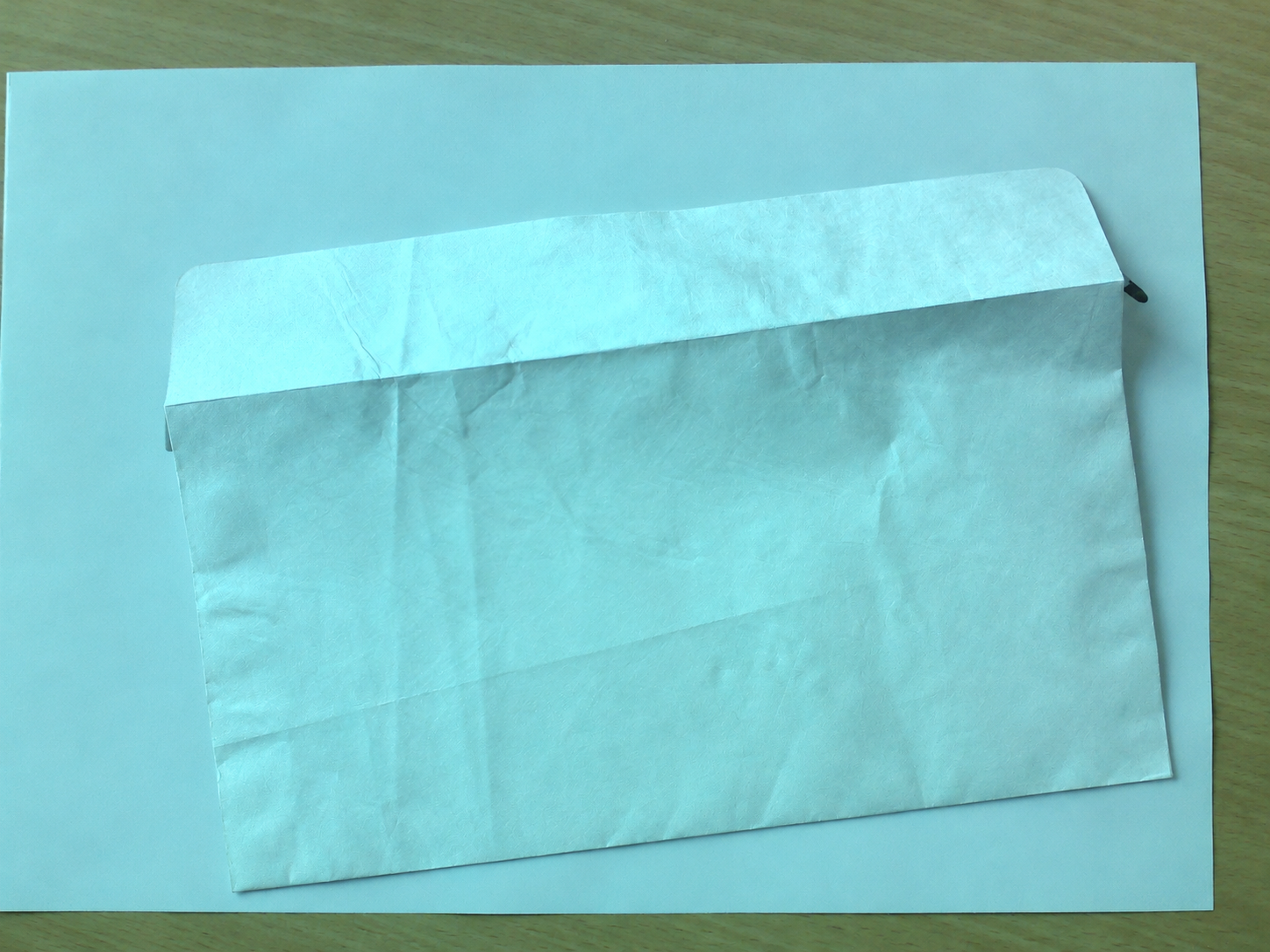
Photo: Newone; source colour/brightness adjustment by Ww2censor; brand cleanup for this article. CC BY-SA 2.0 · Original source. Edited illustration: product logos, handwriting and promotional background removed using image editing; not microscopy or performance evidence. This adapted image is distributed under CC BY-SA 2.0. Source colour/brightness previously adjusted by Ww2censor. The photograph remains under its stated license; no endorsement, specific material grade or JKPD use is implied.

01
Separate paper-like feel from material identity
Tyvek is a branded material, not the generic name for every white, paper-like sheet. DuPont identifies it as a synthetic HDPE-fibre material, offered in hard- and soft-structure categories. Development records need more than appearance descriptions such as paper fabric.
Request the actual style number, supply source and technical sheet before discussing printing, coating or lamination. Creases and a paper-like appearance cannot establish authenticity. External photographs, video and brand literature also do not establish that JKPD has sourced or used the particular article under discussion.
02
Hard and soft describe structures, not a quality ranking
Hard and soft structure are categories rather than a rule that the stiffer material is more durable. DuPont’s soft-structure page describes lighter bonding and embossing for a softer, fabric-like substrate. Confirm the individual style rather than substituting by category alone.
The real envelope photograph above is identified by its source author as Tyvek 1056D. It illustrates folds, mottling and paper-like appearance, not a bag sample or the hand of any soft-structure style. Brand and unrelated promotional information were cleaned from the photograph; the source and editing record are retained. Do not use the edited surface for microscopy or performance judgments.
03
Budget the base sheet and converted construction separately
For a lightweight bag, record base-sheet mass, printing or coating state, backing and adhesive separately, then check the actual cut-panel mass. Different backings on one base style can produce different total weight, thickness and hand. Do not attribute the entire laminate’s behaviour to Tyvek alone.
Worked panel-mass example
For a budgeting illustration only, suppose net panel area is 0.4 m² and sheet mass is 60 g/m². The theoretical contribution is 24 g before printing, backing and hardware. Cutting waste affects purchased material consumption, not the mass of retained panels. This is not a recommended style or a measured product result. Compare the calculation with actual panel weighing to identify omitted layers and components.
04
Sewing creates a different condition to review
DuPont’s converting guide notes that needle holes do not disappear after sewing and cautions against overly dense stitching. Develop the seam on the actual style and stack rather than copying settings from another textile. Examine damage around the perforations.
Keep separate coupons for corners, dense reverse stitching and webbing attachment zones, with allowance and load direction recorded. A base-sheet water-resistance description does not cover holes, edges and closures. If the bag requires rain exposure or more demanding water contact, define that situation first and assess the completed seams and product under the agreed conditions.
05
Manage printing, coating and lamination as new versions
The converting guide discusses coating, lamination, gluing and sewing separately and calls for adhesive suitability and evaluation before production. For bag development, approving the white base sheet therefore does not approve the printed or laminated construction. Bind ink, coating and backing state to the material revision.
Consider reviews of fold-area appearance, print rub-off, bubbles and interlayer separation, using agreed conditioning and judgment methods. These are proposed development checks, not tests performed for this article. Obtain thermal-processing conditions from the relevant material and converting suppliers. A polymer’s melting point should not be used as a safe ironing or pressing temperature.
06
Keep video context within its application
The DuPontEurope video below concerns material structure. Its description compares Tyvek, microporous film and SMS protective-clothing materials. It is supplementary viewing for a discussion of nonwoven constructions. Unreviewed microscopic comparisons and protection conclusions are not adopted here.
Protective-clothing samples, an envelope photograph and a bag-material style are different evidence. A protective-apparel application cannot be transferred into a bag material’s certification, lifetime or waterproofness claim. Return to the intended article and converted condition when asking for data relevant to the actual application.
Related video: Put your Tyvek® to the test -- Material structure · DuPontEurope
Supplementary viewing only. This external demonstration is not evidence of the pictured component, certification or finished-bag performance; consult current article-specific documentation.
A demonstration is not performance certification. If the player is unavailable, use the original link; internet access is required.
07
Approve the style through to its finished use
An inquiry should identify the authentic style, mass and thickness conditions, structure category, coating and laminate state, face orientation, colour and print revision. Add seam, surface and finished-use acceptance conditions. Supplier reports need to match that construction; general brand literature is not the purchase specification.
For end-of-life statements, DuPont links recycling of 100% Tyvek products to local facilities accepting flexible HDPE. Once adhesive, fabric, zippers and hardware are added, confirm the actual recycling route again. Do not simply describe the whole bag as fully recyclable or biodegradable. Material identity and finished-product disposal are separate questions requiring corresponding evidence.
Related reading: DWR finishes and water-resistance boundaries.
Share the application, candidate material articles and available records through the JKPD project inquiry page.
Discuss your bag development project
ANSON XIE
General Manager & Founder
Quanzhou Junkai Pengda Special Equipment Co., Ltd.
Email: ansonxie@jkpdtime.com
Phone: +86 177 5095 3355
WhatsApp: +86 177 5095 3355
Factory address: Floors 2–4, Building 1, Phase I, Huixin Intelligent Manufacturing Industrial Park, Hui'an County, Quanzhou, Fujian, China