
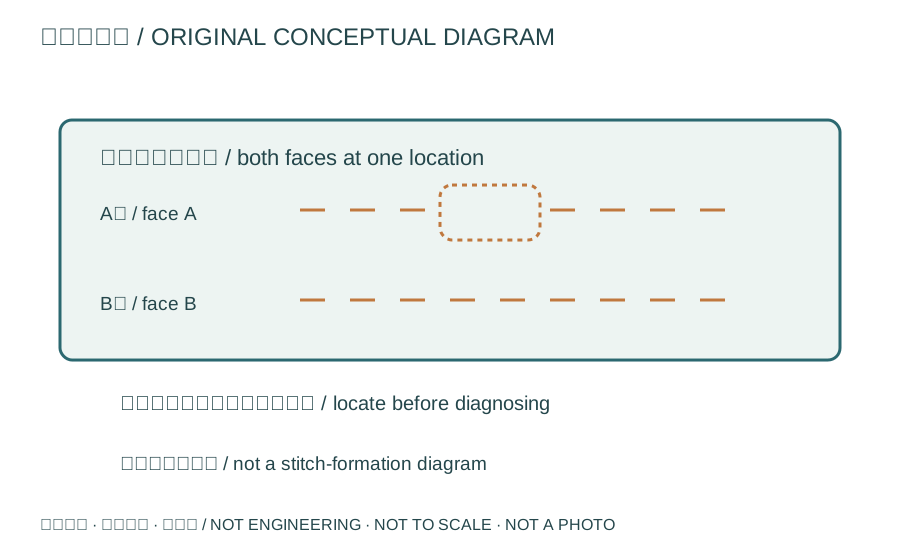
Document both faces and the operation location. Separate suspected skips, thread breaks and stitch-length variation before changing machine settings.
01
Does a long visible stitch prove a skip?
A long visible span is an observation, not a complete diagnosis. It may require investigation of suspected skips, thread breakage or stitch-length variation. Preserve both faces, the beginning and end of the affected region and the original thread ends before covering the area with additional stitching.
The NMSU sewing-problem checklist lists skipping and stitch-length variation separately. It provides basic troubleshooting prompts rather than an industrial bag-machine service manual. Use those prompts to organise evidence. The actual operation still needs review against its machine documentation and technical assessment. Avoid assigning a cause solely because one photograph resembles another example online.
02
Map the defect to the operation
Locate the issue on a straight run, corner, thickness transition, reverse-stitch region or start. Record sewing direction and the layers present at that point. Similar appearances at different locations can require different follow-up questions, so keep the location attached to the defect description.
For example, retain a flat section and a section representing the project's actual thickness transition in the trial set. This does not assert that every transition causes skipping. It makes the trial relevant to the reported operation. A flat piece that sews well cannot by itself show that a problem at an assembled corner or layered junction has been resolved.
03
Identify the needle and thread combination
The NMSU checklist identifies needle insertion, needle-thread suitability, needle condition and threading among checks associated with skipping. For an industrial operation, confirm the permitted needle system and installation requirements against the machine documentation. Similar nominal size is not a sufficient substitution rule.
Record the complete needle identity, thread specification, material combination and actual configuration. Ask the technical team which proposed changes apply to that machine. This article selects no universal needle size and does not treat a larger needle as an automatic remedy. The purpose of the record is to identify the combination that was reviewed, so later substitutions remain visible.
04
Keep both faces linked to the same location
Use location marks to match the same region on both faces. Retain a view of the continuous seam and a close view of the unusual span. The original diagram merely identifies a span for further examination. It does not reproduce an entire stitch-formation mechanism or provide evidence of a particular failure.
Before unpicking or closer examination, preserve the original condition and an independent reference specimen. Ask the reviewer to state what was observed and how it was confirmed. A description of a long thread span should not silently become a specific explanation of loop formation. Keep the observation and the technical conclusion distinguishable in the record.
Original conceptual diagram; not engineering, not to scale, not a photograph or product/test evidence.
05
Make equipment changes traceable
Have the technical team review the actual configuration against the machine documentation before proposing comparable sewing trials. Changes involving internal alignment, timing or component position need a change record. A setting shown in a short online video cannot establish the correct arrangement for another machine and operation.
Avoid changing everything and recording only fixed. Keep the before-and-after configuration, material identity and operation. This allows later production to reproduce the reviewed combination. It also distinguishes a temporary improvement from a repeated result. The buyer does not need a generic service procedure in the article; the buyer needs evidence that the reported operation was reviewed systematically.
06
Separate rework from process correction
An agreed repair needs its own method and inspection conditions. A patched area that looks continuous does not demonstrate that the source of the original issue has been removed. Nor does appearance alone prove restoration of the required seam performance.
Use a separate operation-specific trial to review the process correction. Address structure, appearance and dimensions according to project requirements. Identify the original sample, repaired sample and sample made with the revised process. Do not combine these identities in one approval photograph. Each answers a different question, and the supplier should be able to explain which evidence supports repair acceptance and which supports continued production.
07
Ask for an evidence package
Keep the reviewed combination traceable
Request the location record, both-face photographs, material and needle-thread identity, equipment review, comparative specimens and agreed inspection scope. State the boundary of the result. An operation that works under a documented arrangement does not establish suitability across all machines or materials.
This article proposes a communication and evidence process. It does not claim that JKPD uses a named machine or has completed a performance test. A clear separation of issue, change and result makes a later material substitution or production handover easier to assess. Retain the approved configuration with the sample rather than relying on an informal message saying that skipping no longer occurs.
Related development guidance: Review the connected construction.
Discuss your bag development project
ANSON XIE
General Manager & Founder
Quanzhou Junkai Pengda Special Equipment Co., Ltd.
Email: ansonxie@jkpdtime.com
Phone: +86 177 5095 3355
WhatsApp: +86 177 5095 3355
Factory address: Floors 2–4, Building 1, Phase I, Huixin Intelligent Manufacturing Industrial Park, Hui'an County, Quanzhou, Fujian, China