
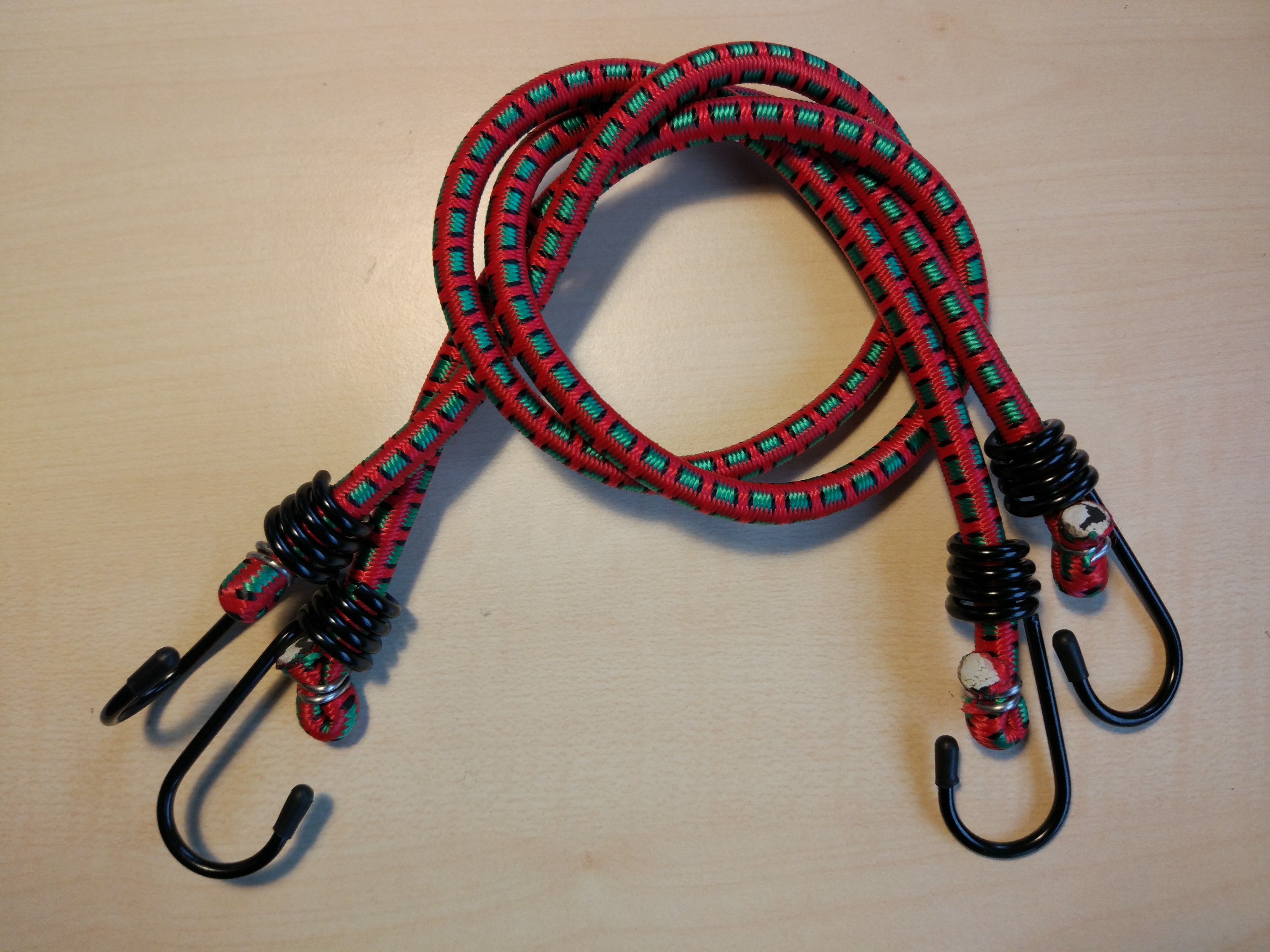
Photo: Lfuhr. CC BY-SA 4.0 · Original source. Unmodified for this article. The photograph remains under its stated license; no endorsement, specific material grade or JKPD use is implied.

01
Diameter is only one part of shock-cord identity
Specify cover, elastic core, construction and supplied condition separately for bag shock cord. Equal nominal diameters do not establish equal feel, extension force or recovery. High-elasticity round cord still needs a material identity and stated evaluation conditions.
This guide concerns ordinary bag closure and item-retention development. It focuses on material records rather than anchor layout. An accessory photograph or supplier elasticity sheet does not establish suitability for person support, climbing or other safety applications. A pull demonstration also leaves service life unproven. Start with the intended range of movement and the required retention behaviour before comparing how readily two loose samples stretch by hand.
02
Use the real ends to locate cover and core
The photograph shows two covered cords with metal hooks and visible internal bundles at their ends. It locates the braided exterior, termination and core area. Colour does not identify rubber type, and the photograph does not establish polyester, nylon or another covering fibre.
These are external accessories, not JKPD products or identified specimens from the Marlow data sheet discussed later. A visible end does not amount to a complete construction examination. Request the supplier’s construction record and article identity. Do not estimate load capacity, elastic content or a safety grade from the image, or assume that the depicted hook termination is appropriate for a different bag application.
03
A manufacturer example shows the value of separate fields
Marlow’s standard shockcord data sheet identifies a natural-rubber core and polyester cover, then distinguishes parallel core threads from the braided covering. This is one specified product system, not a universal recipe for elastic cord.
An inquiry can therefore ask for core and cover separately, followed by cover construction, mass per length and any additional finish. A claim such as latex-free or a named polymer needs an applicable declaration. White core strands and a generic trading name do not establish that claim. A substitution changing only the core still requires a documented review, even when the outer colour and nominal diameter stay the same.
04
State whether a percentage means increase or final length
An elongation percentage needs a defined increase relative to the original gauge length. A trading statement such as stretches to two hundred percent may confuse final length with increase. Clarify gauge length, loading condition and calculation convention before comparing candidates.
For a calculation example, increasing a one-hundred-millimetre gauge length to one hundred and fifty millimetres gives fifty percent elongation. Reaching two hundred millimetres gives a one-hundred-percent increase. These are hypothetical lengths, not measurements of the photograph. Record both original and extended lengths alongside the percentage. That record avoids the ambiguity of saying stretches twice as far and lets suppliers explain their figures using the same convention.
05
Extension force is different from breaking force
Marlow’s sheet lists load ranges at a specified elongation and describes unloaded measurement of length, mass and average diameter. These conditions distinguish the force needed to reach a length from the force at eventual failure.
For bag development, begin with the item size and operating feel, then ask the supplier to define the proposed working-extension range, associated force and recovery conditions. Do not relabel a force at one elongation as breaking strength. Likewise, nominal diameter does not establish the dimension of a pre-extended cord. If measurement conditions differ, resolve them before ranking results. A larger printed force is not automatically the better choice for an operation that a user must repeatedly open.
Suppose two candidates are both described as nominal four-millimetre cord, but one supplier has not stated whether measurement includes pretension. Align the measurement convention before interpreting the difference. A cord that feels easier to pull is not thereby proven to contain an inferior core. Gauge length, gripping arrangement and operation can affect an informal comparison. Document those variables first, then decide which differences need a controlled material or assembly evaluation. This is a hypothetical sourcing example, not a test of either photographed cord.
06
Compare the actual assembly after operation
Use the intended cord lock, channel, webbing loop and termination in evaluation specimens. Proposed observations include adjustment, slippage, cover wear, core retreat and condition after release. Let the project establish cycles, holding time, environment and assessment instead of assigning an unsupported universal life or load value.
The Right Rope video below is supplementary viewing for that supplier’s natural-rubber shock cord. It does not identify the photographed cords. Promotional extension statements are not transferred to Marlow products or JKPD materials. One pull is neither a long-term recovery assessment nor an aging test, and the supplier’s finished cord should not silently replace the assembly being developed.
Related video: Natural Rubber Shock Cord | Bungee Cord · Right Rope
Supplementary viewing only. This external demonstration is not evidence of the pictured component, certification or finished-bag performance; consult current article-specific documentation.
A demonstration is not performance certification. If the player is unavailable, use the original link; internet access is required.
07
Control material and assembly revisions
The inquiry can include core and cover declarations, diameter and unloaded measurement convention, mass per length, force at stated extension, recovery conditions, colour, batch and termination. Add the actual cord lock and installed sample so the combination awaiting approval is explicit.
For substitution, separate changes in core, braiding, diameter and end construction. Retain loose cord, processed ends and the complete assembly. This moves sourcing beyond asking whether the cord is stretchy. It defines how the material should work under stated conditions and gives later website descriptions a sound basis without inventing company use or test results.
Related reading: External cord layouts.
Share the application, candidate material articles and available records through the JKPD project inquiry page.
Discuss your bag development project
ANSON XIE
General Manager & Founder
Quanzhou Junkai Pengda Special Equipment Co., Ltd.
Email: ansonxie@jkpdtime.com
Phone: +86 177 5095 3355
WhatsApp: +86 177 5095 3355
Factory address: Floors 2–4, Building 1, Phase I, Huixin Intelligent Manufacturing Industrial Park, Hui'an County, Quanzhou, Fujian, China