
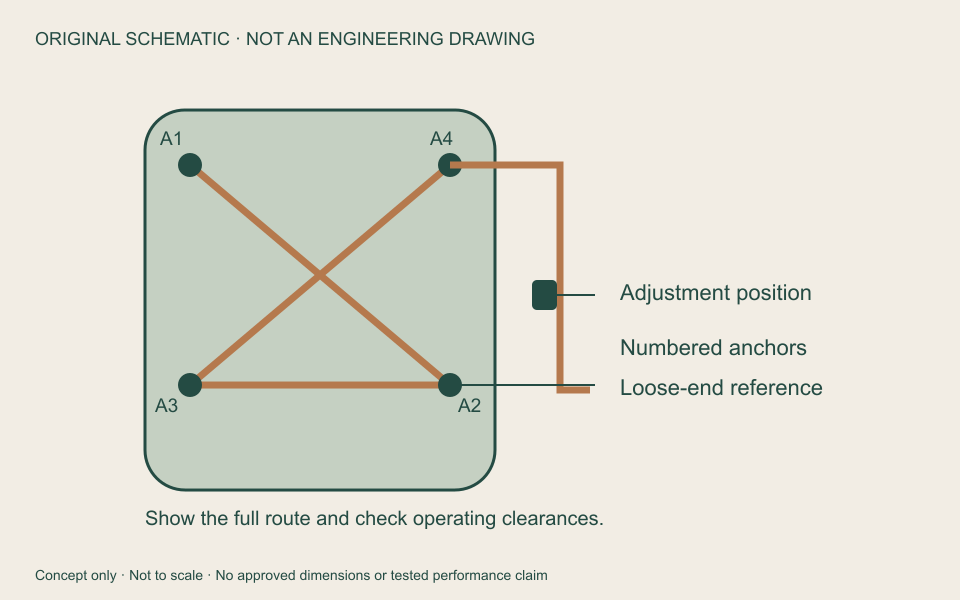
Approve an external cord layout against intended contents, anchor sequence, adjustment access, loose-end storage and bag-opening clearance.
01
Define the external-storage task
List the reference item and state, such as a jacket folded in the agreed way. Separate item retention, pocket adjustment and decoration. A generic instruction to add elastic cord does not define these different tasks.
Record item shape, contact locations, handling and any required verification. This article provides a layout-review method without prescribing cord diameter, material, load rating or retention performance. Another person’s DIY experience is not project evidence.
02
Number anchors and show the routing sequence
Assign IDs to specified anchors and draw each segment, including start, connecting components, adjuster and end. Identify which parts serve this cord route and which serve other attachments. Similar-looking attachment points are not automatically interchangeable.
The original schematic uses numbered anchors and a crossed path to explain documentation. It establishes no anchor strength and is not a verified product structure. Give alternative routing arrangements separate revisions.
03
Operate both loaded and empty states
Insert the reference item, adjust the route and remove it, then check the empty arrangement. Observe whether other connections must open, cord segments cross zipper access or contents obscure the adjuster. Record the actual sequence and hand positions.
Repeat with the main bag packed to the agreed list because bag shape is part of the operating condition. Use the agreed glove reference where glove operation is required, without turning one demonstration into a universal claim.
04
Review loose ends and the parked state
Treat excess cord after adjustment as a separate review item. Record its permitted location and storage method, checking whether it crosses the bag opening, handle or another operating area. Define the complete route when external storage is unused.
A schematic supports layout discussion; a physical sample confirms handling. Agree verification separately for repeated adjustment, retention during movement or environmental conditions. A static photograph cannot establish those results.
05
Deliver a complete routing record
Include the numbered anchor drawing, component list, routing sequence, reference-item state, adjustment and loose-end photographs, and unresolved verification. A front photograph of crossed cord is insufficient on its own.
Review the full route and operation after changes to anchors, adjusters, the bag opening or adjacent attachments. This gives buyers an identifiable assembly configuration and developers a clear basis for deciding what needs review.
Share material references and sample requirements through the JKPD inquiry page.
Discuss your bag development project
ANSON XIE
General Manager & Founder
Quanzhou Junkai Pengda Special Equipment Co., Ltd.
Email: ansonxie@jkpdtime.com
Phone: +86 177 5095 3355
WhatsApp: +86 177 5095 3355
Factory address: Floors 2–4, Building 1, Phase I, Huixin Intelligent Manufacturing Industrial Park, Hui'an County, Quanzhou, Fujian, China