
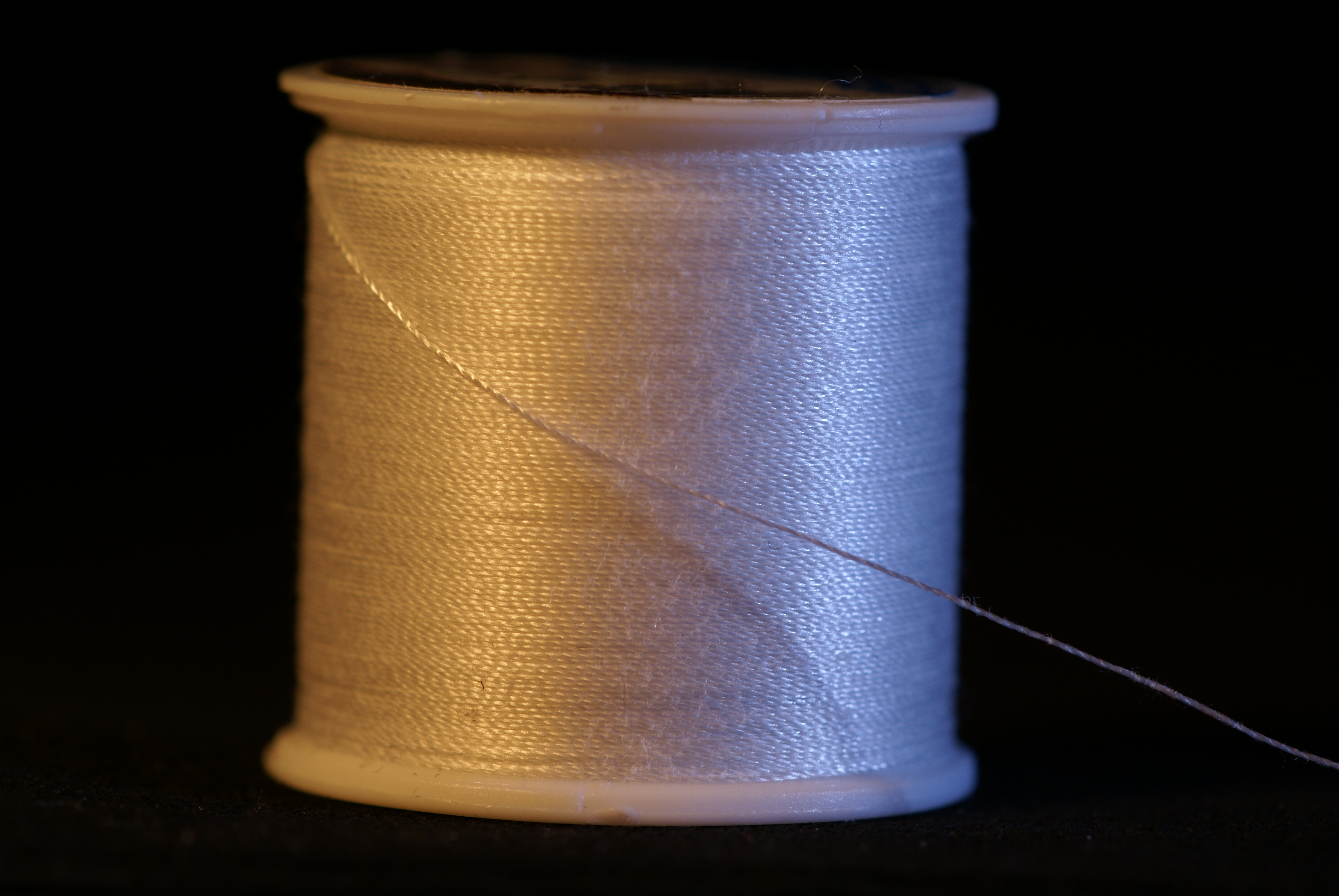
Photo: Dmeranda (attribution inferred by Commons source page). CC BY-SA 3.0 · Original source. Unmodified for this article. The photograph remains under its stated license; no endorsement, specific material grade or JKPD use is implied.

01
Identify the numbering system before the number
A forty-number thread is not an identifiable sewing material. The description may refer to Tex, a commercial ticket or another convention. Equal numbers can represent different linear densities and constructions if the system is missing.
Coats’ numbering guidance distinguishes fixed-length and fixed-weight systems and describes ticket numbers as manufacturer size references. Keep manufacturer, range, article, resultant linear density and the supplier’s corresponding ticket together. This makes an inquiry comparable without assuming that a label used for one thread family can be carried unchanged to a different construction or supplier.
02
Use the macro photograph to explain structure
The white-thread photograph shows a twisted free length and fine surface fibres. Its author describes a two-ply thread with cotton wrapping a polyester core. That description is not a composition test, Tex measurement or brand identification. The specimen is not the identified Coats video product.
A macro view helps explain why one thread can involve fibres, a core, plies and a final twist. Obtain the actual construction declaration from the supplier. Shine alone cannot establish continuous filament, fuzz cannot identify a polymer, and the shape of a spool does not prove suitability for heavy bag construction. The photograph supports visible structure, while the article reference supports supply identity.
03
Tex and count do not increase in the same direction
Tex expresses grams per one thousand metres. Increasing Tex means increasing mass per unit length. Fixed-weight systems such as Nm express length for a fixed mass, so the numerical direction differs. Commercial tickets still require the supplier’s convention; all labels containing forty are not equivalent.
As a unit example, one thousand metres weighing forty grams has a linear density of forty tex. It does not mean a diameter of 0.40 millimetres or a breaking force of forty newtons. Diameter, force and linear density are different quantities. For a designation containing ply information, also clarify whether it names an individual yarn or the resultant combined thread.
04
Equal Tex still leaves the construction open
Coats’ thread classification discusses staple-spun, corespun and filament constructions, alongside twist, plies and finishes. A core-and-wrap arrangement does not make every corespun thread identical in composition or application.
Add construction fields to the material record: fibre or polymer, monofilament or multifilament where applicable, core-and-wrap identity, ply and twist direction. Two close resultant Tex values still leave threading and sewn-sample confirmation to complete. Similar linear density does not establish equal surface condition, extension or processing behaviour. Ask the supplier which characteristics change when an alternative article is offered instead of accepting a size match as a complete equivalence.
05
Treat finish as a separate requirement
Record bonding, lubrication and water-repellent finishes separately from thread construction. Coats’ classification treats finish as an independent dimension. Confirm the exact range, applicable conditions and supporting information rather than extending a feature to every thread made from the same polymer.
If water repellency matters, ask whether the evidence concerns thread, the needle-hole area or a complete seam, and which processed condition was assessed. Water-repellent thread does not automatically establish a waterproof bag. The name printed on a cone also cannot replace results for the actual textile, needle holes and seam construction. Keep the claimed feature tied to the specimen and test object.
06
Move from the cone to the actual material stack
Compare sewn specimens using the intended shell, lining, webbing and reinforcement. Record needle thread, bobbin thread, needle and machine settings. Agree parameters with the selected material, needle and equipment suppliers; one needle size or tension value is not prescribed for every bag.
The Coats video below is supplementary viewing for a particular finished-thread product, not a Tex conversion lesson or the photographed specimen. A proposed comparison can record breaks, skipped stitches, surface damage and seam appearance before project-specific seam evaluation. A breaking result for loose thread is not automatically seam strength. Preserve both thread identity and sewn construction when interpreting the outcome.
Related video: Tech Tip: Coats Epic Liquifense · Coats
Supplementary viewing only. This external demonstration is not evidence of the pictured component, certification or finished-bag performance; consult current article-specific documentation.
A demonstration is not performance certification. If the player is unavailable, use the original link; internet access is required.
07
Turn a size match into traceable conditions
A useful thread specification includes manufacturer and article, numbering system, resultant Tex or its documented equivalent, construction and composition, ply and twist, finish, colour, package and batch. For a substitute, ask the supplier to describe each change instead of offering same-number equivalence.
Keep the cone label, loose-thread specimen and sewn stack together. If the commercial ticket changes on a later purchase, those records provide a route back to the actual material and evaluated conditions. They help determine which approvals remain applicable. Website content can then explain the numbering systems accurately without inventing a performance grade or strength for an unidentified product.
One practical document check is to set the commercial ticket aside temporarily and compare article identity, resultant density, construction and finish first. Then return to the manufacturer’s size mapping. If the relationship cannot be explained, keep the substitution pending. This check does not replace a sewn specimen, but it prevents a familiar number from ending the comparison too early. Record which differences are acceptable in the current seam and which remain untested, so the next buyer does not inherit an approval broader than the sample actually supports.
Related reading: General bag thread selection.
Share the application, candidate material articles and available records through the JKPD project inquiry page.
Discuss your bag development project
ANSON XIE
General Manager & Founder
Quanzhou Junkai Pengda Special Equipment Co., Ltd.
Email: ansonxie@jkpdtime.com
Phone: +86 177 5095 3355
WhatsApp: +86 177 5095 3355
Factory address: Floors 2–4, Building 1, Phase I, Huixin Intelligent Manufacturing Industrial Park, Hui'an County, Quanzhou, Fujian, China