
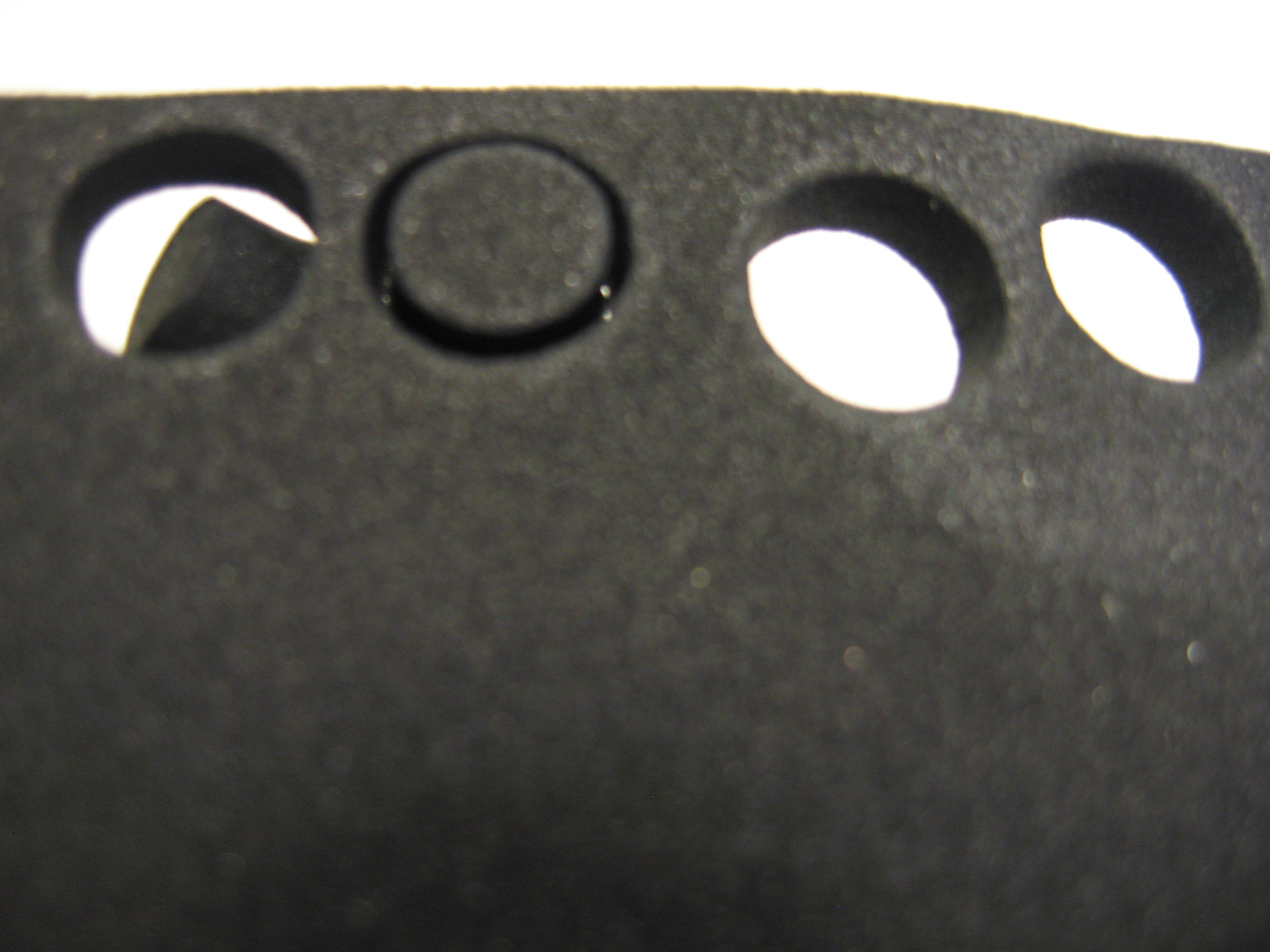
Photo: ProtoSpace. CC BY 2.0 · Original source. Unmodified for this article. The photograph remains under its stated license; no endorsement, specific material grade or JKPD use is implied.

01
A commercial name is not a rubber specification
In bag sourcing, neoprene-type material often means a rubber-foam sheet combined with fabric. The word neoprene alone may not lock down the rubber chemistry. Yong Sheng distinguishes CR, SBR and its SCR blend category. Neoprene in the strict material sense refers to chloroprene rubber, while trade descriptions can be broader.
Specify the core polymer and article before the foam and laminate construction. Do not treat a percentage appearing in an online note as the universal definition of SBR or SCR. The actual blend ratio, additional constituents and technical data need confirmation for the quoted article.
02
Separate the core, adhesive and both surfaces
The manufacturer’s laminate page describes bonding fabric onto rubber foam with adhesive and lists polyester, nylon and stretch-facing products. Record the outer facing, core, inner facing and bonding arrangement as separate parts of the specification.
The real sample photograph above shows punched circular openings and cut pieces. Its source identifies it as neoprene; the image cannot establish polymer identity, hole diameter, density or closed-cell content. It is not a sample of the cited supplier’s product or evidence of JKPD adoption. Obtain both faces and a cross-section from the actual quoted article, then match these to its technical record.
03
Measure thickness and compression on a stated basis
Bare foam thickness differs from total laminate thickness. State the total, tolerance and measurement pressure, and whether facings and adhesive are included. Separate facing mass from whole-sheet mass so a weight difference is not automatically attributed to the core.
For compression comparisons, agree coupon dimensions, loaded area, compression level, holding time and recovery interval before discussing results. Numbers on different hardness scales cannot be ranked directly. A sleeve’s shape retention and a shoulder component’s compression requirements are different development questions. Neither softer hand nor higher nominal density is a sufficient selection rule without the corresponding method and intended use.
04
The facing and bond define the usable construction
When comparing equal-thickness sheets, identify stretch direction, surface construction and whether the two faces are symmetrical. Mark orientation on coupons so a facing-related difference is not automatically blamed on rubber formulation. Record printing and treatment state too: an unprinted swatch does not approve the printed material.
Record the bond failure mode
Retain untreated and agreed conditioned laminate controls. A formal peel review should state specimen width, direction, conditioning and failure location. Facing rupture, failure within the foam and separation at the adhesive interface should be recorded separately. Supplier grade labels and price categories are not adopted here as guarantees of the delivered laminate’s performance.
05
Keep separate evidence for cutting, perforating and sewing
Cut-sheet thickness, hole edges and local deformation after stitching can affect a sleeve opening or bag seam. Make straight, curved and corner coupons with the actual stack. Record needle, thread, feeding, presser foot and allowance, then examine facing wrinkles and edge damage.
If perforations are added, record hole size, spacing, orientation and edge distance, and reassess the affected part. Visible holes do not establish airflow efficiency, and a water-resistance description for an intact material does not automatically cover a perforated version. A wetsuit application elsewhere in the supply chain does not certify a bag sheet for diving, lifesaving or thermal protection.
06
A foam sheet does not define a finished protection rating
The supplier video below provides supplementary context about neoprene categories and lamination activity. Unreviewed manufacturing steps and promotional performance statements are not technical evidence for this article. It is neither the photographed sample nor footage of a JKPD factory.
Verify any equipment-protection claim using an agreed item inside the complete product. Include corners, closure and seams in that assessment. Squeezing a foam coupon by hand cannot establish a finished bag’s drop resistance. Likewise, describing a closed-cell core does not independently make a sewn, zipped case waterproof.
Related video: Neoprene fabric/SBR, SCR, CR/Wetsuit material · DongQian
Supplementary viewing only. This external demonstration is not evidence of the pictured component, certification or finished-bag performance; consult current article-specific documentation.
A demonstration is not performance certification. If the player is unavailable, use the original link; internet access is required.
07
Close the inquiry with a complete laminate specification
A comparable inquiry identifies the core article and composition declaration, foam specification, both facing compositions and articles, bond arrangement, total thickness and measurement conditions, mass, colour and processing state. Add the agreed compression, surface, bond and connection review conditions instead of comparing prices for an undefined “3 mm neoprene”.
Confirm whether each report covers bare foam, laminate or a finished product, and link its colour and batch. Recheck affected requirements whenever adhesive, facing or core changes. If a supplier offers only a trade name without a traceable construction, resolve that gap before the sample becomes the production approval reference.
Related reading: EVA foam selection.
Share the application, candidate material articles and available records through the JKPD project inquiry page.
Discuss your bag development project
ANSON XIE
General Manager & Founder
Quanzhou Junkai Pengda Special Equipment Co., Ltd.
Email: ansonxie@jkpdtime.com
Phone: +86 177 5095 3355
WhatsApp: +86 177 5095 3355
Factory address: Floors 2–4, Building 1, Phase I, Huixin Intelligent Manufacturing Industrial Park, Hui'an County, Quanzhou, Fujian, China