
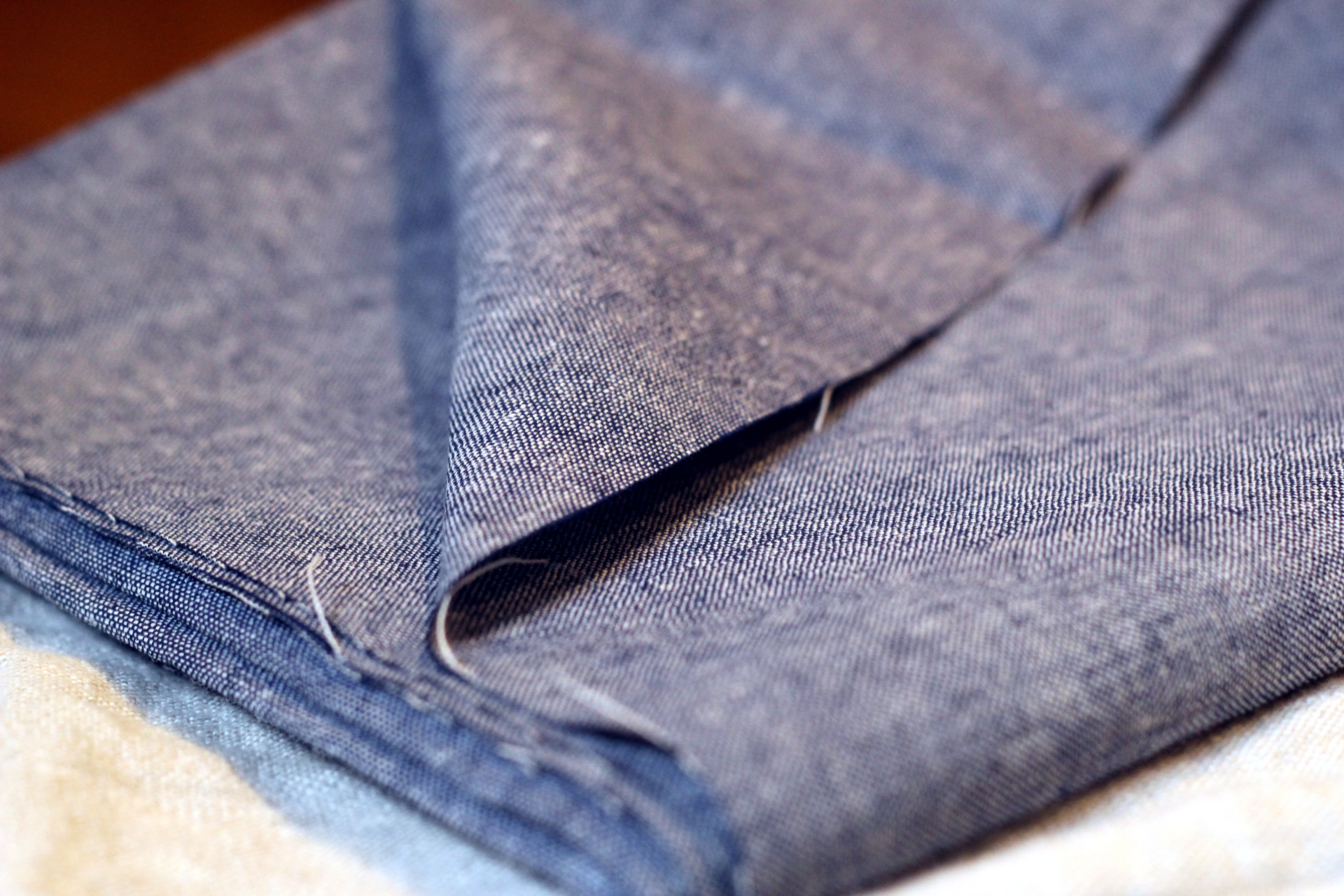
Photo: Enby. CC BY-SA 4.0 · Original source. Unmodified for this article. The photograph remains under its stated license; no endorsement, specific material grade or JKPD use is implied.

01
Confirm linen content before approving a linen look
A linen-like description can refer to flax linen, another plant fibre, a blend or simply a textured appearance. For custom totes, organizers and decorative panels, list the flax percentage and other fibres separately. Colour, slubs and hand are not composition verification.
Request an article number, composition, textile construction and finishing state. Distinguish an intimate fibre blend in the yarn from a fabric combining different yarns. The phrase cotton-linen alone does not locate those fibres within the construction. Establish that identity before comparing reports, samples or alternative materials offered under a similar commercial description.
02
Follow the route from fibre extraction to cloth
The Alliance for European Flax-Linen & Hemp describes mechanical scutching to separate fibres from woody stem material, followed by hackling, preparation and spinning. Fibre extraction, yarn manufacture and weaving are distinct stages. An origin description cannot replace the fabric specification.
The real photograph above is identified by its author as a cotton-linen chambray. It shows blue and pale interlaced yarns and folded cloth. It illustrates linen in a blended textile, without verifying fibre percentages, spinning route or suitability for bags. It is not evidence of pure linen or a material used by JKPD.
03
Treat spinning route as information, not a quality rank
The Alliance’s ten-stage resource distinguishes wet and dry spinning and the different yarn characteristics they produce. For a bag fabric, return to the candidate article’s yarn size, construction, density and finish. Long-fibre or wet-spun descriptions alone do not guarantee product durability.
Ask the textile supplier to identify yarn specifications in both directions and any blending. Compare swatches in the same processing state. Where another fibre or spinning system is used, literature for a fine pure-linen yarn should not be used to explain that fabric’s appearance or strength. Keep the technical description attached to the supplied construction.
04
Define mass and appearance tolerances together
Equal mass does not establish equal thickness, coverage or slub distribution. Review a panel at the intended application size, not only a small colour card. Keep records of both faces, selvedge and panel orientation. Use approved samples to define acceptable slubs, knots and shade variation instead of leaving natural texture undefined until production.
For a visible decorative face, decide whether the target is uniformity or deliberate variation, then agree appearance limits with the supplier. Do not classify every irregularity as a natural feature. A photographed texture is not an inspection standard, and mass after adding a backing belongs on a separate specification line.
05
Assess dimensional change and seams in the actual stack
If the bag will be washed, wiped or laminated, define care and processing conditions before comparing dimensions, appearance and hand after treatment. Retain base, pretreated and laminated controls separately. Do not explain one dimensional requirement using samples in different states. This article supplies no unverified universal shrinkage rate or pressing setting.
Use the proposed layer stack
Seam coupons should include the actual lining, interlining and allowance. Examine yarn displacement, loose edges and sewn appearance. A natural-fibre description does not exempt a loaded part from connection assessment. The textured visible face and the load path can also be designed separately, with their combined behaviour confirmed on a representative sample.
06
Separate origin evidence from whole-bag claims
Plant origin does not establish the complete environmental performance of a bag. If origin, traceability or certification wording is required, request valid evidence covering the entity, material version and transaction scope, following the relevant scheme’s rules. Neither an Alliance overview nor a photograph certifies a supplied fabric batch.
The Alliance-channel video candidate below concerns field-to-fibre context. The video is not used as technical evidence here; it is supplementary viewing only. No unverified steps, environmental data or origin conclusions are adopted. Information about cultivation in one region is not automatically applicable to every linen article or to a bag containing adhesive, trim and other fibres.
Supplementary viewing (content unreviewed): Linen Experience 2026: Discovering European Flax-Linen from Field to Fibre · Alliance for European Flax-Linen & Hemp
Supplementary viewing only; content has not been independently reviewed for this article. No processing, performance or environmental conclusions are drawn from the video. Use the original external link; availability may vary.
A demonstration is not performance certification; internet access is required.
07
Approve the material together with its application
An inquiry should identify use, flax and other-fibre percentages, yarn and construction, mass and thickness conditions, colour and texture standard, finish and backing. Add care, processing, dimensional and seam assessment conditions. That gives suppliers the same construction to quote rather than an undefined cotton-linen canvas category.
After approval, link the swatch, technical sheet and reports to article, batch and state. Reassess affected requirements if fibre content, construction, dyeing, finishing or backing changes. This turns the desired natural appearance into an executable purchasing requirement. It avoids relying on a fibre’s reputation to promise what the assembled product has not demonstrated.
For a bag collection, retain references for visible and inside faces separately, and state whether the same texture variation is acceptable on different parts. If sampling and production use different yarn batches or finishes, agree how the approval reference will be updated. Reusing the colour name alone is insufficient. This preserves the design intention while giving receiving inspectors a concrete comparison.
Related reading: Felt fibre and construction.
Share the intended use, candidate article and available records through the JKPD project inquiry page.
Discuss your bag development project
ANSON XIE
General Manager & Founder
Quanzhou Junkai Pengda Special Equipment Co., Ltd.
Email: ansonxie@jkpdtime.com
Phone: +86 177 5095 3355
WhatsApp: +86 177 5095 3355
Factory address: Floors 2–4, Building 1, Phase I, Huixin Intelligent Manufacturing Industrial Park, Hui'an County, Quanzhou, Fujian, China