
Review a named adjuster and webbing combination for tightening, retention and release. Nominal width alone does not define an approved pairing.
01
Define the adjustment task
Select a ladder-style adjuster around a specific movement, rather than appearance and nominal webbing width alone. The ITW Nexus Ladderloc™ page describes its product as an adjustment buckle for tightening and releasing webbing. Its trademark and product statements should not become generic performance claims for every similar component.
State which strap section changes length, whether adjustment occurs while loaded and whether one-handed operation is required. Then review the actual component information and sample. A generic category name does not establish retention force or environmental suitability. This task definition gives the supplier a clearer starting point than a photograph labelled only with a width.
02
Identify the actual webbing
Width addresses only part of the interface. Record thickness, edge profile, surface condition and any folded layers. Check whether the specified webbing can follow the component's intended route and move through it as required. Do not infer that two materials behave identically because their width labels match.
Keep the approved strip identified. Another strip of the same width and similar hand feel is not an adequate reference for a substitution decision. When yarn, finishing or construction changes, ask whether the trial still represents the material being purchased. Use that answer to determine the review scope instead of silently carrying a previous approval onto a different webbing.
03
Separate anchoring from adjustment
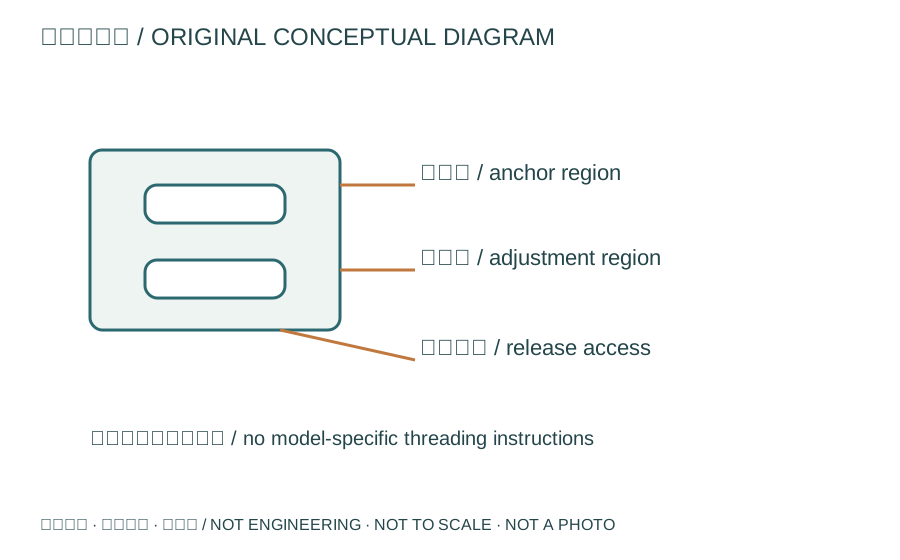
Have the supplier confirm component orientation, fixed attachment and adjustment route before photographing the completed arrangement. The original diagram identifies the anchor region, adjustment region and release access. It is not threading guidance for a particular component and provides no engineering dimensions.
Include the sewn attachment layers in the sample. A loose buckle and webbing strip can answer a preliminary fit question. If the installed angle or attachment changes on the finished bag, review the resulting movement again. The earlier loose-component demonstration may no longer represent the configuration in which the user must tighten or release the strap during use.
Original conceptual diagram; not engineering, not to scale, not a photograph or product/test evidence.
04
Review tightening, retention and release separately
Tighten the strap under the agreed packing condition and record its position. Then review retention and release as separate questions. Smooth tightening does not establish retention performance. Conversely, a strap that is difficult to move does not automatically demonstrate desirable resistance to slipping.
Keep displacement observations, operating requirements and conditions in distinct fields. If the project requires quantified retention or durability, agree the relevant procedure and acceptance criteria with the supplier. A single hand-pull demonstration cannot supply a load rating. Make clear which finding is an access observation and which finding, if any, comes from an identified performance evaluation on the actual combination.
05
Inspect the installed access space
Check whether binding, padding or adjacent parts obstruct the component. Observe whether release requires an awkward rotation. Review the shortest and longest agreed working lengths, including the relationship between the tail, nearby zippers, clothing and pockets. Record interference at the actual installed location.
If one-handed or gloved operation is a requirement, include that condition in the physical review. A statement about a loose component cannot validate access on a completed bag. Installation creates a different space around fingers and moving parts. Photograph the arrangement that works and identify any part the user must reposition before operating it, so the approval reflects the complete sequence.
06
Review substitutions as new combinations
Retain the original and proposed component identities, corresponding webbing, specified threading and installed arrangement. Similar external dimensions do not establish identical adjustment geometry or release movement. Ask the supplier to identify the actual differences rather than approving a substitution from a front-view photograph.
Review functional fit separately from material identity, attachment strength and environmental requirements. Colour cannot establish polymer composition, and successful threading cannot establish load capability. Any required performance evidence should identify the component and webbing combination evaluated. If a change affects the fixed attachment, include it explicitly. That prevents an approval for one interface from becoming an unsupported statement about another superficially similar part.
07
Keep the approval reproducible
Keep the reviewed combination traceable
The approval should name the component and webbing, retain thickness information and show the completed route and fixed attachment. Record adjustment range, operating conditions and performance questions still awaiting evidence. Keep permitted substitutions and review triggers in the same revision.
Approve a defined combination and installation. This makes the sourcing decision traceable and gives development a specific next action. The record should show whether a revision changes webbing, component, anchor position or operating sequence. It should not simply say that the buckle works. This article proposes that decision structure; it does not report a JKPD load test or certify a component for a particular application.
Related development guidance: Review the connected construction.
Discuss your bag development project
ANSON XIE
General Manager & Founder
Quanzhou Junkai Pengda Special Equipment Co., Ltd.
Email: ansonxie@jkpdtime.com
Phone: +86 177 5095 3355
WhatsApp: +86 177 5095 3355
Factory address: Floors 2–4, Building 1, Phase I, Huixin Intelligent Manufacturing Industrial Park, Hui'an County, Quanzhou, Fujian, China