
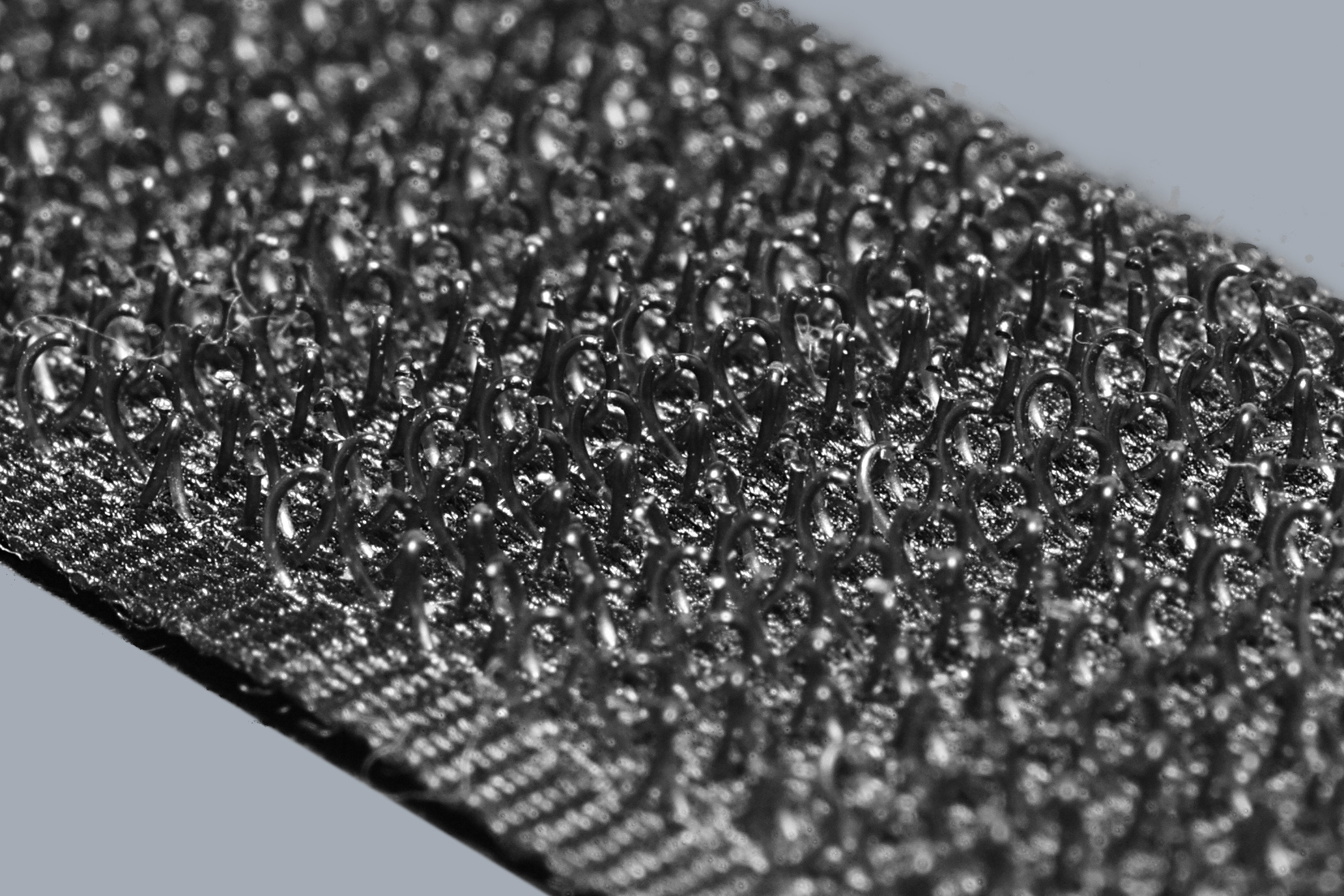
Photo: Alexander Klink; background edit by Nagualdesign. CC BY 3.0 · Original source. Unmodified for this article. The photograph remains under its stated license; no endorsement, polymer identification or JKPD use is implied.

01
Begin with a matched pair
Hook-and-loop material is not fully specified by ordering “nylon tape.” The two faces work together. One side’s composition or appearance cannot define the opening behaviour of a mating pair. Identify both articles, orientation, engaged area and attachment before discussing the required feel or service life.
This article concerns generic hook-and-loop fasteners. VELCRO is a brand, not proof of identity for an arbitrary supply. Keep material cards as paired specimens for bag projects. A replacement loop face or backing should not silently inherit an approval issued for the previous combination. A familiar trade description is a starting point for inquiry, not a completed specification.
02
Read the two roles in real macro photographs
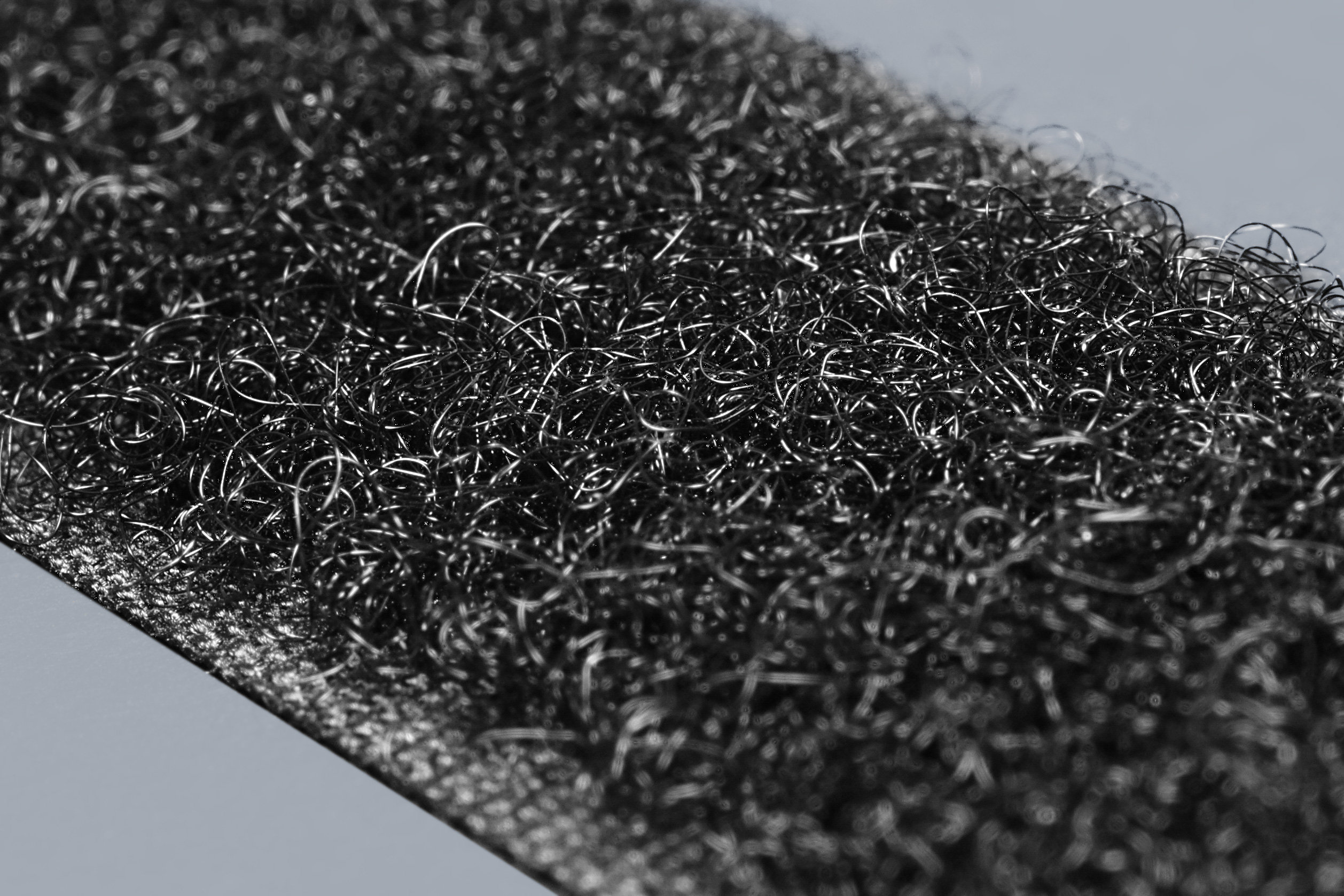
The hook photograph above and loop photograph below show curved hook-like filaments and a field of fine loops. They illustrate visible form, not a confirmed brand, polymer, article or strength. They are not identified samples of the manufacturer ranges discussed later. The hook form and receptive loops explain why the combination needs evaluation together.
Photographs on a material card can document hook geometry, loop condition and edges. Black colour, gloss or softness cannot establish nylon, polyester or a particular molded resin. Request separate composition declarations for both faces. Keep the photograph’s role limited to what it actually shows instead of turning surface appearance into a material certificate.

03
Separate textile construction from molded hooks
VELCRO’s textile-fastener information distinguishes textile constructions and material options. Its molded-hook information describes different hook profiles, base materials and compatible loop constructions. These are supplier ranges, not a classification that proves every retail product’s properties.
Ask whether the hook side has a textile or molded construction and whether the loop is woven, knitted or another form. Keep construction separate from fibre composition. Two products described as nylon may differ in profile, backing, thickness and mating behaviour. A low profile does not by itself establish long life or compatibility with delicate clothing.
04
Avoid a universal nylon-versus-polyester ranking
Composition needs a layer-by-layer answer. If a supplier states all nylon, clarify whether that includes the backing textile, engaging filaments and added layers. List adhesive, coatings and laminated backings separately. Apply the same discipline to polyester alternatives. A single umbrella term can conceal changes that later become difficult to trace.
Compare candidate pairs under the same intended conditions rather than ranking fibres in advance. State whether the closure will be washed, exposed to sweat or debris, or used beside knitted clothing. Describe the opening experience needed. Article-specific documents and paired-sample observations provide a stronger purchasing basis than an unsupported claim that one fibre is always better.
05
Discuss peel, shear and clothing contact separately
Peel progressively opens an edge; shear loads the engaged faces along their plane. Describe them separately in the requirement. If a supplier provides results, request the mating articles, engaged area, orientation, engagement procedure, environment and cycle condition. A new-sample result for one pair cannot simply be transferred to another loop.
A claim of no clothing snagging also needs application evidence. Proposed review can include opening, rubbing and storage contact against the actual adjacent textile, with visible pulls, fuzzing or appearance changes recorded. This is a comparison plan without a universal acceptance threshold. The photographed hook face is not assigned a low-damage grade.
06
Treat attachment as part of material development
Sew-on and adhesive-backed versions require different records. For sewing, sample the actual backing, stitch area and edge, then observe local flatness and engagement after attachment. For adhesive versions, identify the adhesive, substrate, surface condition, pressure and waiting conditions through the selected supplier’s instructions. Initial tack does not establish long-term attachment.
The manufacturer video below offers supplementary context for textile-fastener production. It is not evidence of JKPD manufacturing, the photographed specimens or a universal process. Any laboratory or certificate shown in a video also leaves the current article, batch and applicable scope to be documented separately.
Related video: MH Hook & loop Factory | Do you know how to produce velcro? Let's find answers at MH Factory. · China MH
Supplementary viewing only. This external demonstration is not evidence of the pictured component, certification or finished-bag performance; consult current article-specific documentation.
A demonstration is not performance certification. If the player is unavailable, use the original link; internet access is required.
07
Control the version of the pair
An inquiry can include both article references, construction and composition, width and thickness requirements, orientation, backing or adhesive, attachment, neighbouring textiles, opening expectations and proposed environmental or cycle comparisons. Retain one unused pair and another pair evaluated after the intended attachment process.
When either face, adhesive or laminate changes, record the revision and decide which reviews need repeating. This moves purchasing beyond asking whether the tape is strong enough. The useful question becomes which documented combination meets which defined use, in which condition. That answer can be shared across design, sourcing and sample review without turning a generic fibre name into a performance promise.
Related reading: Hook-and-loop closure design.
Share the application, candidate material articles and available records through the JKPD project inquiry page.
Discuss your bag development project
ANSON XIE
General Manager & Founder
Quanzhou Junkai Pengda Special Equipment Co., Ltd.
Email: ansonxie@jkpdtime.com
Phone: +86 177 5095 3355
WhatsApp: +86 177 5095 3355
Factory address: Floors 2–4, Building 1, Phase I, Huixin Intelligent Manufacturing Industrial Park, Hui'an County, Quanzhou, Fujian, China