
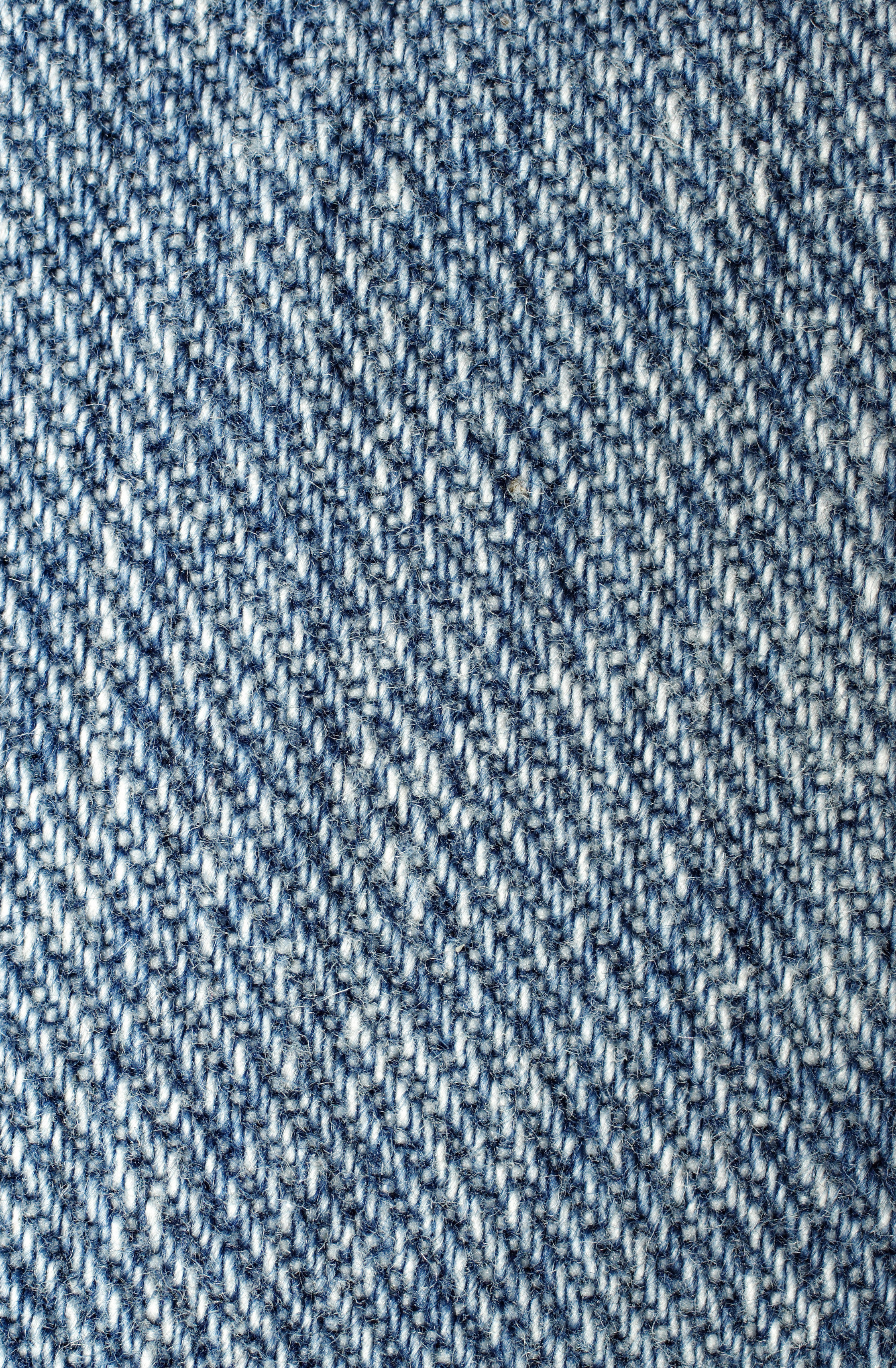
Photo: Thegreenj. CC BY-SA 3.0 · Original source. Unmodified for this article. The photograph remains under its stated license; no endorsement, specific material grade or JKPD use is implied.

01
Define the fabric rather than a blue appearance
A denim specification should identify composition, warp and weft yarns, construction and finishing state. “Blue denim” is insufficient. CottonWorks describes familiar dyed-warp, pale-weft and twill constructions, but denim-look materials do not all share the same fibre blend or dye route.
For custom totes, casual backpacks and organizers, define the desired appearance and shape before selecting an article. Ask suppliers to distinguish cotton, blended and stretch-containing versions. Composition alone does not establish extension, recovery, colourfastness or seam behaviour. Request evidence for the actual fabric rather than borrowing results from a visually similar article.
02
Twill notation describes interlacing, not weight
CottonWorks explains that notation such as 3×1 describes warp and weft interlacing. The corresponding warp repeat passes over three picks and under one. Identify 2×1, 2×2 and broken-twill constructions separately. These numbers are neither fabric mass nor an untested durability ranking.
The real denim macro above shows blue and pale yarns with diagonal surface lines. It helps illustrate textile appearance, without establishing fibre content, mass, dye identity or tested performance. Purchasing still needs the technical specification and actual swatch. Do not assign yarn count or fabric density from this photograph or assume that every material sharing the diagonal look is equivalent.
03
Confirm that ounces mean mass per square yard
Worked mass-per-area conversion
A denim quote using ounces should identify whether it means oz/yd². One oz/yd² is approximately 33.91 g/m². A hypothetical 12 oz/yd² fabric therefore converts to about 407 g/m². This is unit conversion, not a measurement, recommendation or carrying-load guarantee.
State whether mass refers to loomstate, washed or laminated cloth. Equal nominal mass across different constructions and finishes can still produce different thickness and hand. A bag-weight budget also includes net panel area, lining, interlining and trim. The face fabric’s mass per area is not the empty weight of the finished bag, and must not be quoted as one.
04
Lock the finishing state when approving appearance
CottonWorks’ finishing resource distinguishes desizing, washing and appearance-changing treatments. For bag development, washed blue should identify an approved processing state and appearance standard, not only a colour name. Garment processing should not transfer automatically to a bag containing interlinings and hardware.
Retain before-and-after measurements and swatches. State whether cloth is treated before cutting or the assembled product afterward. Do not mix unwashed cloth and washed-product hand, shade and dimensions within one approval reference. Processing formulations and settings need confirmation by the actual material and finishing suppliers; this article provides no universal recipe.
05
Assess colour transfer separately from intended fading
If denim contacts pale clothing, straps or lining, define transfer requirements during development. Screen the actual contact combinations first, then agree formal methods and acceptance levels with the laboratory. Dry rubbing, wet rubbing and washing contact involve different conditions. Allowing natural fading does not resolve every transfer question.
Record shade, finishing state and batch, and match reports to the same version. Prewashing is not an automatic guarantee against transfer, while photographic shade cannot establish fastness. Packaging contacts and prolonged folds may warrant separate review. Keep an intended visual ageing effect distinct from staining of another component or a customer’s clothing.
06
Review multilayer seams in the final processing state
A tote rim, handle attachment or base corner can create several layers. Sample the actual folds, lining and interlining together. Examine feeding, damage around needle holes, seam waviness and failure location. A substantial single-layer hand does not establish reliable performance at every seam.
If approval concerns post-assembly treatment, assess the complete combination in that state too. The manufacturer’s factory-tour candidate below is supplementary viewing only. Its content has not been independently reviewed for this article. No unseen steps, machinery or performance claims are cited, and no footage is presented as JKPD’s factory or evidence of the photographed fabric’s origin.
Supplementary viewing (content unreviewed): ISKO factory tour · ISKO Denim
Supplementary viewing only; content has not been independently reviewed for this article. No processing, performance or environmental conclusions are drawn from the video. Use the original external link; availability may vary.
A demonstration is not performance certification; internet access is required.
07
Compare quotes and substitutes in the same state
An inquiry should state composition, warp and weft specifications, construction, usable width, mass and state, colour and appearance reference, processing sequence and backing. Add dimensional, transfer, surface and seam requirements, distinguishing screening observations from order acceptance conditions.
Use the approved swatch, processing record and reports together to lock the version before comparing substitutes. Review more than colour. A change in yarn, construction or finish may call for renewed dimensional, shape and seam assessment. Purchasing needs a traceable set of conditions, rather than a blue swatch that appears similar under one light or in a supplier photograph.
At sample approval, ask whether weighing includes the finish, after which care process dimensions were measured, and whether the colour reference covers all panels. Archive those answers with the physical standard. Even when two articles share an ounce weight, keep their processing and seam records separate instead of merging them into one generic acceptance reference.
Related reading: Waxed cotton.
Share the intended use, candidate article and available records through the JKPD project inquiry page.
Discuss your bag development project
ANSON XIE
General Manager & Founder
Quanzhou Junkai Pengda Special Equipment Co., Ltd.
Email: ansonxie@jkpdtime.com
Phone: +86 177 5095 3355
WhatsApp: +86 177 5095 3355
Factory address: Floors 2–4, Building 1, Phase I, Huixin Intelligent Manufacturing Industrial Park, Hui'an County, Quanzhou, Fujian, China