
Pair the actual cord and lock through diameter, strand count and installation. Separate visible routing, operating access and retention evidence.
01
Define more than an opening diameter
A cord-lock pairing needs cord identity, strand count, nominal diameter and installation arrangement. Measuring one visible opening cannot fully describe pressing, threading and the resting condition. Identify the intended operation before deciding whether a component is suitable.
The Duraflex official catalogue lists cord configurations and size information for different locks, including single- and multiple-strand arrangements. That illustrates why an order needs a specific component reference. It does not establish a common size range for all cord locks. Ask the supplier to confirm the actual combination rather than selecting solely by external appearance or a generic description such as small cord stopper.
02
Read only what the photograph shows
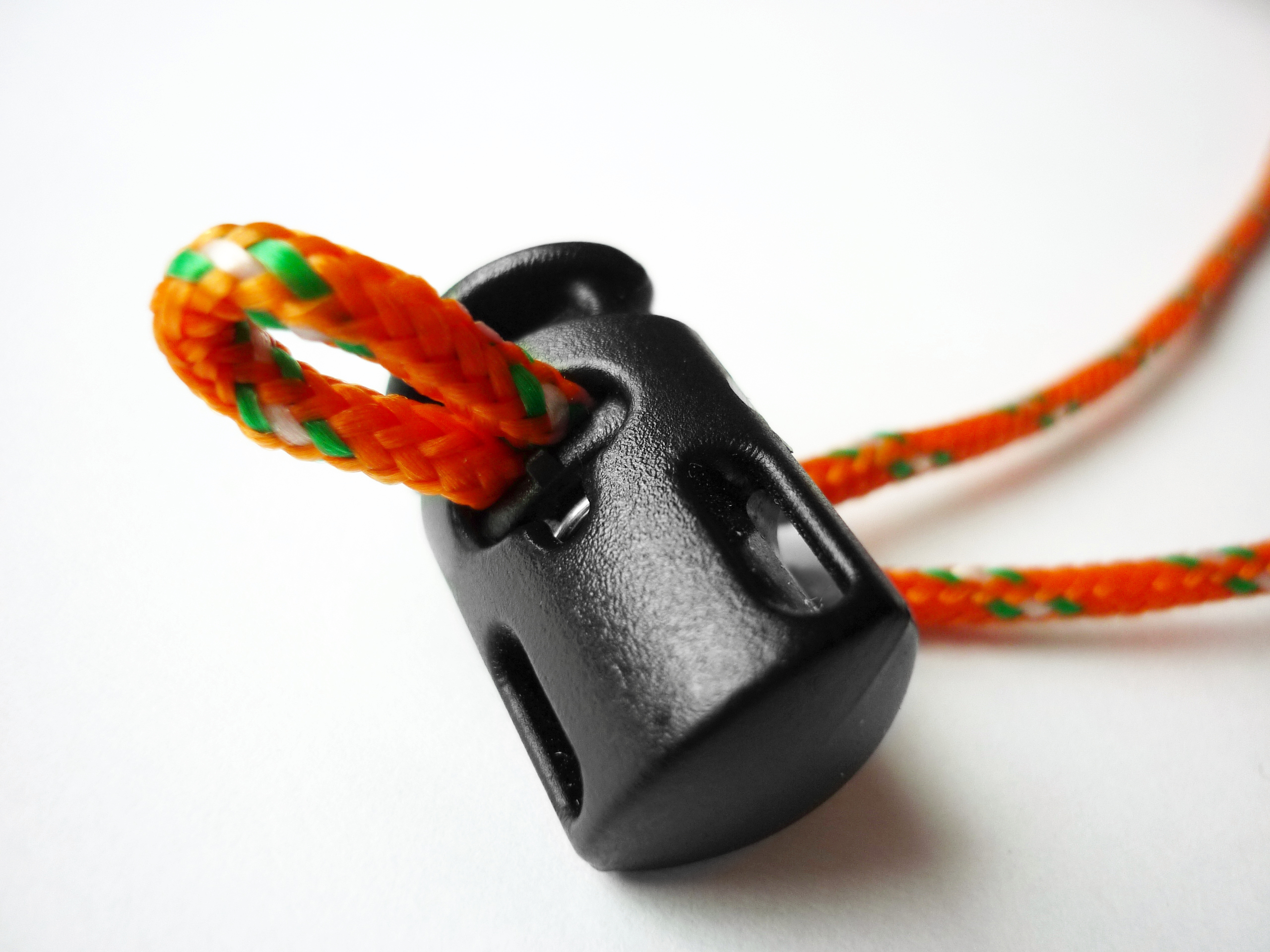
The photograph shows a black cord-lock body, orange patterned cord, a loop and visible contact between the cord and body. It provides a close view for discussing the visible route. It is not a dimensional reference or evidence of the internal mechanism.
This is neither a JKPD product nor an identified Duraflex model from the cited catalogue. The photograph cannot establish cord fibre, elasticity, body composition, rated retention or an approved diameter. Confirm those attributes through relevant documentation and the actual pairing. Keep the distinction visible in the caption so a useful generic photograph does not become an invented product specification or brand endorsement.
Photograph: Obersachse; colour adjustments by Till.niermann and Hohum, CC BY-SA 3.0. Source version used unchanged in this batch; not a JKPD product or the cited Duraflex model. Source · License

03
Review strand count explicitly
State whether one cord segment or two pass through the component and whether they belong to the same loop. Use the actual cord to review insertion in the operating state, resting after release and movement of each segment during adjustment. Keep the observed arrangement identified.
Do not infer that two strands will work smoothly because one passes through. Likewise, a catalogue entry for multiple strands is not permission to substitute an arbitrary single thicker cord. Follow the selected component's information and have the supplier confirm the pairing. External body size alone cannot define the internal space available through the full operating movement.
04
Define whether the body is anchored
Some proposals leave the body moving along the cord; others locate it near the bag. The Duraflex catalogue includes designs with a side loop for attachment. That is a feature of identified designs, not an instruction to anchor every cord lock in the same manner.
Review finger reach, obstruction by binding, interaction with nearby zippers and any need for the other hand to support the assembly. A loose component that is easy to press does not establish the same access after installation. Photograph the supporting surfaces and actual cord route. If one-handed operation is required, review the complete installed action under the agreed condition.
05
Separate retention from release
Set the cord to the intended length under the agreed condition and record its position. Review movement and release separately. Feels tight and feels smooth are observations, not substitutes for retention or durability evidence under defined conditions. Keep the interpretation proportionate to what was actually evaluated.
For elastic cord, record the actual extension or packing state. Operation with a relaxed cord does not establish behaviour while tensioned. If quantified performance is required, agree the method, sample condition and acceptance criteria with the supplier and project team. This article assigns no universal force value and reports no test of the photographed component or any JKPD product.
06
Include ends and bag exits
Check how knots, pulls or end pieces assemble and whether they enter the lock or bag exit during adjustment. Observe twisting, interaction between segments and where spare cord rests at the short and long working states. Include any required user action to restore the intended route.
This reviews the complete use path, beyond the initial question of strands entering the component. If the exit or end construction changes, retain a new revision and review the affected movement. A small-looking end change can alter assembly or access without changing the lock itself. Keep that distinction in the evidence rather than assuming the original demonstration still covers every later detail.
07
Keep the pairing scope with the order
Keep the reviewed combination traceable
Retain the lock reference, cord identity, diameter and strand description, anchoring, ends, installed photographs and operating condition. Separate functional observations, supplier statements and requirements needing tests. An image is not a certificate, and a reference photograph cannot approve a different combination.
The photograph used here is licensed and credited. It has not been edited or stripped of attribution in this batch. Its role is to support observation of visible cord routing. Procurement approval still needs the project's actual sample. Keep the resulting record tied to that combination so later changes to cord, body, anchor or ends can be evaluated without borrowing unsupported claims from the external photograph.
Related development guidance: Review the connected construction.
Discuss your bag development project
ANSON XIE
General Manager & Founder
Quanzhou Junkai Pengda Special Equipment Co., Ltd.
Email: ansonxie@jkpdtime.com
Phone: +86 177 5095 3355
WhatsApp: +86 177 5095 3355
Factory address: Floors 2–4, Building 1, Phase I, Huixin Intelligent Manufacturing Industrial Park, Hui'an County, Quanzhou, Fujian, China