
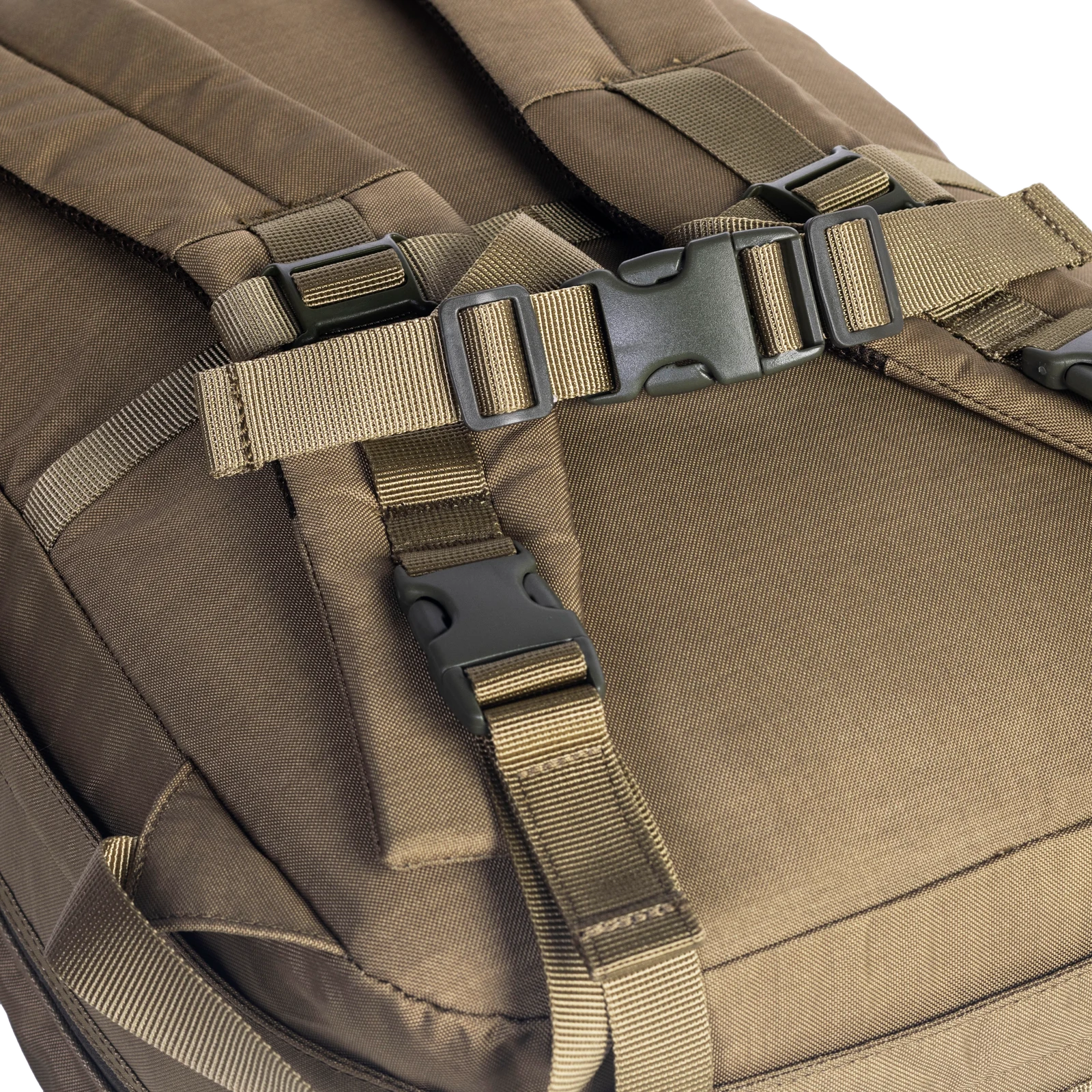
A shoulder strap opening point needs a defined purpose before a buckle location is approved. It may support a particular removal action, work with specific clothing or help organize the harness. Describe the intended sequence first, then develop the connection around it.
Development priorities: define the situation; identify shoulder and chest connections separately; establish support before opening; check webbing direction and twists after reconnection.
01
Describe the action before calling it quick release
A speed claim needs an action and evaluation conditions. Begin by stating whether the user stands or sits, where the bag rests and whether another hand supports it. Identify the step that should become easier instead of treating the presence of a buckle as evidence of an emergency-release system.
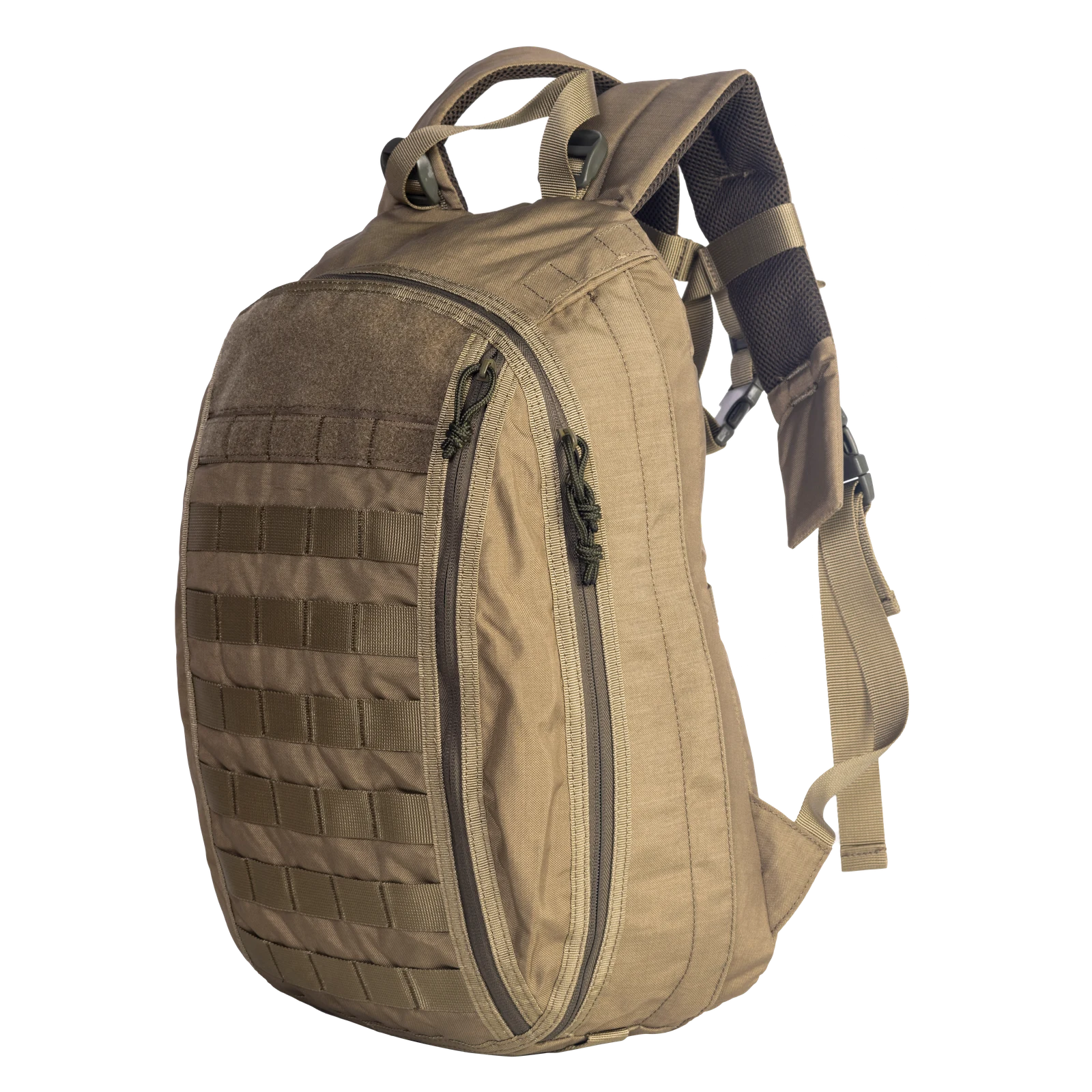
The side photograph records the visible shoulder-strap relationship. It does not demonstrate removal. This article proposes a development review and reports neither an operating time nor loaded-release performance.
A useful brief can be modest and specific: make a planned removal sequence easier under stated conditions. That objective is clearer for a sample room than an undefined promise of rapid access. It also gives later instructions an action that can be illustrated accurately.
02
Identify the different harness components
Several fittings can appear together on a pack. A chest connection joins the shoulder straps at one location; it is not the same as an opening in a shoulder strap. An adjuster is also not automatically a normal disconnection point.
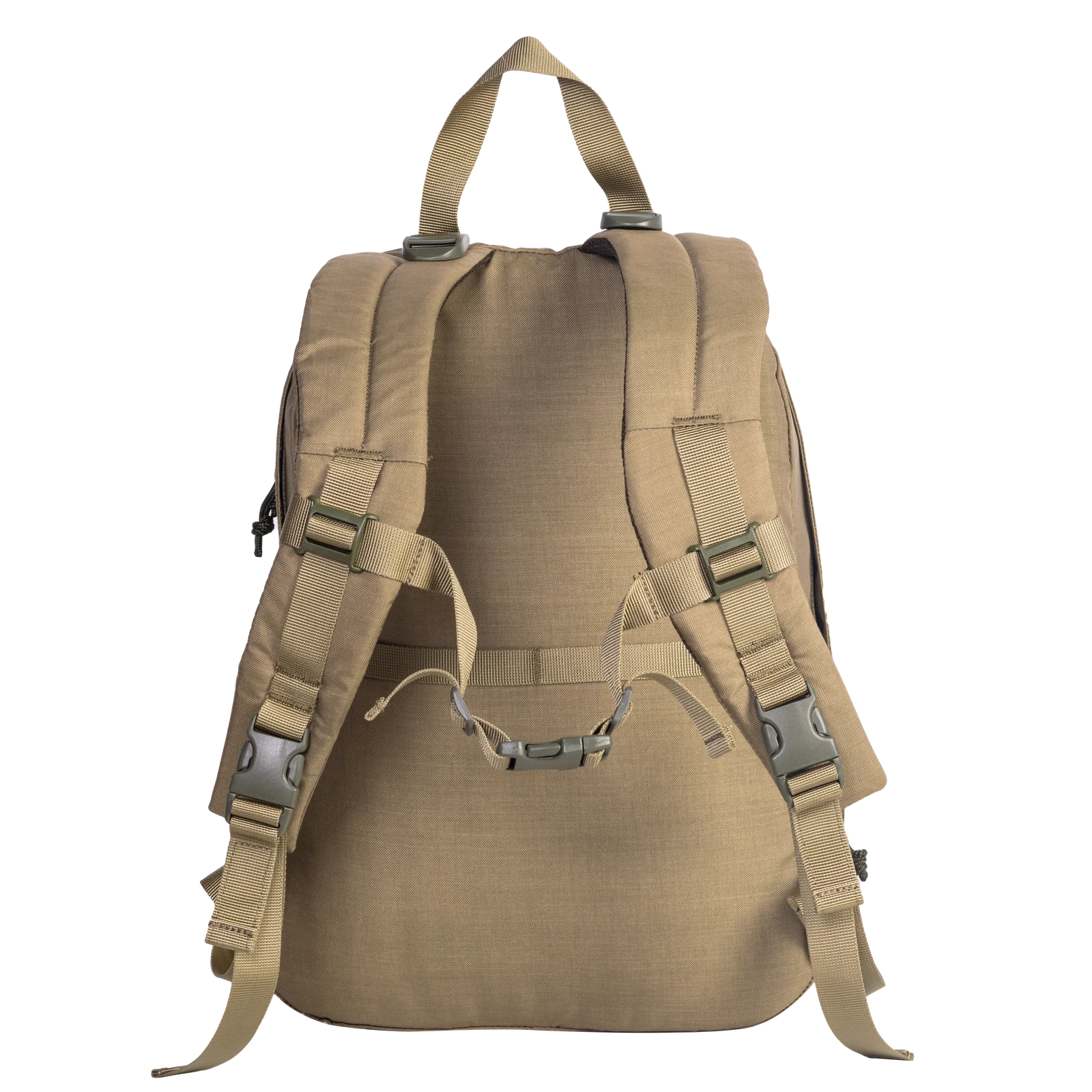
Keep the component labels consistent across drawings, sample comments and instructions. If the customer calls one item a release while the sample room calls another item by the same name, a small location change can produce a different workflow than intended.
03
Establish support before a connection opens
Consider where the bag and its contents go during removal. Under controlled review conditions, define whether the bag rests on a support or is held by a hand. Then observe how the remaining strap and body change position after one connection opens.
If the bag turns unexpectedly, revisit the hold point and sequence rather than silently adding a catch action for the user. No such review has been performed for this article, and no one-handed loaded-removal capability is claimed.
Use the intended packing arrangement during later evaluation. A nearly empty sample may move differently from the planned contents. Record the condition so a comparison between versions addresses the harness change rather than a different load arrangement.
04
Place the buckle for deliberate operation
The user needs to locate and identify the intended connection. Review its relationship to arms, clothing and neighbouring objects. A fitting accessible over a thin shirt may require a separate check with an outer layer or gloves when those are intended use conditions.
Opening force, strength and use limits require component documentation and suitable verification. Black plastic does not identify a resin grade. A simple pressing demonstration is not an accidental-release or durability test.
If a proposed location creates interference, identify what contacts the fitting and during which action. Moving a component should respond to that observation rather than simply to a preference for a different-looking harness arrangement.
05
Include reconnection in the workflow
After opening, confirm that both ends can be identified, connected in the intended orientation and returned to the agreed adjustment. Check for twisted webbing. If length must be reset each time, decide whether that meets the expected workflow and include the step in instructions.
A location revision should also trigger a review of the chest connection, lower loose webbing and body-contact region. The buckle affects more than opening: it can change where surrounding straps lie. Keep whole-harness reference photographs rather than approving a detail in isolation.
06
Hand over the confirmed sequence
Keep the approved sample identifiable
Save the target clothing, packing condition, component labels, opening order, support method and reconnection photographs. Identify confirmed and pending conditions separately. After a buckle or webbing substitution, review the sequence again instead of approving only the replacement’s appearance.
No emergency-rescue or protective function is claimed for the sample. These company product photographs explain visible construction. Explore further product-development topics in the JKPD blog.
Related: tactical bag buckle matched halves review. See the photographed product reference.
Discuss your bag development project
ANSON XIE
General Manager & Founder
Quanzhou Junkai Pengda Special Equipment Co., Ltd.
Email: ansonxie@jkpdtime.com
Phone: +86 177 5095 3355
WhatsApp: +86 177 5095 3355
Factory address: Floors 2–4, Building 1, Phase I, Huixin Intelligent Manufacturing Industrial Park, Hui'an County, Quanzhou, Fujian, China