
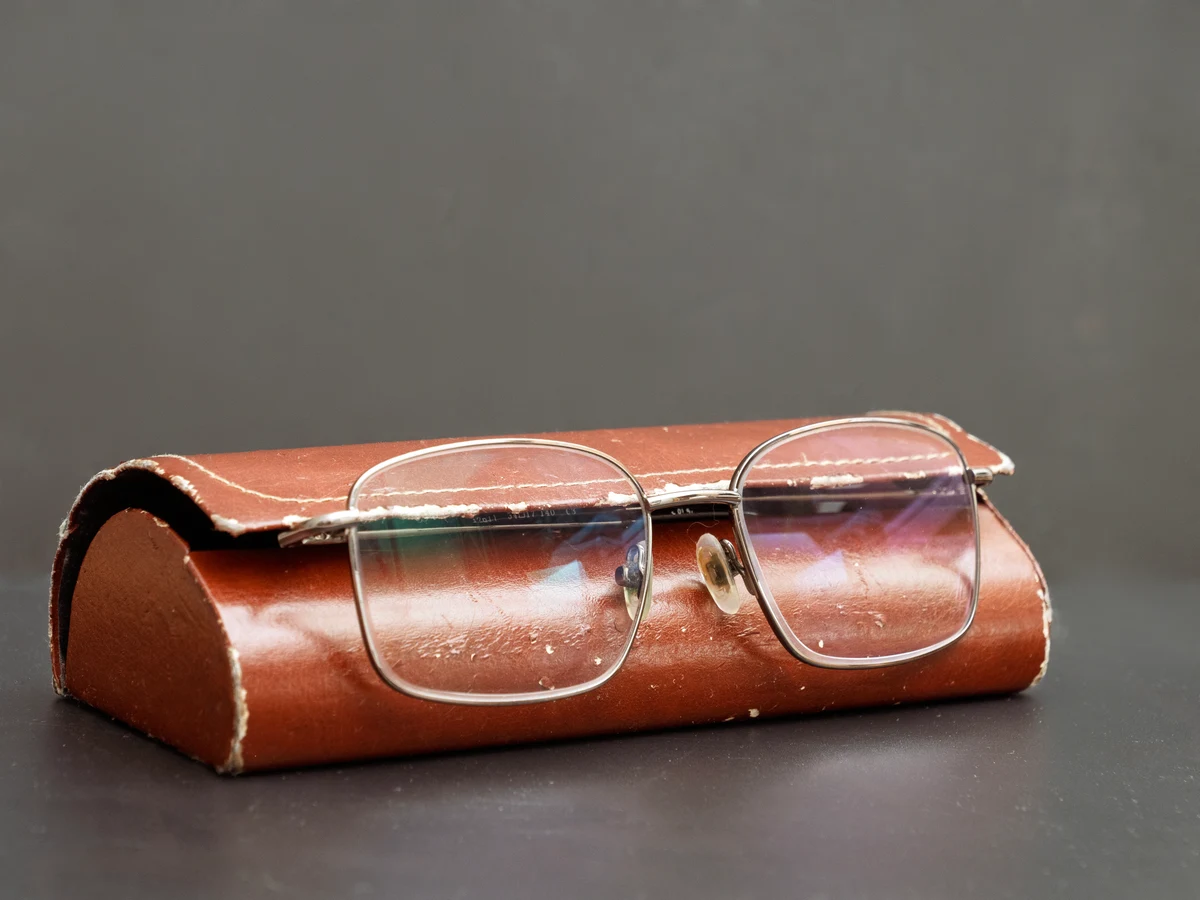
External example, not a JKPD product or fit test. Photo: VSerebrenikov, Leather glasses case, CC BY-SA 4.0. Proportionally resized and WebP-encoded; no crop. This image remains available under the same license.

An eyewear pocket needs room for the folded frame, the fingers holding it and a complete opening-and-closing action. An entrance that accepts part of a pair of glasses does not establish a usable storage arrangement. Develop the contact surfaces and the pocket’s space inside a packed bag alongside the opening itself.
Decide whether the pocket holds bare glasses, a soft sleeve or a case. Define access, separation from hard objects and resistance to external compression as separate requirements. An entrance-only review cannot establish all three.
01
Start with the folded frame
The actual folded shape gives a sample maker more useful information than a request to fit sunglasses. Select reference frames and identify their widest point, folded thickness and protruding temples. State whether a case stays around the glasses. If it does, use the outside of that case as the reference shape.
Leave a place for the user’s fingers as well. If retrieval requires pinching the lens edge and pulling hard, compare a wider entrance, a different pocket depth or another storage direction. Simply adding fabric does not identify which restriction caused the problem. Review different intended frame shapes separately instead of treating one pair as universal.
02
Keep the frame out of the closing path
Observe insertion and zipper closure as separate actions. First establish where the folded temples rest relative to the teeth. Then look at whether the slider can travel without the other hand pushing the frame aside. The user should have a practical place to hold the frame during both insertion and retrieval.
Review the relationship between the frame and entrance during insertion, then inspect the glasses fully inside with the zipper normally closed. Partial insertion does not establish complete storage or confirmed fit. The external photograph illustrates glasses and a separate case, not an installed JKPD pocket or a fit test.
03
Specify the surfaces touching the glasses
Choose a contact layer around the places the frame and lenses actually meet. Locate seam allowances, binding ends and the back of the zipper with those contact areas in mind. Keep the inside accessible for cleaning. A softer lining alone does not resolve the problem of keys or gritty objects sharing the same pocket.
The Osprey Manta/Mira owner’s manual identifies a dedicated zippered pocket for sunglasses or electronics and describes its own contact construction. This is a manufacturer example of a separately specified use. Its heat-embossed construction and scratch-free marketing description cannot be transferred to a different pocket without evidence.
04
Review the space with the main compartment packed
A small pocket can take space inward from the main compartment or project outward from the front. Review its shape under the intended everyday load before deciding how those spaces should be allocated. A rigid item pressing directly behind the pocket presents a different condition from soft clothing placed nearby.
On the sample, inspect the pocket from inside and establish where its bottom is attached and how freely it moves. Look for changes that push the stored item toward the zipper, fold the pocket downward or narrow its usable interior.
05
Separate storage from compression protection
A soft pocket can provide a separate location for an item. If the project also requires resistance to external squeezing, specify a case or protective construction and its intended conditions separately. Thicker foam does not establish a verified protection rating. Added rigid components also occupy space and change how the item can be grasped.
Compare the required depth with and without the reference case before adding construction to the whole bag. These are development choices, not reported test results. No drop, compression or lens-abrasion test results are presented in this article.
06
Give the sample team a defined storage arrangement
Keep the approved sample identifiable
Supply the reference eyewear or case together with its planned direction, an open-entrance view and the intended packed-bag condition. Request information for the contact layer separately from the outer fabric. If either changes, revisit the actual contact path. Sample comments should identify the action that feels restricted, so a revision can address the relevant area.
An external eyewear carrier and an internal zippered pocket use different attachment and access arrangements; their performance conclusions are not interchangeable. See the JKPD development blog for related product questions.
Related: backpack curved front pocket books. See the JKPD product reference.
Discuss your bag development project
ANSON XIE
General Manager & Founder
Quanzhou Junkai Pengda Special Equipment Co., Ltd.
Email: ansonxie@jkpdtime.com
Phone: +86 177 5095 3355
WhatsApp: +86 177 5095 3355
Factory address: Floors 2–4, Building 1, Phase I, Huixin Intelligent Manufacturing Industrial Park, Hui'an County, Quanzhou, Fujian, China