
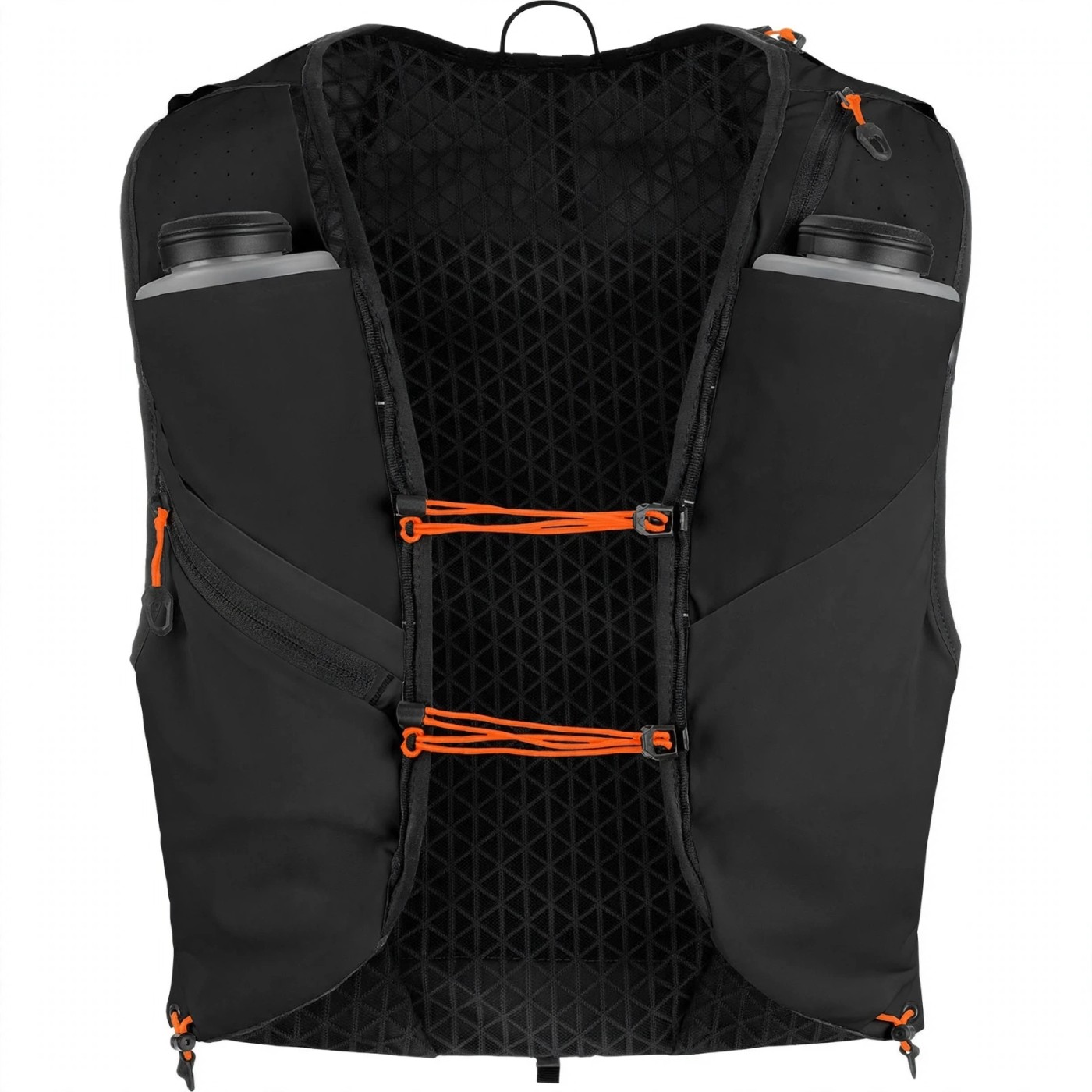
An 8-litre trail vest can divide the load between reachable chest flasks and a rear compartment for layers and food. This layout pairs two adjustment directions with three ways to carry folded poles.
The key question for a mid-size vest is what remains accessible once the layer, food and water are installed. The position of the pole attachments affects access as much as the storage volume.
01
At a glance
| Feature | Reference layout |
|---|---|
| Type | Trail running vest, flask-first all-rounder |
| Capacity | 8 L |
| Flask positions | Two front pockets for wide-mouth soft flasks |
| Reservoir | Check fit with the intended reservoir |
| Sizes | Compare available size blocks on the body |
| Closure | Two height-adjustable elastic chest straps; side adjustment system |
| Materials | Three-dimensional monofilament mesh and stretch warp-knit nylon |
02
Design positioning: one vest for most mountain runs
The front carries two flasks and small items; the rear makes space for a layer. Check the packed vest with the required gear for the specific run and see whether each pole position leaves the opening you use most clear.
03
Functions and features
Two wide-mouth soft flasks
The two front pockets are shaped for 500 ml soft flasks. Wide mouths provide room for filling, and the pockets bring the bite valves toward the chest. Compare retention full and nearly empty.
A main compartment you can reach two ways
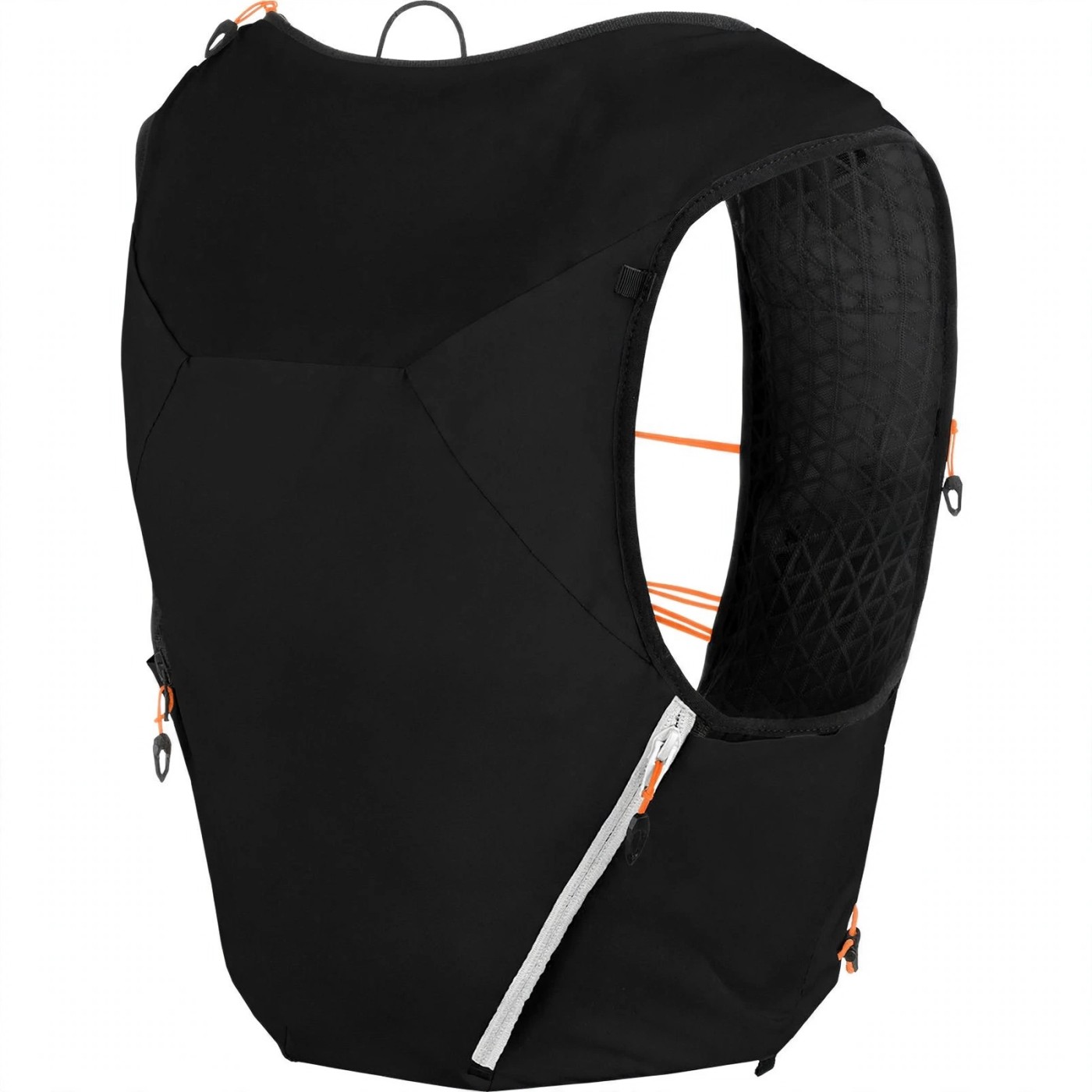
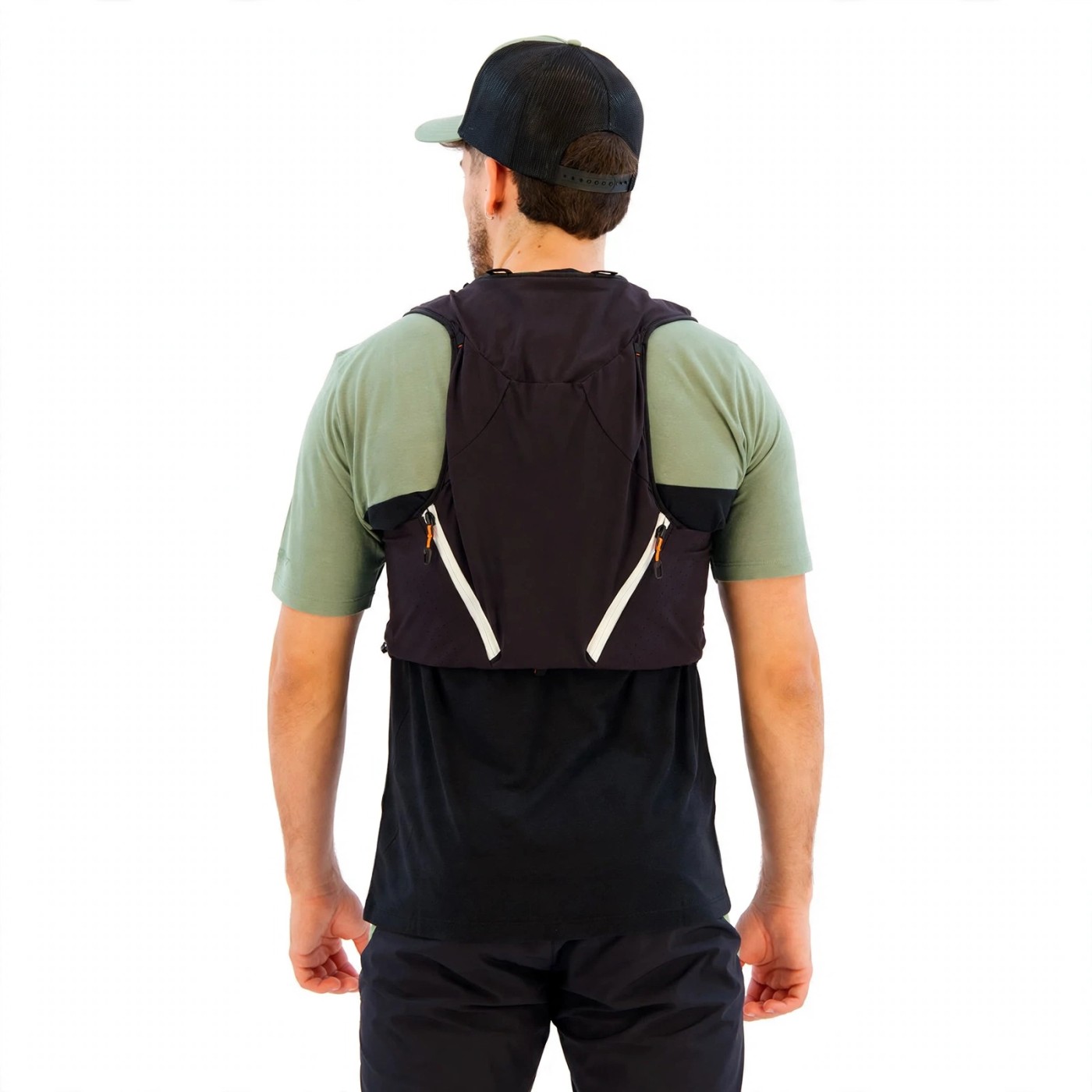
Two overlapping rear compartments have upper and lower access. The lower route can keep a layer within reach while the pack is worn; verify that the compartment divider does not block the reach when both compartments are filled.
A removable pocket for the phone
The removable phone pocket keeps the phone and small valuables apart from the main load. Verify the closure and water resistance of the actual pocket before relying on it in the rain.
Three ways to carry poles
The three positions are vertical at the front, vertical at the rear and across the rear in a V. Reposition the attachments while stopped. Check arm movement and clearance at the chin and thighs in the front position; at the rear, check what stays accessible with the poles installed.
A fit that adjusts in two directions
Two elastic chest straps can change height as clothing layers change. A side adjustment sets the tension around the torso. Verify the combination with different chest measurements and front-to-back load distributions.
Pockets for the small things, within reach
Open stretch compartments take gels, bars and gloves. Softer pocket fabric limits hard contact with skin or screens. A zip pocket separates keys or cards; confirm which openings a runner can actually reach when the vest is loaded.
A whistle and reflective details
The vest pairs a built-in whistle with reflective details. Confirm placement and reach independently of any minimum equipment or visibility requirement.
04
Fabric and material combinations
A dense, three-dimensional monofilament mesh gives the main panel structure without closing off the spaces between yarns. The feel and ventilation will depend on how it sits against the body and how the fabric is tensioned.
Stretch warp-knit nylon gives pockets room to expand. Compare recovery after repeated insertion and confirm that the empty pocket returns close to the panel.
05
Who is it for?
Mountain trail runners. Runners who climb and descend on technical ground get the most from this vest: the pole options, the stable fit, the whistle and the room for a layer.
Mid-distance runners can use the rear space for layers while leaving their drink and food within reach. Check the full gear list before choosing the volume.
Runners who use poles. If poles are part of the runner's kit, three carry options beat one, and the repositionable fixations mean the carry can change during a race.
It is less suitable for very long ultras, where a bigger pack is needed for a full mandatory kit list and more food, and for runners who want the lightest possible race vest, where every gram counts and poles are never carried.
06
Pain points it solves
A phone pressed against wet gear. The detachable pocket separates it from damp layers.
Poles with nowhere to go. Three attachment options cover front, rear and V carry, so the poles are carried the way the runner wants, not the way the vest dictates.
Gear buried in one deep pocket. The dual-access main compartment opens from the top and the bottom, so a jacket can be reached without unpacking everything.
A shifting load on descents. Check what changes when sternum strap height or side tension is adjusted.
07
Design strengths
- Two 500 ml flask positions with wide-mouth caps.
- Three pole carry options. Front vertical, rear vertical or rear horizontal V, all repositionable.
- A dual-access main compartment. Two overlapping compartments, reachable from the top and the bottom while running.
- A removable pocket to separate the phone and valuables.
- Height-adjustable elastic chest straps and side adjustment.
- Whistle and reflective details at identifiable positions.
08
Limitations to keep in mind
Without rear compression, check whether the load shifts when the rear compartments are partly empty. Side adjustment can change the fit at the torso but does not close the empty volume at the back.
Check fit with the intended reservoir and route the hose before relying on it; no specific reservoir capacity is confirmed for this layout.
Eight litres has a ceiling. For very long races with a large mandatory kit list, eight litres can run out of room. The vest is an all-rounder for most runs, not a pack for the longest ones.
09
Design lessons
Give poles more than one home. One pole attachment forces a compromise; three let the runner choose by terrain. Repositionable fixations turn a feature into a system.
Make the main compartment reachable two ways. A top zip and a bottom zip mean the runner never has to take the vest off to get a layer. Access from two directions is worth more than a slightly bigger single opening.
Keep the phone pocket separate from wet layers. Check the real seams and closure if a water-resistance claim is required.
Make chest strap height adjustable where the pattern permits it so the front fit can be checked with different clothing layers.
10
Prototype brief
For an 8 litre flask-first all-rounder vest, a precise brief helps us build the right sample the first time. Useful inputs include:
- Target capacity, target weight and the runs or races the vest is designed for.
- Hydration layout: flask count and size, intended reservoir fit and hose routing.
- Pole carry: which attachment positions are needed, whether fixations must be repositionable, and the pole length and folded size they must hold.
- Main compartment access: top, bottom or dual access, and how the compartments divide the load.
- Size range and the measurement point for each fit block.
- Fabric choices: mesh density and structure, stretch nylon weight, water-repellent finish, and reflective print positions.
- Pocket size and opening direction, including a removable phone pocket and whistle position.
Related guide: Trail Vests That Switch Between Flasks and a Rear Reservoir
Discuss your bag development project
ANSON XIE
General Manager & Founder
Quanzhou Junkai Pengda Special Equipment Co., Ltd.
Email: ansonxie@jkpdtime.com
Phone: +86 177 5095 3355
WhatsApp: +86 177 5095 3355
Factory address: Floors 2–4, Building 1, Phase I, Huixin Intelligent Manufacturing Industrial Park, Hui'an County, Quanzhou, Fujian, China