
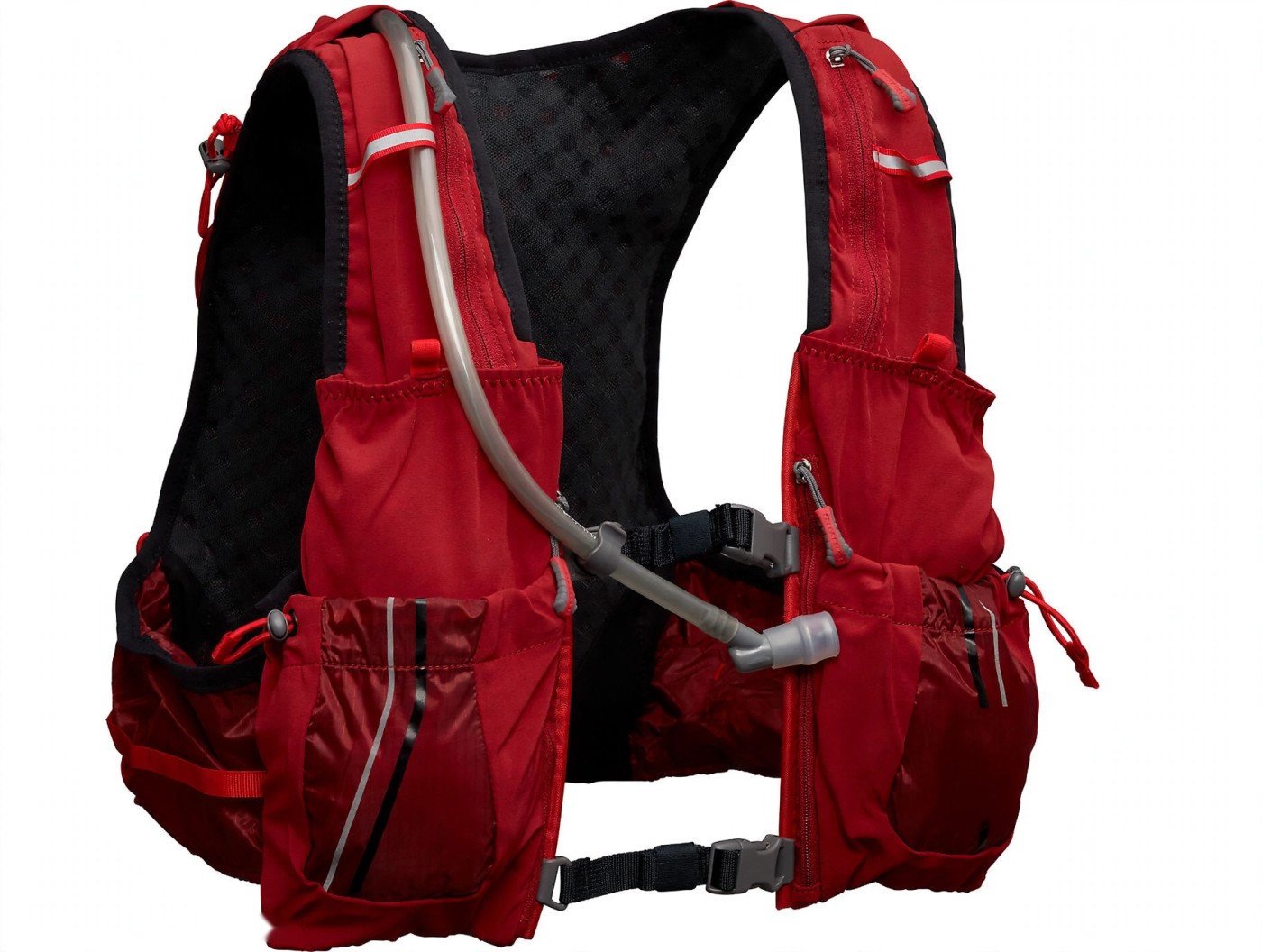
Most trail running vests put water on the chest: two soft flasks in holsters on the shoulder straps, lifted to the mouth to drink. It is a good system, and it has become the standard layout for racing. But it is not the only system. Some runners prefer a reservoir on the back and a hose over the shoulder, the way hikers have carried water for years: hands-free drinking, the weight sitting low and central, and two litres of water on board for long stretches between aid stations.
In this 7 L reference design, a 2 L rear reservoir and hose are the primary water system. The front pockets then serve food, layers and small items, with optional flask space. This is a design example, not a JKPD product.
01
At a glance
| Feature | Reference design |
|---|---|
| Type | Trail running hydration vest built around a rear reservoir |
| Capacity | 7 L (427 cubic inches) without the reservoir; 5 L (305 cubic inches) with it fitted |
| Weight | Approx. 235 g (8.3 oz) without reservoir |
| Rear hydration | 2 L reservoir with hose and bite valve |
| Soft flasks | Front sleeves accept secondary flasks; measure against the chosen flask |
| Sizes (chest) | Two sizes only: XS–M 76–97 cm, L–XXXL 97–112 cm |
| Pockets | 8 front pockets, 4 of them zipped; 3 rear compartments plus a kangaroo pocket |
| Materials | Nylon body with polyester mesh in the contact areas |
A fitted reservoir occupies part of the storage volume. In this example the nominal gear space goes from 7 L without it to about 5 L with it fitted. Compare both configurations under load.
02
Design positioning: the reservoir is the main water system
The defining choice of this vest is that the reservoir is not an accessory but the main hydration system, and the rest of the vest is designed around it.
That shows in the back of the vest. The largest rear compartment is shaped for the reservoir, with a hook-and-loop strap at the top that holds it up so it does not sink to the bottom as it empties. The reservoir itself is hourglass-shaped, narrower in the middle, which keeps the water from sloshing from side to side while running. The hose runs over the shoulder and down the chest, where a magnetic clip on the upper chest strap holds it in place when it is not in use. A quick-release fitting on the hose lets the runner take the reservoir out for refilling without threading the hose out of the shoulder straps.
This is a deliberate trade: a reservoir on the back is harder to see and harder to judge how much water is left than a flask on the chest, but in exchange the runner gets two litres of water in one place, hands-free drinking, and a back that stays balanced because the water sits close to the spine.
The second defining choice is that the vest is built from heavier, more structured fabric than a stretch race vest. It does not rely on stretch to hold its shape: it builds its 7 litres out of panels, pockets and compartments, with adjustment straps to pull it tight, so it feels more like a small running pack than like a piece of clothing.

03
Functions and features
Reservoir compartment and hose system
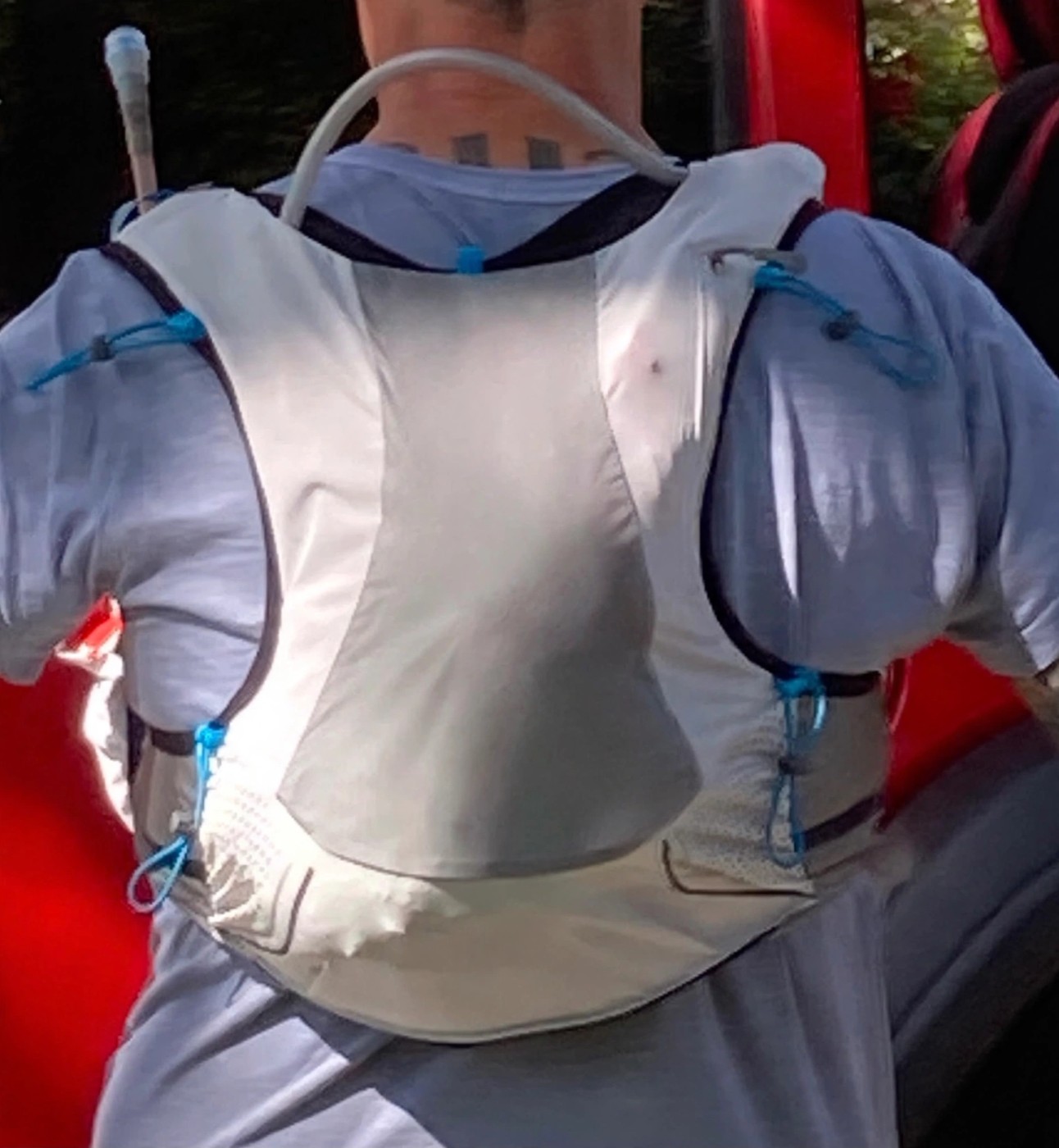
The rear of the vest has three compartments. The largest is the reservoir compartment, with a hook-and-loop strap at the top that supports the reservoir. Behind it sits a second compartment of about the same size for extra layers and food, and behind that a smaller one that does not run to the bottom of the vest. A zipped pocket on the very back holds small items.
The magnetic clip holds the hose near the upper sternum strap so it does not hang loose. A quick-release connector lets the reservoir come out for refilling without having to pull the hose through the shoulder routing. Check valve leakage and connector access on a loaded sample.
Eight front pockets
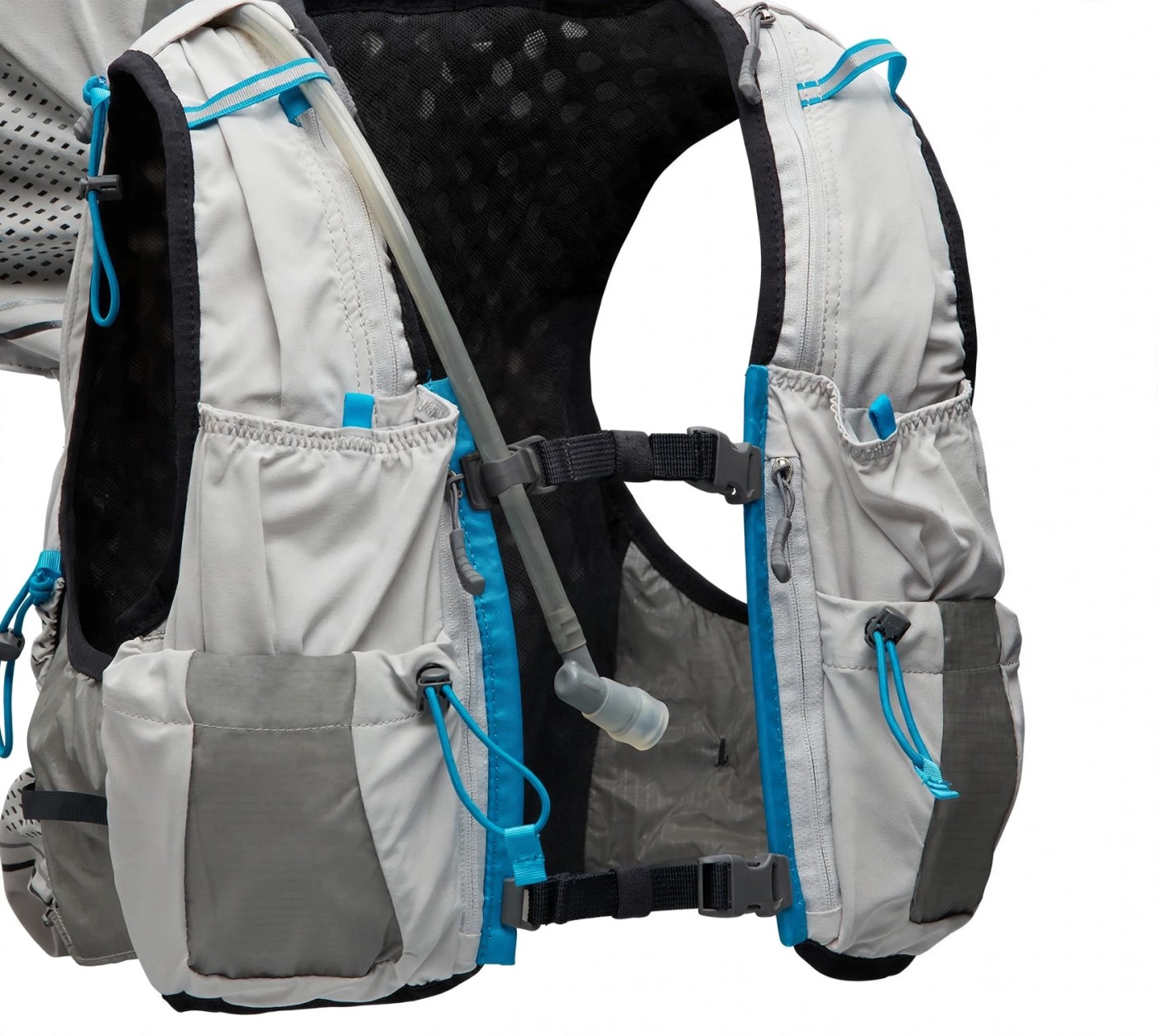
The front of the vest carries eight pockets, four of them zipped — a lot for a 7 litre vest.
The lower zipped pockets are sized for small essentials such as a phone and also contain the side adjusters. Open pouches and a smaller pocket with an elastic closure offer quicker access to gels. Taller sleeves take optional flasks; two narrower zipped pockets sit higher on the chest.
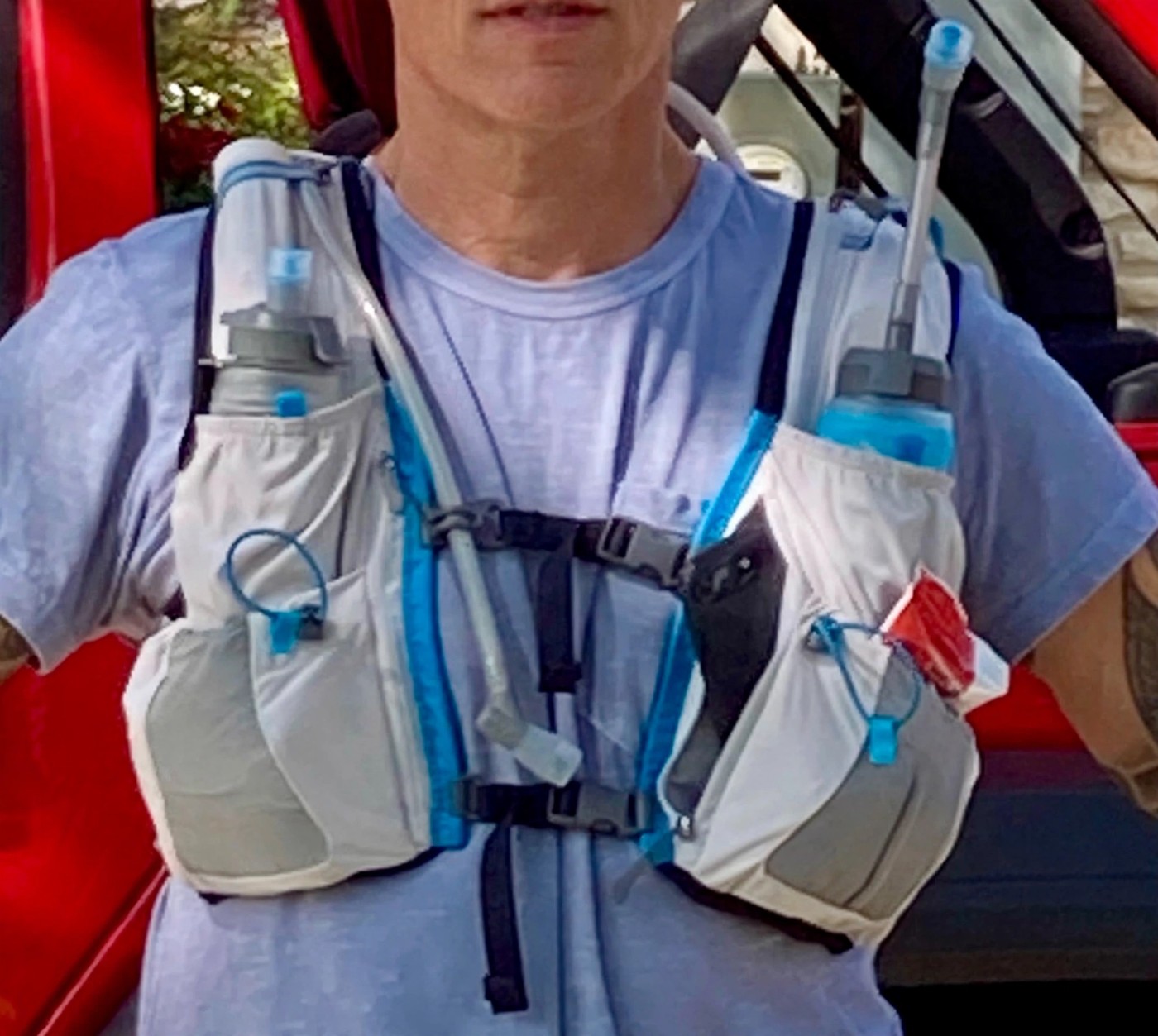
Soft flask pockets without elastic loops
The tall sleeves have no cap-retention loops. Elastic in the adjoining lower pockets can help hold the flasks in place, but retention with half-empty flasks needs a movement check. Front water also changes the balance against a full rear reservoir.
Kangaroo pocket and pole carry
An elasticized kangaroo pocket at the bottom of the back holds a shell or light layer. Four rear elastic loops carry folded poles; check that pole tips and grips clear the arms with the vest full.
Adjustable fit: slide rails and hidden flank straps
Two sliding sternum straps adjust vertically. The upper clasp also carries the hose clip. Side straps pull the vest around the ribs, but placing their adjusters inside the lower zipped pockets makes them harder to reach when those pockets are full. Check adjustment under both water loads.
Rear external shock cord and reflective details
The rear shock cord can hold a bulky layer or compress the load. Contrast between the reflective trim and the body fabric varies by colour. A water-resistant zip pocket on the front shoulder holds small essentials.
04
Fabric and material combinations
Nylon body. The main fabric is nylon, chosen for strength and for holding the structured shape of the vest. Because the vest does not rely on stretch, the nylon can be a firmer, more pack-like fabric than the stretch knits used on race vests.
Polyester mesh in the contact areas promotes airflow. Check the texture with the intended running layer, particularly at the edges and seams.
The perforated interior lining adds ventilation without a heavy solid layer.
Nylon back panel. The back panel is a firmer nylon with a slight crinkle to it. It gives the rear compartments their shape and protects the contents.
Firmer panels can support the shape of a bladder-first vest because straps control fit. The trade-off is empty weight; weigh the complete configuration and record whether it includes the reservoir.
05
Who is it for?
Ultra runners who prefer a reservoir and want two litres of water on board for long sections between aid stations. Runners doing long days with resupply, where aid stations come periodically: the vest carries a full kit for a long day, but it is not a self-supported multi-day pack. Summer day hikers, who can use the same pocket layout and reservoir for a light hiking day. Runners who want maximum organisation, with a dedicated place for every item.
It is less suitable for runners who want the lightest possible vest, for short races where a 5 litre flask vest is enough, and for runners who want to see their water on the chest.
06
Pain points it solves
Hands-free drinking. The hose and magnetic clip let the runner drink without stopping, reaching or taking anything out of a pocket.
Carrying two litres of water. A full reservoir gives enough water for long gaps between aid stations, and the hourglass shape keeps it from sloshing.
Running out of places to put things. Eight front pockets and three rear compartments give every item a dedicated place. Poles getting in the way. The rear pole loops hold folded poles clear of the arms, so they can be carried without hand-carrying them.
Overheating. The porous mesh and perforated lining move air through the vest, and the open front pockets are easy to reach without stopping.
07
Design strengths
- A dedicated 2 L hydration layout with hose, bite valve, quick-release fitting and magnetic clip.
- Two litres of hands-free water, drinkable without stopping or reaching.
- Exceptional pocket count: eight front pockets and three rear compartments in a 7 litre vest.
- Front sleeves provide a secondary flask option. Verify bottle diameter, neck height and retention on the intended flasks.
- Adjustable fit: sternum straps on slide rails and side straps adapt the vest to different bodies.
- Good pole carry: rear loops hold folded poles clear of arm swing.
- Kangaroo pocket for layers, easily reached from the rear.
- 360 degree reflective details for low-light visibility.
08
Limitations to keep in mind
Balance with a full reservoir. The rear load changes the vest's balance. Test full, half-full and nearly empty, then repeat with two front flasks if that configuration is intended.
Fiddly flank adjustment. The side straps sit inside the zipped front pockets, so they are hard to adjust on the move and hard to reach when the pockets are full. Getting the fit right takes patience.
The two broad size bands make loaded fit especially important. Check breathing room and the usable adjustment range near each size boundary.
Heavier per litre than stretch vests. The structured fabrics and the reservoir system add weight. At around 235 g without the reservoir, it is one of the heavier vests in its class for the volume it carries.
The tall flask pockets have no dedicated cap-retention loops. Check whether partly empty flasks settle, fold or work upward when the runner moves.
09
Design lessons
Choose the main hydration system first. A rear reservoir makes hose access, back-panel retention and front-to-back balance primary design requirements.
Design the hose as a system, not an accessory. The magnetic clip, the quick-release fitting and the top strap that holds the reservoir up are small features, but together they make the reservoir usable while running.
A narrower midsection can help control water movement. Compare it against a plain reservoir at partial fill before specifying the shape.
Do not hide adjustment inside storage. Putting the side adjustment straps inside the zipped front pockets means the runner cannot adjust the fit without emptying a pocket. Adjustment controls should be reachable with the vest loaded.
Mind the volume-to-weight ratio. Structured fabrics give a vest its shape, but they cost weight. If the target is a light race vest, stretch fabrics with real recovery are a better choice than panels.
A broad size band can leave some users at the end of the adjustment range. Explain where to measure, and sample both boundaries.
10
Development checklist
Record these inputs on the sample brief before approving the layout:
- Target capacity with and without the reservoir fitted, and target empty weight.
- Hydration layout: reservoir size and shape, hose routing, bite valve, magnetic clip, quick-release fitting, and whether front flask pockets are needed.
- Size range and chest measurements for each size.
- Fabric choices by zone: structured panels, mesh contact areas, perforated lining.
- Pocket list with sizes, closures, and which pockets hold adjustment straps.
- Closure and adjustment systems: sternum straps, slide rails and side straps.
- Pole carry, kangaroo pocket, shock cord, reflective details, colourways.
Related guide: Hydration Pack Hose Routing: Review the Path from Exit Port to Harness
Discuss your bag development project
ANSON XIE
General Manager & Founder
Quanzhou Junkai Pengda Special Equipment Co., Ltd.
Email: ansonxie@jkpdtime.com
Phone: +86 177 5095 3355
WhatsApp: +86 177 5095 3355
Factory address: Floors 2–4, Building 1, Phase I, Huixin Intelligent Manufacturing Industrial Park, Hui'an County, Quanzhou, Fujian, China