
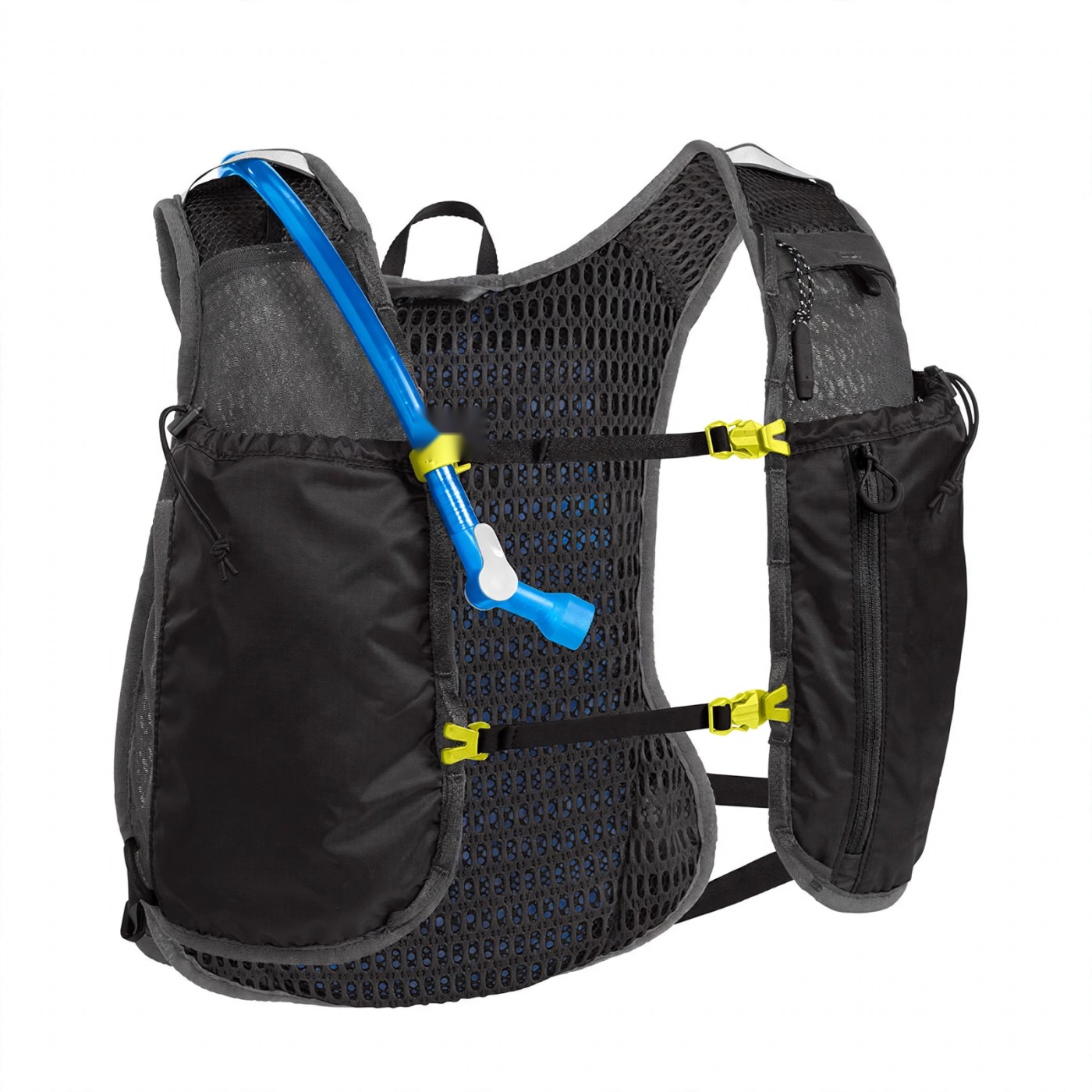
This 5-litre vest uses a rear reservoir as its main water supply. The front pockets can stay available for food and small gear or take soft flasks when more water is needed.
That simplicity is the design. There are no complicated adjustments, no modular parts and no long list of features to learn. There are two straps across the chest, two straps at the sides, five pockets, and a reservoir that does most of the work. It is the vest for a runner's first trail runs, for road runners moving onto the trails, and for anyone who wants hydration to be one less thing to think about.
01
At a glance
| Feature | 5 L reservoir-first vest |
|---|---|
| Type | Trail running vest, reservoir-first with flask pockets |
| Capacity | 5 L |
| Front flask layout | 1.5 L reservoir with hose and bite valve |
| Flasks | Front pockets shaped for 0.5 L soft flasks |
| Sizes | One size; men's and women's specific fits |
| Closure | Dual adjustable sternum straps; side adjustment straps |
02
Design positioning: the reservoir does the work
The design question this vest answers is what a runner needs for one to three hours on the trails without stopping: enough water, a phone, keys, some food, and a layer for when the weather turns. A 1.5 litre reservoir covers the water for most runs of that length, and five litres of storage covers the rest. Nothing about the vest is built for a twelve-hour mountain ultra, and that is a strength: every part of it is sized for the run it is actually meant for.
That is also why the vest comes in one size, with a men's fit and a women's specific fit. Instead of four sizes and a size chart, there are two side straps and two chest straps that pull the vest snug around almost any torso. It is a simpler answer to fit, and for most runners it works — though the published chest ranges disagree with each other, and very small or very large runners should check the fit before committing.
03
Functions and features
A dedicated slot for a 1.5-litre reservoir
The 1.5-litre reservoir is the main component. Its filling opening, handle and internal baffle affect the way it fills, fits the sleeve and moves when partly empty. Check those tasks with the exact reservoir and the user's normal rear load.
A hose that stays where it is put
The hose runs from the reservoir up over the shoulder, and a clip on the strap holds it in place so it does not flap around while running. The clip takes a little force to use, and it is best fitted before the vest goes on, but once it is in, the bite valve sits within easy reach of the mouth and the hose stays put for the whole run. A flapping hose is a small annoyance that a runner notices on every step; this clip is the vest's answer to it.
Two front pockets for flasks — or for anything else
The two front pockets are shaped for 0.5-litre soft flasks. If the reservoir provides all the planned water, these pockets can take other small items instead.
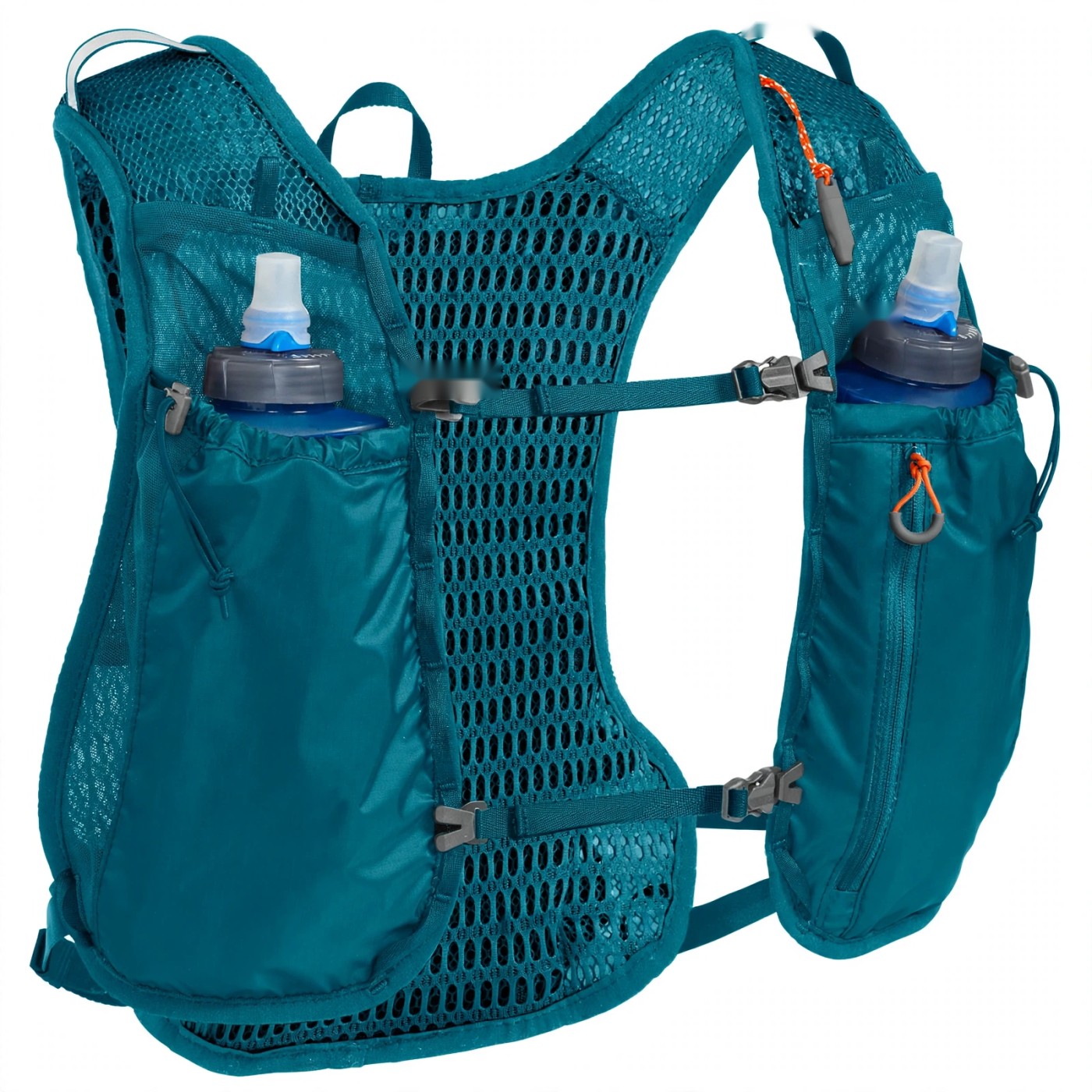
A zipped phone pocket and a mesh fuel pocket
A small mesh fuel pocket and a zipped valuables pocket sit next to the front storage. Verify the intended phone with its case on and the adjacent pocket filled.
A fit that adjusts in seconds
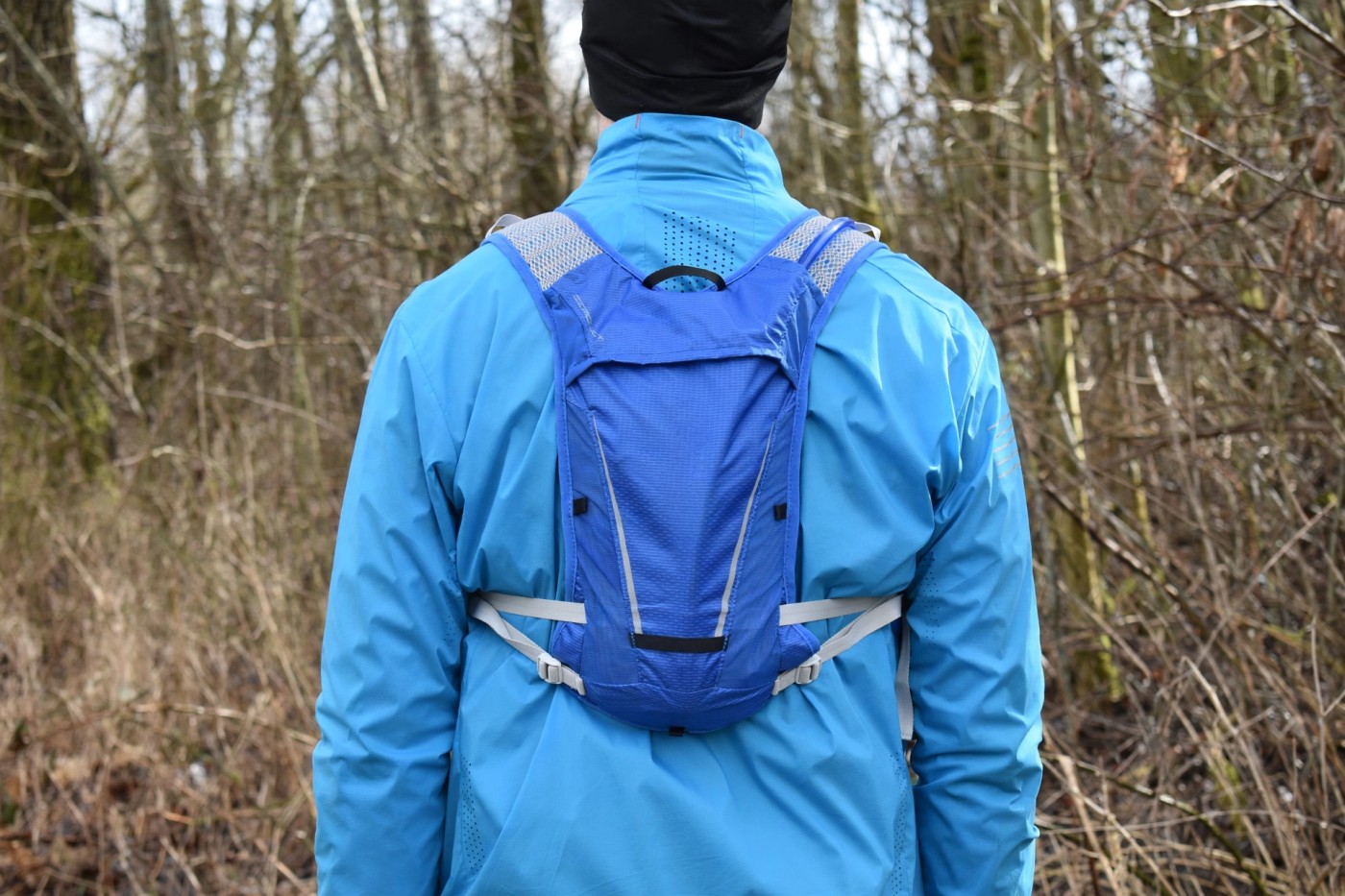
The vest closes with two adjustable sternum straps across the chest — the lower one elastic, so it does not restrict breathing on a hard effort — and two side straps that pull the whole vest snug around the body. There is no waist belt and no complicated harness: pull the side straps, set the chest straps, and the vest sits close enough to forget. Because the reservoir is fixed at the top of the vest, a little side-to-side movement can be felt when running with a full reservoir, but the fit is snug enough that the movement stays small.
04
Fabric and material combinations
The shell uses lightweight ripstop. Confirm the fibre, recycled content and finish for the selected fabric rather than inferring them from the look of the sample.
Reflective details for low light. The vest carries reflective strips and details in several places, including the shoulder straps, so the runner stays visible as the light fades. Combined with the light colourways the vest comes in, the visibility is a practical safety feature for runners who train early or late.
05
Who is it for?
First-time wearers can start by checking the reservoir, hose and fit as one system.
Road runners moving onto the trails. The vest is light, simple and comfortable enough for road running, and the reservoir and the storage make it ready for trails as soon as the runner is.
Training outings. Plan actual water, food and clothing needs instead of treating a time range as a capacity promise.
Speed hikers and walkers. The same fit and storage suit fast hiking, where the water is just as important and the pace is lower.
It is less suitable for ultras and multi-day races, where five litres is not enough for a mandatory kit list, and for runners who want a flask-first vest with the water on the chest rather than on the back.
06
Pain points it solves
Drinking without stopping. The reservoir and the hose mean water is always within reach of the mouth, with no bottle to hold and no pocket to dig in.
Overheating in a vest. The deep vent mesh keeps air moving across the back and the shoulders, where a vest usually traps heat.
A hose that flaps. The strap clip holds the hose still, so the runner hears nothing and feels nothing extra while moving.
Gear with nowhere to go. Five pockets put the phone, keys, food and a layer within reach, without taking the vest off.
07
Design strengths
- A dedicated reservoir layout with a shoulder hose route and accessible bite valve.
- Simple to fit. One size, two side straps and two chest straps, adjusted in seconds.
- Two water-carry options: a reservoir on the back and open front pockets sized for soft flasks.
- Comfortable against the skin. Deep vent mesh that is soft to the touch and breathes well.
- Reflective details. Visible in low light, for early and late runs.
08
Limitations to keep in mind
The reservoir is fiddly to get in. The opening for the reservoir is narrow, and pushing the reservoir into the vest takes practice. It gets easier, but the first few times are awkward.
With water remaining in the reservoir, check whether the sleeve still supports it at the base and the top attachment controls movement.
Phone fit depends on its case and on the loaded shape of the pocket. Check the full zip opening, not just the width laid flat.
One adjustable size still has limits. Establish a chest range using the actual fit sample loaded with water.
09
Design lessons
Specify the reservoir and carrier together. Review loading, hose parking and cleaning before freezing the pattern.
Make the hose clip part of the strap. A clip that holds the hose on the strap, rather than an add- on, keeps the hose still without adding a part the runner has to manage.
Define the adjustment range for each fit profile rather than calling one size universal.
Keep the mesh deep and soft. Ventilation that feels comfortable against bare skin is worth more than a lighter fabric that chafes.
10
Prototype brief
Useful inputs for a reservoir-first vest prototype include:
- Target capacity, target weight and the runs or races the vest is designed for.
- Reservoir capacity, hose path, valve holder position and front pocket dimensions.
- Size range and the measurement point for each size, including the chest range a one-size fit must cover.
- Fabric choices: ripstop nylon weight and recycled content, vent mesh depth and softness, water-repellent finish, and reflective print positions.
- Pocket list with approximate sizes and opening directions, including a secure pocket for phone and keys.
- Pole carry positions, whistle anchor and colour options.
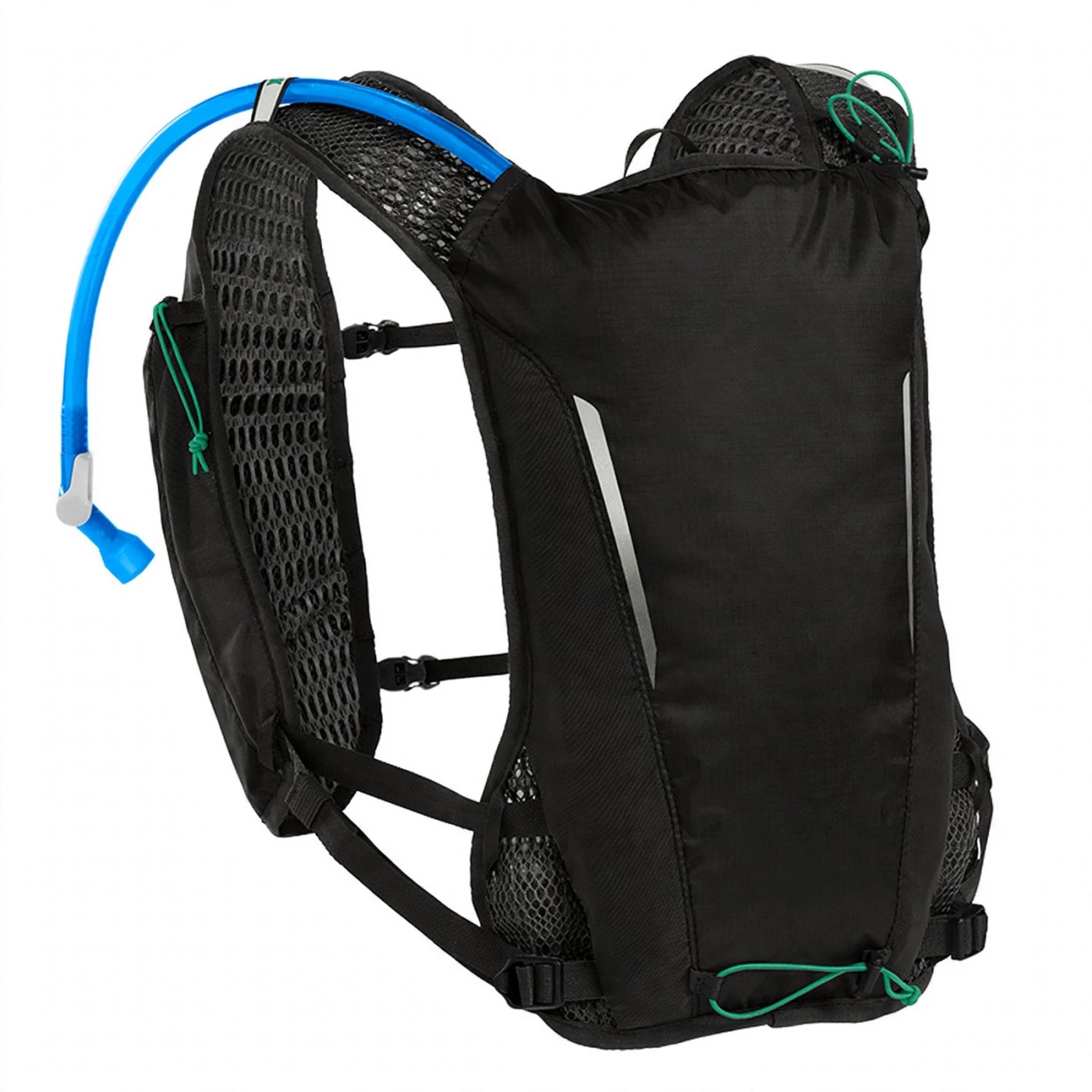
Related guide: How a 7 L Trail Vest Is Built Around a Rear Reservoir
Discuss your bag development project
ANSON XIE
General Manager & Founder
Quanzhou Junkai Pengda Special Equipment Co., Ltd.
Email: ansonxie@jkpdtime.com
Phone: +86 177 5095 3355
WhatsApp: +86 177 5095 3355
Factory address: Floors 2–4, Building 1, Phase I, Huixin Intelligent Manufacturing Industrial Park, Hui'an County, Quanzhou, Fujian, China