
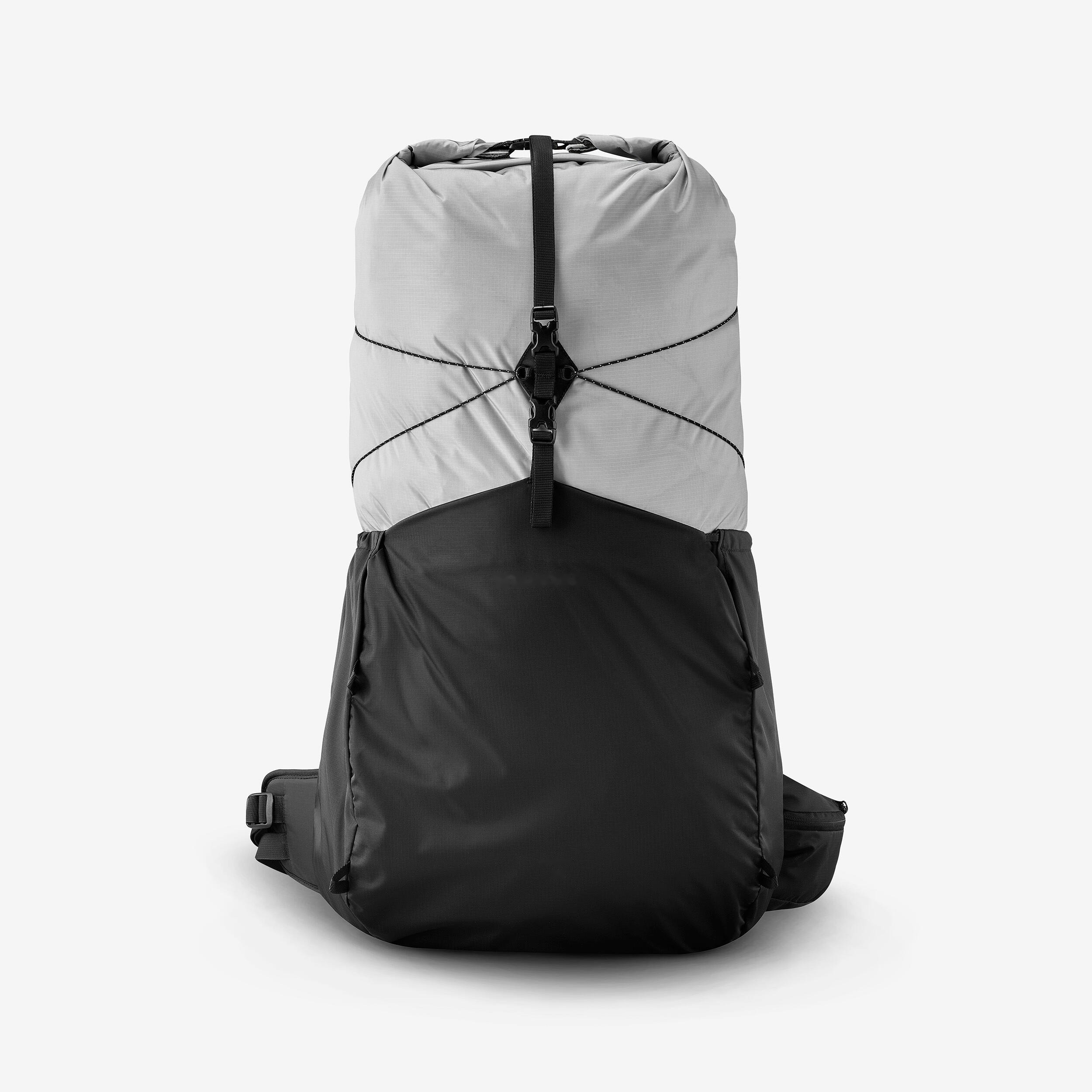
An early 50 L roll-top layout used broad mesh pockets and a simple harness. In the finished reference, solid exterior pockets, an adjustable back and a curved frame change both how the pack carries and how the user finds gear.
The point of comparing these two layouts is to separate useful volume, empty weight and support. The finished pack is shown as a design example, not a JKPD product.
01
At a glance
| Feature | Reference design |
|---|---|
| Type | Ultralight trekking and long-distance hiking pack |
| Capacity | 50 L (main compartment about 39 L, plus outer pockets) |
| Weight | 880 g |
| Main fabric | 100-denier ripstop nylon (polyamide) |
| Frame | Curved ultralight steel-alloy frame with a suspended mesh back panel |
| Back length | Adjustable, 37–53 cm |
| Opening | Roll-top |
| Outer pockets | 3 large pockets in the same fabric as the body (centre 4.5 L, sides 3.5 L each) |
| Water protection | Water-resistant, not waterproof |
| Recommended load | 10 kg (maximum 12 kg) |
| Colour | Grey and black (light grey upper, black lower) |
02
Early layout: mesh storage and a simple harness
The early concept used a straight-sided 50 L roll-top with four fixing points, a 200-denier nylon body, one large front mesh pocket and two smaller mesh side pockets. Webbing between the pockets left space for attachments. The exact frame construction is not clear from the available views.
Another layout fixed the front pockets at their seams and added webbing loops. A design check is whether an attached pad can sit clear of the side pockets and lower edge.
The early concept's 850 g figure is a target, not a substitute for weighing a finished pack with its frame and belt pocket.
03
Finished layout: solid pockets and a curved frame
The finished example retains the 50 L layout but changes several details:
- Weight: 880 grams, 30 grams more than the prototype's claim.
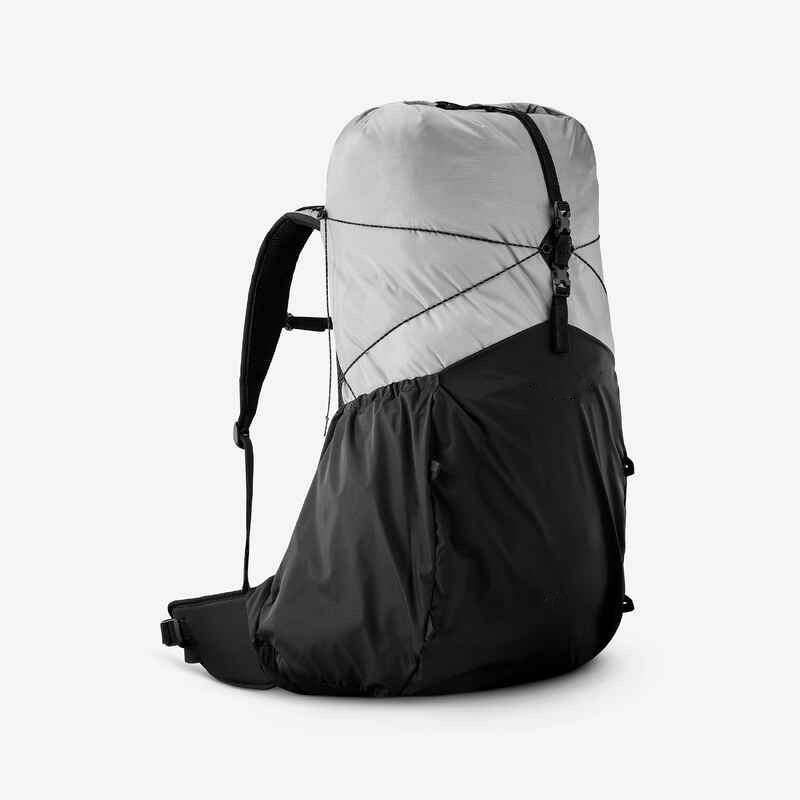
- Panel zoning: light upper fabric and a dark lower body mark different exposure to dirt and wear.
- Fabric: 100-denier ripstop nylon, lighter than the prototype's 200-denier fabric.
- Frame: a curved, lightweight steel-alloy frame supports the suspended mesh panel.
- Outer pockets: three large pockets in the same fabric as the body, not mesh — a central pocket of 4.5 litres and two side pockets of 3.5 litres each.
- Belt storage: the finished pack has a zipped pocket on the hip belt, which the prototype lacked.
- Attachment points: six external hooks on the back of the pack, plus side compression cords.
04
Functions and features
Roll-top opening with room to grow
The main compartment closes with a roll-top. Rolled down, the pack holds 50 litres; with the roll-top extended, the capacity grows to about 50–55 litres. The roll-top is held by a central compression strap with buckles, and the top of the pack has straps for lashing a sleeping pad or a bear canister on top. A roll-top has no lid to lose and no zip to fail, and it lets the pack shrink when it is not full — which matters on a pack this light, because a half-empty pack that cannot compress will sway.
Three large outer pockets
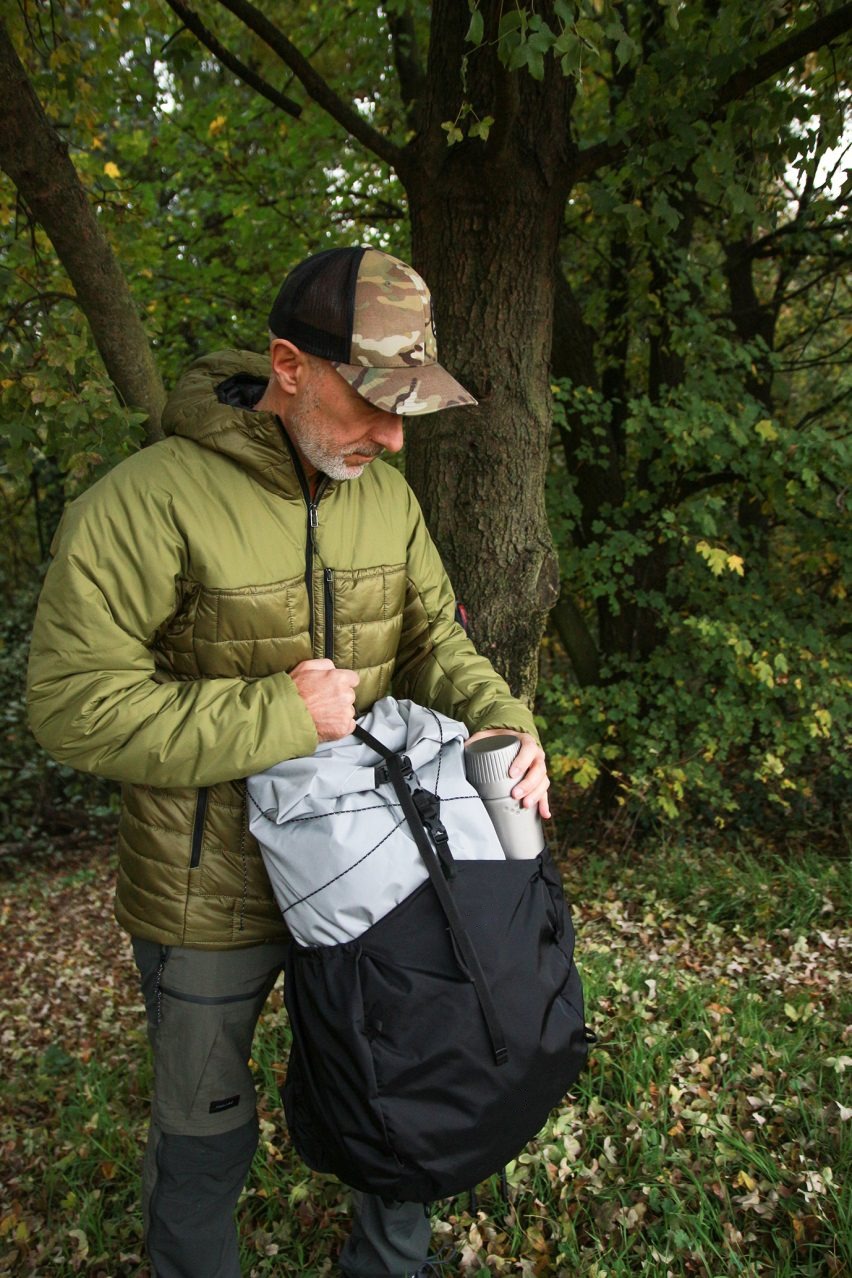
The three outer pockets are the most visible change from the prototype. Instead of stretch mesh, they are made from the same 100-denier ripstop as the body. That makes them tougher and more weather-resistant than mesh, at the cost of some stretch. The central pocket holds 4.5 litres — a rain jacket, a map, a water filter — and each side pocket holds 3.5 litres, enough for a bottle or a rolled-up layer. A crossed elastic cord runs over the front of the pack, giving a place to tuck a jacket or a sit pad quickly without opening anything.
The carry system
For a pack of 880 grams, the carry system is unusually complete.
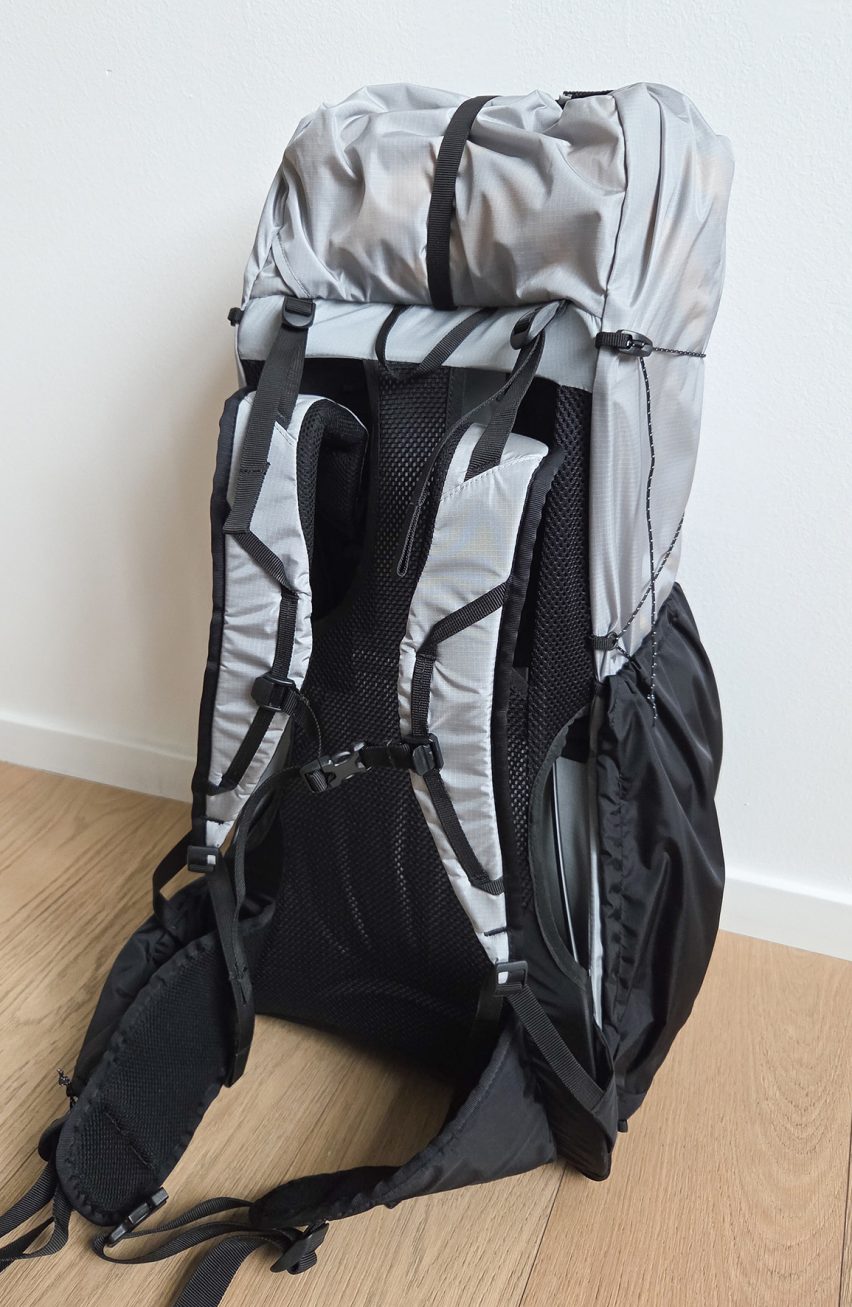
- Suspended mesh back panel. The back panel is a curved mesh suspended over the frame, so air can move between the pack and the wearer's back. The frame is a curved ultralight steel alloy, shaped to follow the back.
- Adjustable back length. The back length adjusts from 37 to 53 cm with a buckle system, so the same pack fits a wide range of torso lengths without coming in separate sizes.
- Dual-density foam straps and belt. The shoulder straps and hip belt use foam of two densities — firmer where the load sits, softer where it touches the body.
- Adjustable sternum strap and load lifters. The sternum strap keeps the shoulder straps in place, and load lifters tune how the pack sits against the shoulders.
The recommended load is 10 kilograms, with a maximum of 12. That is the honest limit of a pack this light: it is built for a light kit, carefully packed, not for carrying everything including the kitchen.
Storage and attachment points
- Internal zip pocket inside the main compartment for valuables.
- Zipped hip-belt pocket for a phone, cash or snacks.
- 2-litre hydration compartment for a water bladder.
- Six external hooks on the back of the pack for clipping gear, plus side compression cords that also stabilise the load.
The fabric can shed light rain, but the seams and roll-top are possible routes for water entry. Treat this as a water-resistant layout, not as a waterproof enclosure.
05
Fabric and material combinations
The material choices are the reason the pack weighs 880 grams.
- Main fabric: 100-denier ripstop nylon. The grid is intended to limit tear propagation. Compare the actual weave, coating and abrasion performance with heavier samples; denier alone does not predict durability.
- The solid nylon pockets trade stretch for a continuous surface. Check drainage and access with the main body fully packed.
- Back panel: suspended mesh over a steel-alloy frame. Mesh where the pack touches the body, metal where the structure is.
- Shoulder straps and hip belt: dual-density foam, firmer under load and softer against the skin.
- Hardware: light plastic buckles, including the buckle system that adjusts the back length.
The trade-off is wear tolerance. Test the actual 100-denier fabric and panel layout where sharp gear or rough ground could contact it.
06
Who is it for?
- Long-distance hikers and thru-hikers who count grams and carry a light kit.
- Fast packers who want a 50-litre pack that weighs under 900 grams.
- Hikers between sizes, who benefit from the 37–53 cm adjustable back length.
- Walkers who use a roll-top and want the pack to shrink when it is not full.
07
Pain points it solves
- Empty weight. The example is 880 g; compare other candidates in the same ready-to-use configuration.
- One-size-fits-none backs. The adjustable back length covers 37–53 cm in a single pack.
- Sweaty backs. The suspended mesh panel keeps air moving behind the wearer.
- Mesh pockets that tear. Solid fabric outer pockets resist snags and weather better than mesh.
- Packs that stay bulky when half empty. The roll-top compresses the pack down to its contents.
08
Design strengths
- 880 grams for 50 litres, with a real frame and a real hip belt.
- Adjustable back length of 37–53 cm, with no need to choose a size.
- Three large solid-fabric outer pockets totalling 11.5 litres.
09
Limitations to keep in mind
- Water-resistant construction is not waterproof. Check the roll-top and seams if prolonged rain is likely.
- The reference specifies 10 kg as a working load and 12 kg as a maximum. Sample fit and panel deformation close to the intended load before fixing a limit.
- 100-denier fabric is not bombproof. It needs care on rough ground and around sharp gear.
- No lid. The roll-top is simple and light, but there is no lid pocket for quick-access storage.
10
What to verify between prototype and production
The changes are linked: solid pockets reduce stretch, a curved frame adds structure, and a belt pocket moves essentials out of the main bag. Verify those changes together rather than optimizing each panel in isolation.
Weigh the approved configuration with frame, harness and all pockets. Record volume inside the body and in external pockets separately. A difference between an early target and the finished weight is only meaningful when the included parts are clear.
11
Development checklist
Record these inputs on the sample brief before approving the layout:
- Capacity and target weight, and the maximum load the pack must carry.
- Frame type: curved stays, a framesheet, or a frameless design, and how the back panel should ventilate.
- Whether the back length should be adjustable, and across what range.
- Opening style: roll-top, lid, or a combination, and how the pack should compress when partly full.
- Pocket plan: mesh or solid fabric, and how much volume should sit outside the main compartment.
- Fabric choice by zone, including denier, ripstop construction and water resistance.
- Hardware and trim list, and whether a rain cover is included.
Related guide: The 36-Litre Suspended-Mesh Hiking Pack: A Bright, Simple Design Built Around a Ventilated Back
Discuss your bag development project
ANSON XIE
General Manager & Founder
Quanzhou Junkai Pengda Special Equipment Co., Ltd.
Email: ansonxie@jkpdtime.com
Phone: +86 177 5095 3355
WhatsApp: +86 177 5095 3355
Factory address: Floors 2–4, Building 1, Phase I, Huixin Intelligent Manufacturing Industrial Park, Hui'an County, Quanzhou, Fujian, China