
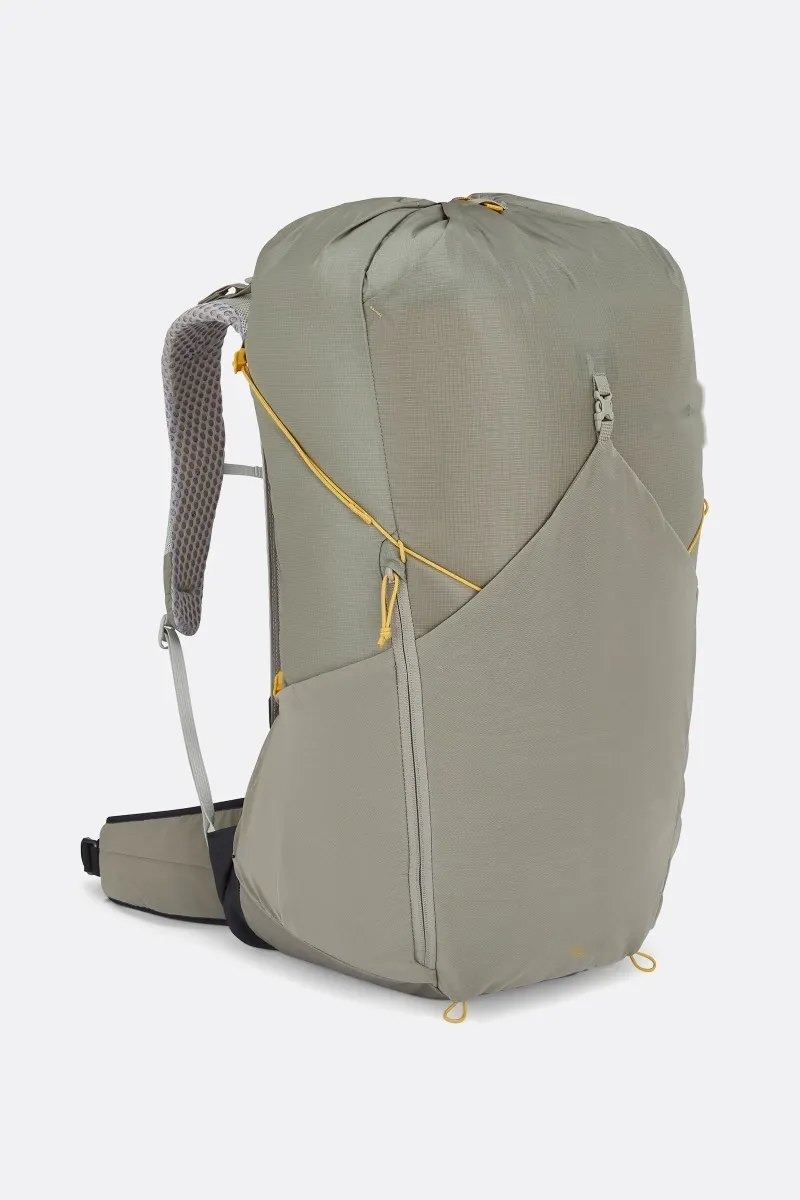
Some packs win attention with a long feature list. The pack in this article wins it with two things you notice in the first ten seconds: a cheerful colour scheme with sunflower-yellow accents, and a back panel that stands away from your body on a curved frame. Everything else is deliberately plain. There is one main compartment with a drawcord top, a handful of well-placed pockets, and a light coated ripstop shell. That restraint is exactly why it is worth studying, both for hikers choosing a pack and for brands planning their own lightweight range.
This design example looks at how a 36-litre suspended-mesh hiking pack is built, how its carry system works and where the design has limits. The pack shown is not a JKPD product.
01
At a glance
| Feature | 36 L suspended-mesh hiking pack |
|---|---|
| Capacity | 36 L (2,195 cu in) |
| Weight | About 815 g |
| Dimensions | 64 × 35 × 30 cm |
| Back length | M 48 cm (19 in) / L–XL 53 cm (21 in), fixed |
| Back system | Knitted mesh panel suspended on a curved spring-steel frame |
| Main fabric | 100D high-tenacity nylon ripstop, with a protective coating |
| Lining | 100% polyester |
| Colours | Grey-green, dark graphite grey, both with yellow details |
02
The carry system: a suspended, knitted back
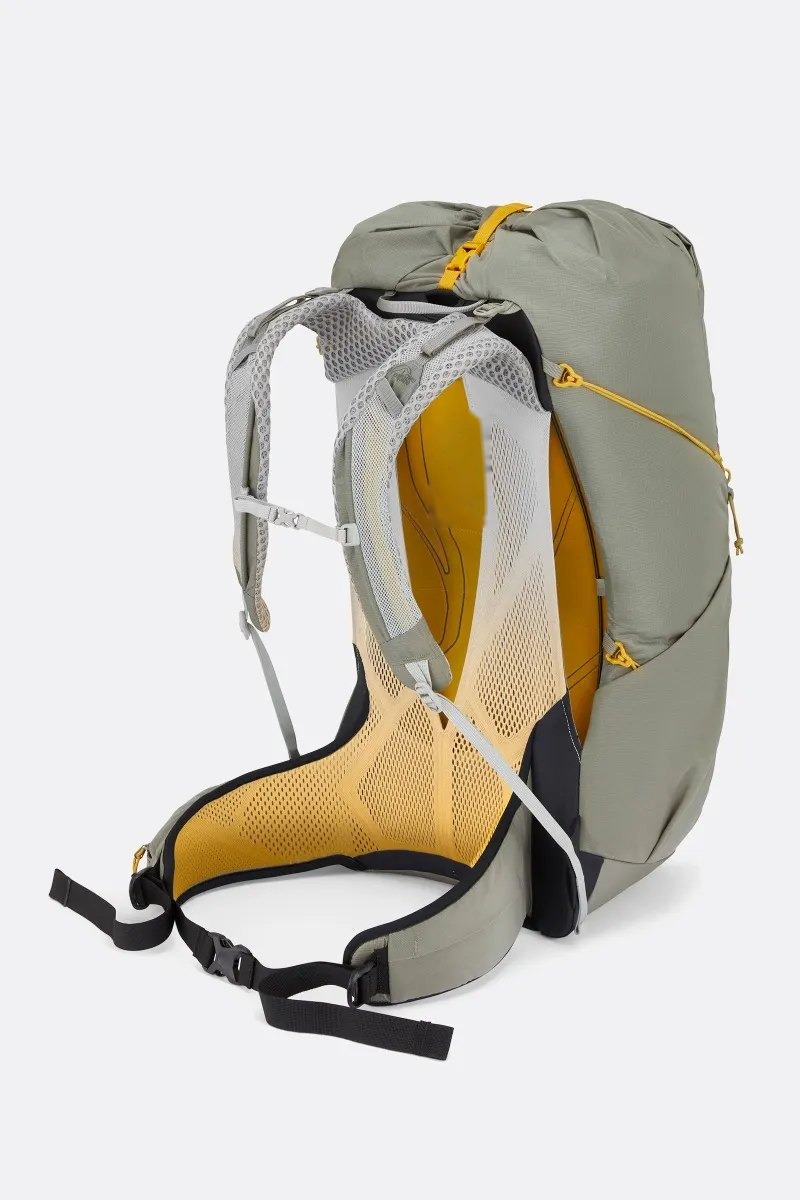
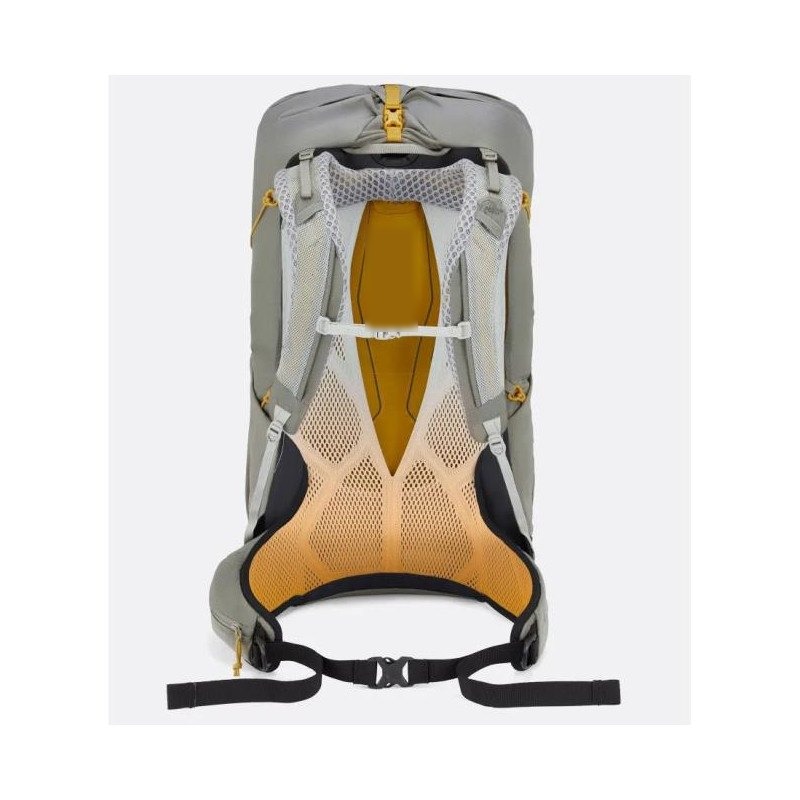
The defining feature of this pack is its back. Instead of foam pads pressed against your spine, it uses a curved spring-steel frame that holds a tensioned mesh panel. Your back touches only the mesh, and there is an open channel between the mesh and the pack body. The frame curves the pack bag away from you, so warm air can move through that channel rather than being trapped against your shirt. In effect, the gap works as a convection channel that lets excess heat escape.
The mesh and harness are not cut and sewn from many layers of mesh and foam. The back panel is knitted as one shaped piece. Different knit structures in different zones give stability where the pack needs to hold its shape, and flexibility where it needs to follow your body. The yellow-and-white honeycomb knit visible in the photos is that knitted panel.
How much weight can it carry comfortably?
A thin perimeter wire and a heavy stay system do not handle load in the same way. Try the pack with the weight you actually carry. Check whether the hip belt stays on the hips, whether the shoulders carry excess pressure and whether the mesh gap closes when the bag is full. Do not infer a load rating from capacity or frame material alone.
Two back lengths, no adjustment
The 36-litre pack comes in two fixed back lengths: M (48 cm) and L–XL (53 cm). There is no sliding torso adjustment. This keeps weight down and removes parts that can slip, but it means the buyer must pick the right size. For brands, this is a common trade-off in lightweight packs. Adjustable harnesses suit retail shelves where one size must fit many people. Fixed sizes save weight and cost, but they need clear sizing guidance.
03
Materials: coated nylon ripstop
A coated 100D nylon ripstop shell and a polyester lining are one way to keep panel weight down. Review the shell, coating and lining as separate components: the coating affects water resistance, while fabric construction and seam design affect durability.
What 100D means in practice:
- Light, but not fragile. 100D sits between ultralight fabrics (20D–70D) and heavy daypack fabrics (210D–500D). It is light enough to keep the whole pack at about 815 g while being robust enough for normal trail use.
- Ripstop grid. The reinforced grid limits how far a small tear can spread, which matters on a pack that will brush against rock and branches.
- Coating for weather. The coating adds protection. The pack is not sold as waterproof, and it does not include a built-in rain cover, so a separate cover or liner is a sensible addition for wet climates.
- Recycled content. For buyers and brands that care about recycled materials, a fully recycled main fabric is a clear selling point rather than a small percentage blend.
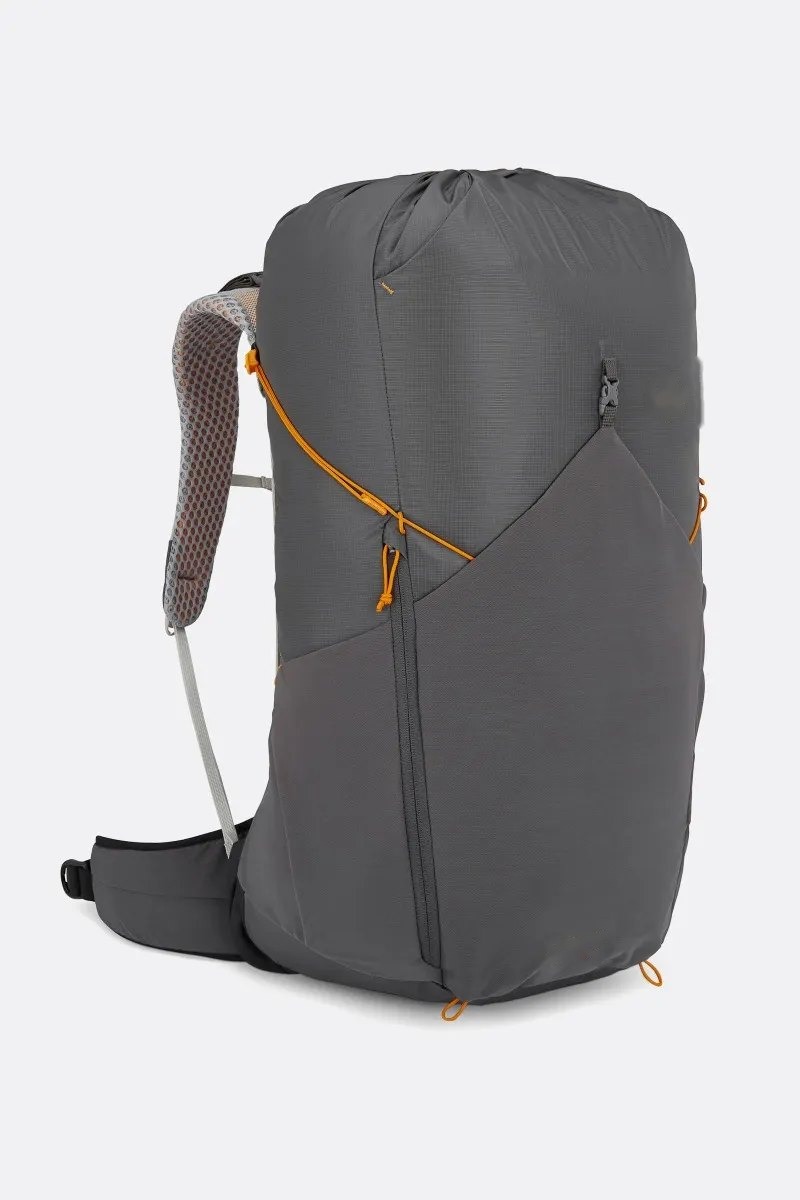
The two colourways are a soft grey-green and a dark graphite grey. Both use the same yellow drawcords, zip pulls and yellow knitted back panel. That small amount of bright colour on a calm base is what gives the pack its "dopamine" look without making it loud.
04
Storage layout: simple, with the right pockets
The pack has six pockets in total. Each is placed so it can be reached without taking the pack off, or with the least fuss when you do.
- Main compartment with drawcord closure. A single large compartment closed with a drawcord and weather flap. Drawcords are lighter and simpler than zips and let you overfill the pack a little.
- Large front stash pocket. A tall front pocket with a vertical zip, sized for a map, a thin jacket or gloves.
- Two stretch side pockets. Each holds a one-litre wide-mouth water bottle or a small dry bag.
- Two hip-belt pockets. One zipped and one open, for snacks, a phone, a compass or sunscreen.
- Internal zipped pocket. For keys, cards and items you do not want loose in the main bag.
- Hydration sleeve. Takes a reservoir of up to 3 L, with dual hose exits so the drinking tube can run over either shoulder.
There are also trekking-pole attachment points. The shoulder straps have small yellow-zipped pockets and loops where a phone or a key leash can sit, and the sternum strap keeps the harness stable on uneven ground.
05
Who is it for?
This 36-litre pack suits:
- Day hikers who carry a full kit. Thirty-six litres is generous for a day hike. It leaves room for a warm layer, waterproofs, lunch, water and a first-aid kit without packing everything tightly.
- Lightweight overnighters and fastpackers. With a compact sleeping bag and shelter, an experienced lightweight hiker can use it for one or two nights in mild weather.
- Hikers who overheat. The suspended mesh back is the reason to choose this pack. If a sweaty back is your main complaint with daypacks, this design addresses it directly.
- People with pressure-sensitive shoulders. The frame and hip belt take some load off the shoulders, which suits hikers who cannot get on with soft, frameless packs.
- Buyers who want a calm look with some colour. The grey-green and graphite bases are muted enough for travel and town, while the yellow details stand out in photos and on the trail.
It suits less well:
- Hikers whose regular load calls for a stiffer frame and a more supportive hip belt.
- Those who need a fully waterproof pack without adding a liner or cover.
- Users who need an adjustable torso length because they fall between sizes.
06
Pain points it solves
Sweaty back. Conventional daypacks press padded foam against your back. On warm climbs, that foam traps sweat. The suspended mesh and convection channel keep the pack body off your shirt.
Heavy "ultralight" packs. Many packs advertised as light still weigh well over a kilogram once a frame and ventilated back are added. At about 815 g, this pack keeps both features within a weight that most lightweight hikers accept.
Too many features. Lids, extra zips and adjustment systems add weight and more things that can break. This pack keeps one main opening, six useful pockets and no torso adjuster.
Reaching essentials on the move. Hip-belt pockets, shoulder-strap pockets and stretch side pockets mean water, snacks, phone and navigation tools are reachable without stopping.
Material claims. If recycled nylon is specified, record the fibre percentage and the supplier documentation for the exact fabric lot.
07
Selling points and advantages
- Ventilation as the headline feature. The suspended knitted back is visible, easy to explain and easy to feel in a shop.
- Low weight for a framed, ventilated pack. About 815 g for 36 L with a spring-steel frame.
- Clean, honest layout. Six pockets, each with an obvious job.
- Coated ripstop shell. 100D nylon keeps the shell light; check wear where the pack meets rock or the ground.
- Colour that photographs well. Bright yellow details on a calm base give the pack a distinctive look online and on the trail.
- Two sizes. The two fixed back lengths make loaded fit checks more important.
08
Limitations worth knowing
- Load range needs checking. Compare the pack with a stiffer support system if the hip belt sags or the mesh bottoms out.
- No rain cover included. Budget for one if you hike in wet regions.
- No back-length adjustment. Try both sizes if possible.
09
What brands can learn from this pack
This 36-litre pack is a useful reference for any brand planning a lightweight hiking pack:
- Pick one headline feature and build around it. Here it is ventilation. Every other choice (simple main bag, few pockets, light fabric) supports that headline rather than competing with it.
- Use colour where it costs little. Drawcords, zip pulls and the knitted back panel carry the bright colour. The main fabric stays neutral, which keeps fabric minimums and stock risk manageable while still giving the product a recognisable look.
- Choose fabric weight for the job. 100D ripstop is a balanced choice for a 36 L pack that should weigh under a kilogram but still survive normal trail use.
- Decide early: fixed sizes or adjustable back. It affects the frame, the tooling, the size curve in your order and how retailers display the product.
- Make recycled content a real claim. A 100% recycled main fabric is a stronger message than a small blend, but it needs a traceable fabric supply.
10
Building a similar pack with JKPD
Quanzhou Junkaipengda Special Equipment Co., Ltd. (JKPD) is a textile bag manufacturer in Hui'an County, Quanzhou, Fujian, China. We produce outdoor, business, leisure, student and tactical bags, as well as pet harnesses, for overseas brands and distributors on an OEM and ODM basis. Our factory is certified to ISO 9001, ISO 14001 and ISO 45001.
For a brand that wants its own lightweight, ventilated hiking pack along these lines, a useful starting brief includes:
- Target capacity, target weight and the load range the pack should carry comfortably.
- Back system type: suspended mesh on a wire frame, frame sheet with padded back, or frameless.
- Fabric map by panel: main body, bottom, pockets, lining, with denier and coating for each.
- Fixed sizes or an adjustable back length, and the size split for the order.
- Pocket list and hardware preferences (buckles, zips, drawcords, cord locks).
- Colourways, including which details carry accent colours.
Our standard terms for a new style:
- MOQ: 500 pcs per style.
- Price: quoted per style, based on materials and construction.
- Sampling fee: USD 300 per style.
- Lead time: usually 60–120 days, depending on order quantity.
We do not copy other brands' designs, logos or protected features. We help clients develop their own product from their brief and their brand identity.
Discuss your bag development project
ANSON XIE
General Manager & Founder
Quanzhou Junkai Pengda Special Equipment Co., Ltd.
Email: ansonxie@jkpdtime.com
Phone: +86 177 5095 3355
WhatsApp: +86 177 5095 3355
Factory address: Floors 2–4, Building 1, Phase I, Huixin Intelligent Manufacturing Industrial Park, Hui'an County, Quanzhou, Fujian, China