
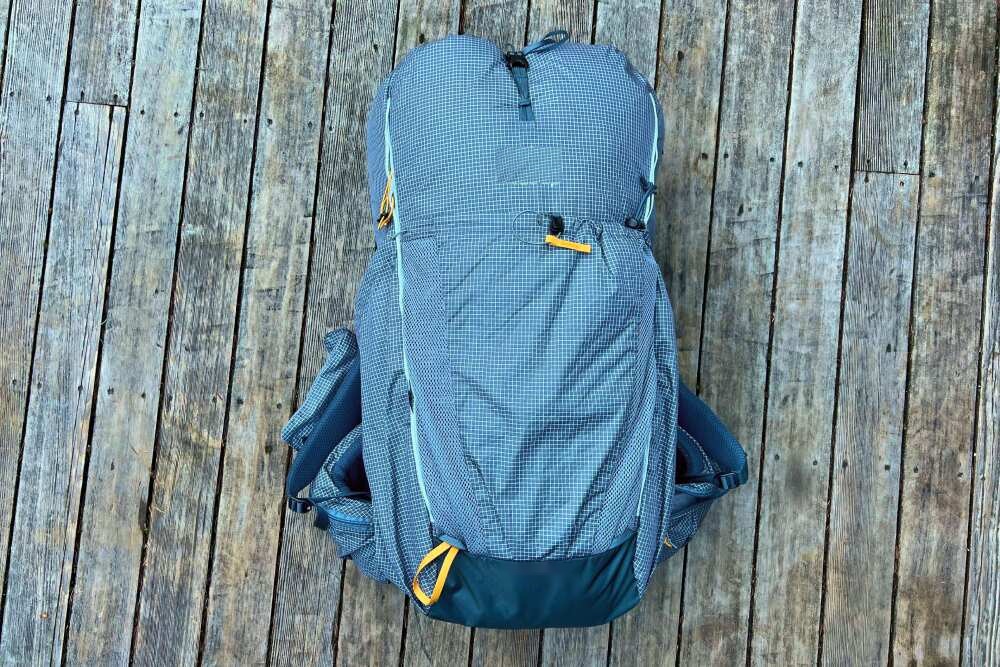
A roll-top trekking pack can remove the lid and torso adjustment while keeping a steel frame, padded belt and accessible exterior pockets. The compact hardware and fixed torso simplify the layout, but shift more of the fit decision to the choice of size.
01
At a glance
| Feature | S | M | L |
|---|---|---|---|
| Volume | 49 L | 50 L | 51 L |
| Torso length | 46 cm | 48 cm | 50 cm |
| Hip-belt size | 81–102 cm | 86–107 cm | 91–117 cm |
| Frame | Internal spring-steel perimeter wire, wishbone shaped, not removable | Same | Same |
| Main fabric | UHMWPE-reinforced nylon ripstop | Same | Same |
| Base fabric | Reinforced nylon base | Same | Same |
The reference varies by size in storage volume and torso length. Use the same ready-to-carry configuration when measuring capacity, and confirm whether the collar and pockets are counted in the number.
02
Why keep the frame in a stripped-down roll-top?
The useful question is what was removed and which jobs still need doing.
A top Y-strap takes the place of the lid. The torso is fixed; belt pockets are sewn on and a side cord replaces a second compression point. A hanger and hose ports allow a reservoir route without adding a dedicated inner sleeve.
The spring-steel frame, padded back and shaped hip belt still provide a path for the load. At a prototype review, compare that path in the full and half-packed configurations.
03
Functions and features
Roll-top closure and the top Y-strap
The roll-top clips above the opening rather than to the sides. It can adjust the volume, but check whether the top can be secured when the upper bag is lightly filled. A narrow Y-strap may not take out the slack alone.
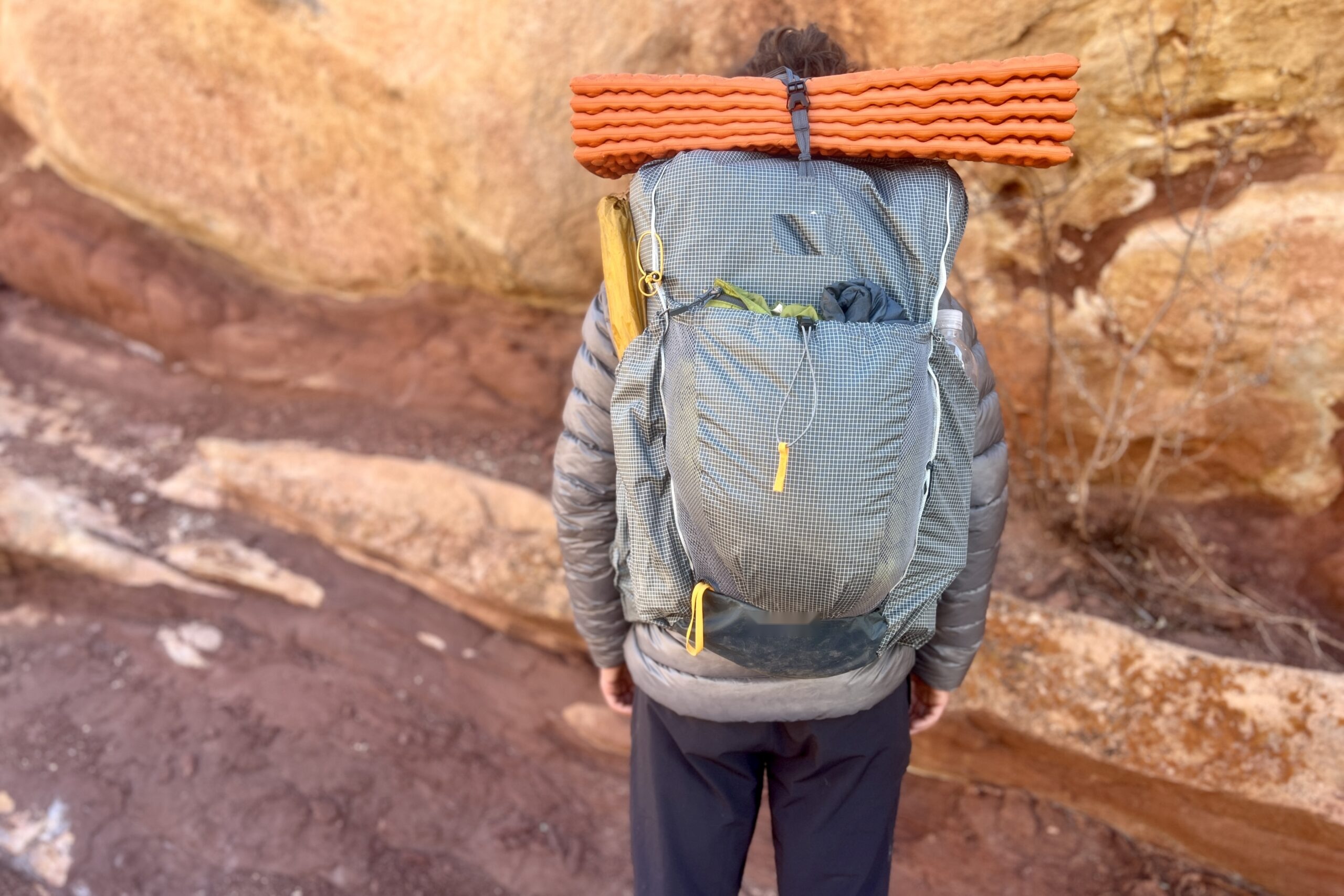
The Y-strap can support a foam pad or similarly bulky item. Test the intended item for lateral movement and check that it does not prevent the roll-top from closing.
The main compartment is a top-access tube. The hose ports and hanger provide a route for a reservoir; check the reservoir envelope against the frame wires because there is no sleeve.
Exterior pockets and clip-on accessories
Beyond the main compartment, the exterior layout provides a front pocket, bottle sleeves, tall side pockets and belt pockets. Clip-on attachments add storage where needed.
The front pocket is a stretch pocket with a drawcord top and mesh side panels, so damp or frequently used items can be stowed without opening the pack and wet items can drain and dry. It shrinks when the main compartment is full, and the mesh side panels are a snag risk, as mesh always is.
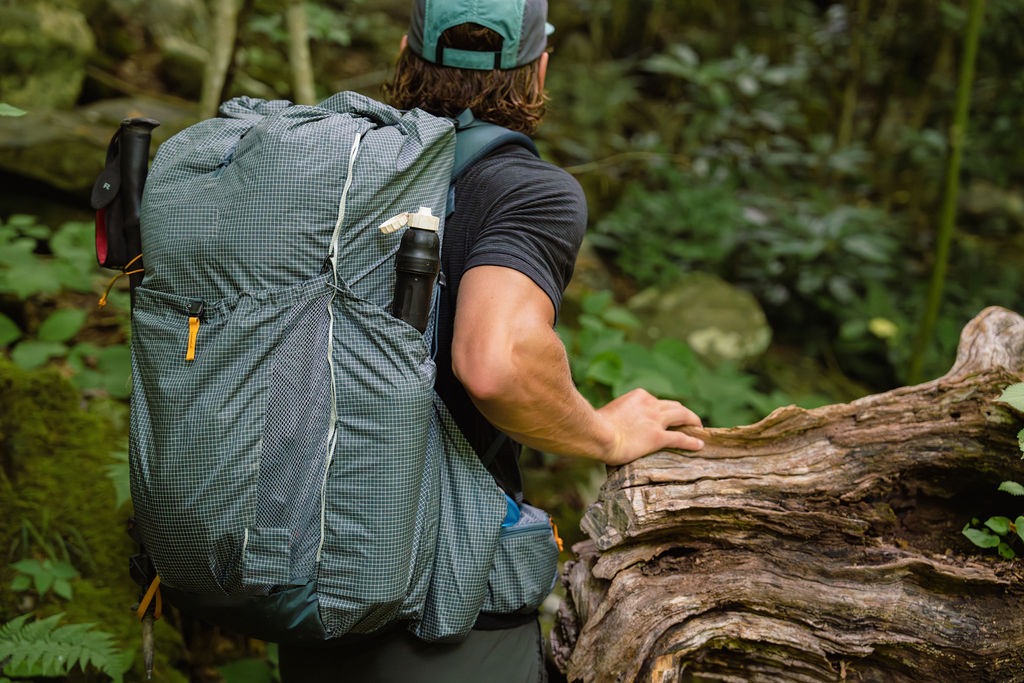
The sleeves angle forward near the belt to make a bottle easier to reach on the body. Check the bottle diameter, loaded opening and whether the belt gets in the way while reinserting it.
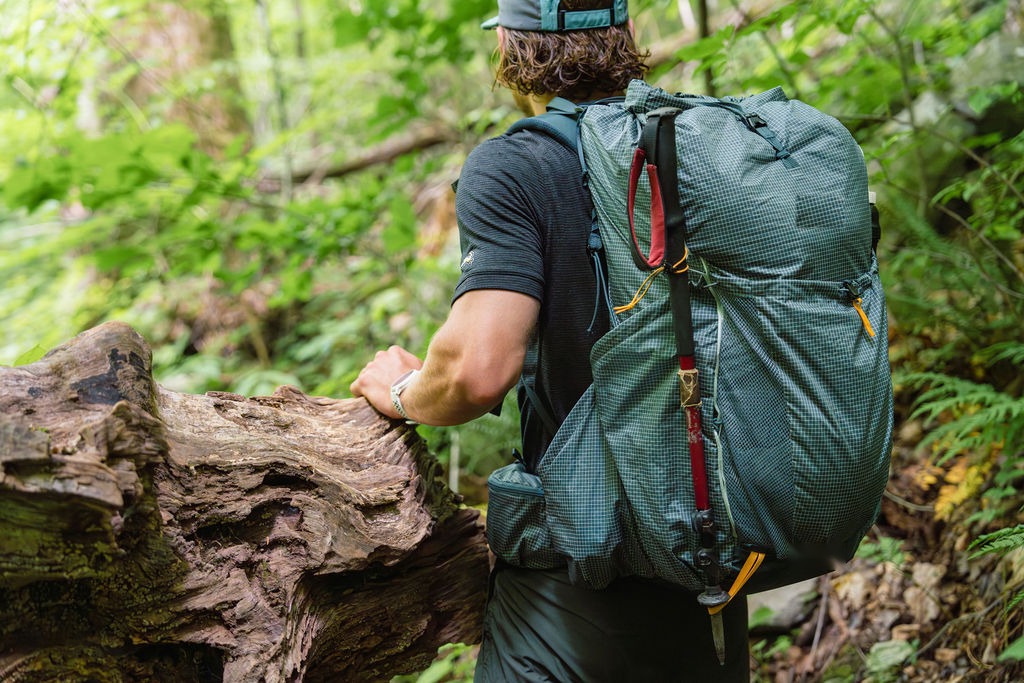
Tall side pockets can take longer items secured by a side cord. The belt pockets are sewn on, and narrow webbing along the front pocket can anchor compression or lashing points. Check the actual pole or tool length before deciding where the attachment belongs.
A detachable mesh shoulder pocket and hanging mesh sack add small-item storage. Compare phone fit, protection and motion when the sack is loaded; detach the accessory if its movement outweighs the extra space.
Fixed torso and the wishbone steel frame
Torso length is fixed, so use a torso measurement and try the size loaded. Check where the hip belt rests and where the load lifters leave the shoulder strap.
The frame is a lightweight spring-steel perimeter wire, shaped like a wishbone and running around the inside of the pack. It is not removable. It gives the pack torsional flex — it moves with the body — and the horizontal rigidity that load lifters need. The load lifters anchor to the top of the frame, above the shoulder straps, so tightening them pulls the load in towards the shoulders instead of just pulling on fabric.
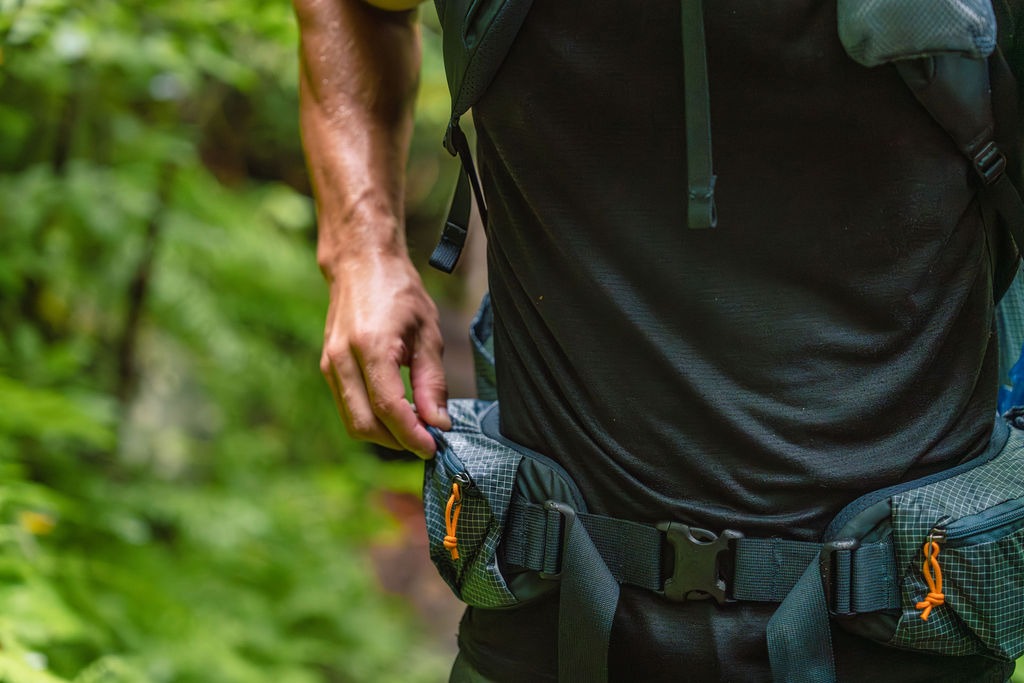
The belt joins the bag directly, with contoured padding, pull-forward straps and a central buckle. Check contact at the hips with the intended load and test the buckle in gloves.
The back is padded foam under mesh rather than a suspended air gap. The shoulder straps are J-shaped with a sliding sternum strap; check the slider's retention during adjustment and wear.
04
Fabric and material combinations
The fabric is the most technical part of this pack, and the reason it can be this light with a frame.
- Main body: a fine-grid nylon and UHMWPE ripstop. Verify fibre content and strength on the selected fabric rather than inferring performance from the grid alone.
- Base: a reinforced nylon panel at the ground contact area.
- Front and side pockets: stretch mesh, keeping weight down and letting wet items drain; the front pocket has a solid face with mesh only at the sides, so items lashed to the front do not press through mesh.
- Back panel and straps: foam padding covered in breathable mesh, with a contoured, pre- curved hip belt.
- Frame: a single spring-steel perimeter wire, internal and non-removable.
- Hardware: review cord fittings, zipper pulls and buckles with the intended gloves.
Water can enter through seams, hose ports or an improperly closed roll-top. Test the completed bag before claiming protection; confirm the size and access of any protective liner.
05
Who is it for?
- Backpackers moving from a conventional pack to lightweight gear, who want a frame, load lifters and a real hip belt.
- Hikers with a settled, light kit, who pack the main compartment full and need neither a lid nor an adjustable torso.
06
Pain points it solves
- Bottles that cannot be reached while walking. The angled sleeves sit just behind the hip belt, so a bottle can be pulled out and replaced without taking the pack off.
- A lid that is always there whether it is needed or not. There is no lid to carry or lose; the Y-strap covers the one job a lid does that matters, holding a bulky item on top.
07
Design strengths
- A fine-grid ripstop body paired with a separate base panel.
- Angled bottle sleeves plus separate external and belt storage.
- A top Y-strap that holds a foam pad or a canister where a lid used to be.
08
Limitations to keep in mind
- Do not assume waterproofness from the face fabric: the construction includes sewn seams and hose ports.
- Weak compression. One thin cord per side and a roll-top that buckles only on top make it hard to compress a half-empty pack, which is why the pack is awkward on short trips.
- A clip-on shoulder pouch may be tight around a large phone, and a hanging sack needs a check for movement.
- The front pocket shrinks when the pack is full, because the main compartment and the front pocket compete for the same space.
- A fixed torso makes a loaded fit check part of size selection.
09
What the design teaches
Removing the lid, an adjustment mechanism and secondary compression can reduce parts while keeping the frame, back panel and belt. Check that the remaining straps still control the load across the expected range.
State volume by configuration, distinguish collar and pocket volume from the main bag, and measure the weight with the same attachments installed. Treat load support as a separate sample check.
For brands, the takeaway is that a lighter version of an existing pack is a real product when the subtractions are chosen carefully. Remove the lid and the adjustment, keep the frame and the belt, and the result is a pack with its own audience rather than a compromised copy.
10
Prototype brief
A lightweight framed trekking pack is a demanding brief, because every gram saved has to come from somewhere, and the pack must still carry well at its rated load. Useful inputs include:
- Target weight, capacity and recommended maximum load, by size, in full and stripped configurations.
- Frame design: wire or stay material and shape, how the frame sits in the back panel, and how the load lifters connect to it.
- Fabric by zone: high-strength ripstop for the body, heavier nylon for the base, mesh for the pockets, and the water-resistance target — including whether seams should be taped.
- Closure and access: roll-top volume, top-strap design for bulky items, and the split between the main compartment and the pockets.
- Pocket layout: bottle-sleeve angle and size, front pocket construction, hip-belt pockets, and hydration options.
- Sizing: torso lengths and hip-belt sizes, fixed or adjustable, and which sizes the line should cover.
Related guide: Inside a 50 L Ultralight Roll-Top Pack: Frame and Pocket Trade-Offs
Discuss your bag development project
ANSON XIE
General Manager & Founder
Quanzhou Junkai Pengda Special Equipment Co., Ltd.
Email: ansonxie@jkpdtime.com
Phone: +86 177 5095 3355
WhatsApp: +86 177 5095 3355
Factory address: Floors 2–4, Building 1, Phase I, Huixin Intelligent Manufacturing Industrial Park, Hui'an County, Quanzhou, Fujian, China