
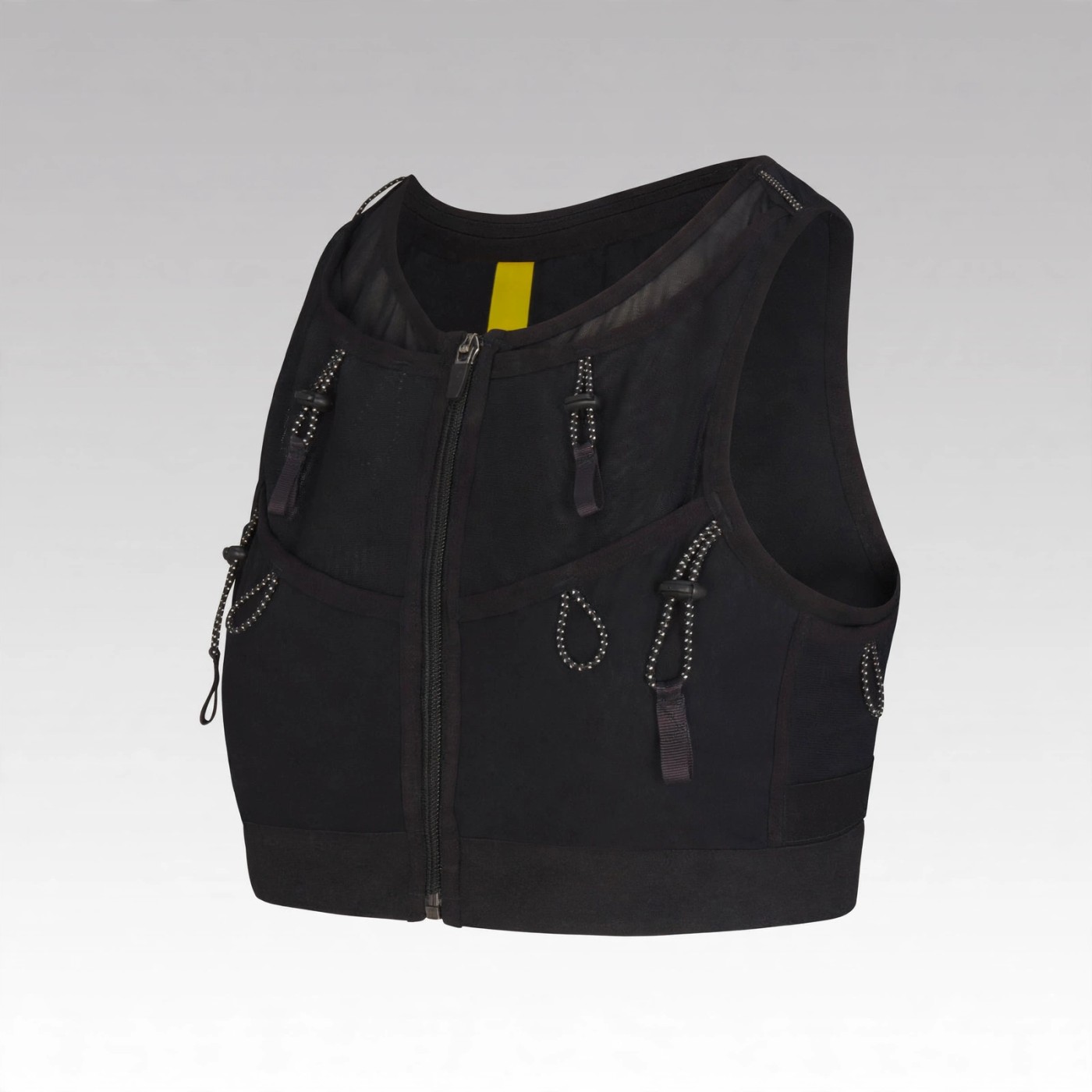
This compact vest uses stretch mesh and a full-length front zipper instead of adjustable sternum straps. The mesh holds a small load close to the torso. There are still small elastic loops at the flask and pole carriers; they do not adjust the main fit.
Chest sizing therefore does the work that hardware does on an adjustable vest. This 3 L reference design shows what a single closure can simplify, and where it makes fit and loaded access less forgiving. It is not a JKPD product.
01
At a glance
| Feature | Reference design |
|---|---|
| Type | Minimalist zip-front running vest, sized by chest circumference |
| Capacity | 3+ L |
| Weight | Around 99 g (3.5 oz), men's size 6 |
| Front hydration | Two 500 ml soft flasks |
| Reservoir | Rear pouch can fit a 1–1.5 L reservoir; check loaded carry |
| Sizes | 12 numbered sizes, men's and women's, by chest circumference |
| Closure | Full-length front zip with a semi-locking pull; no straps or buckles |
| Materials | Stretch power mesh; nylon zipper |
Weight and usable volume vary with size. Measure both with the intended configuration, and state whether the flasks are included in the weight.
02
Design positioning: the vest is the adjustment
Every other vest in this series adjusts to the runner. This one does not, because it does not need to. The whole vest is made of thin stretch mesh that expands to take the load and compresses to hold it still. Put a phone, two flasks, gels and a jacket in it, and the mesh grows around them. Take things out as the run goes on, and the mesh shrinks back. There is never a strap to tighten, because the fabric itself is the tension system.
A compression fit depends on choosing the right size and on how the fabric recovers. A fit that feels secure with dry, full pockets may behave differently after water is used or the fabric is wet.
The vest is also worn high on the body, higher than most vests, so the mouthpieces of the flasks sit close to the mouth. That is part of the design: water is always there without reaching for anything.
03
Functions and features
Two front flask pockets
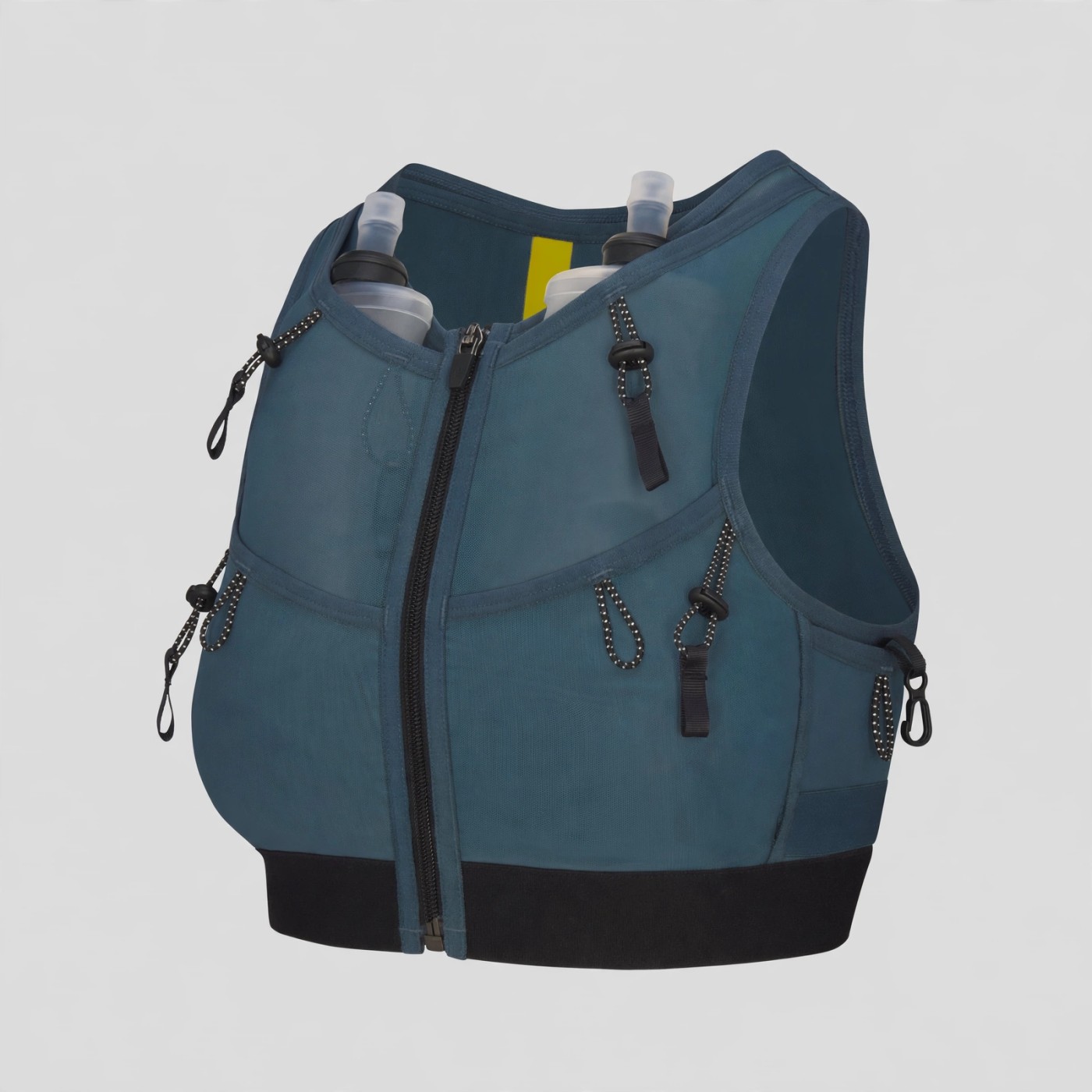
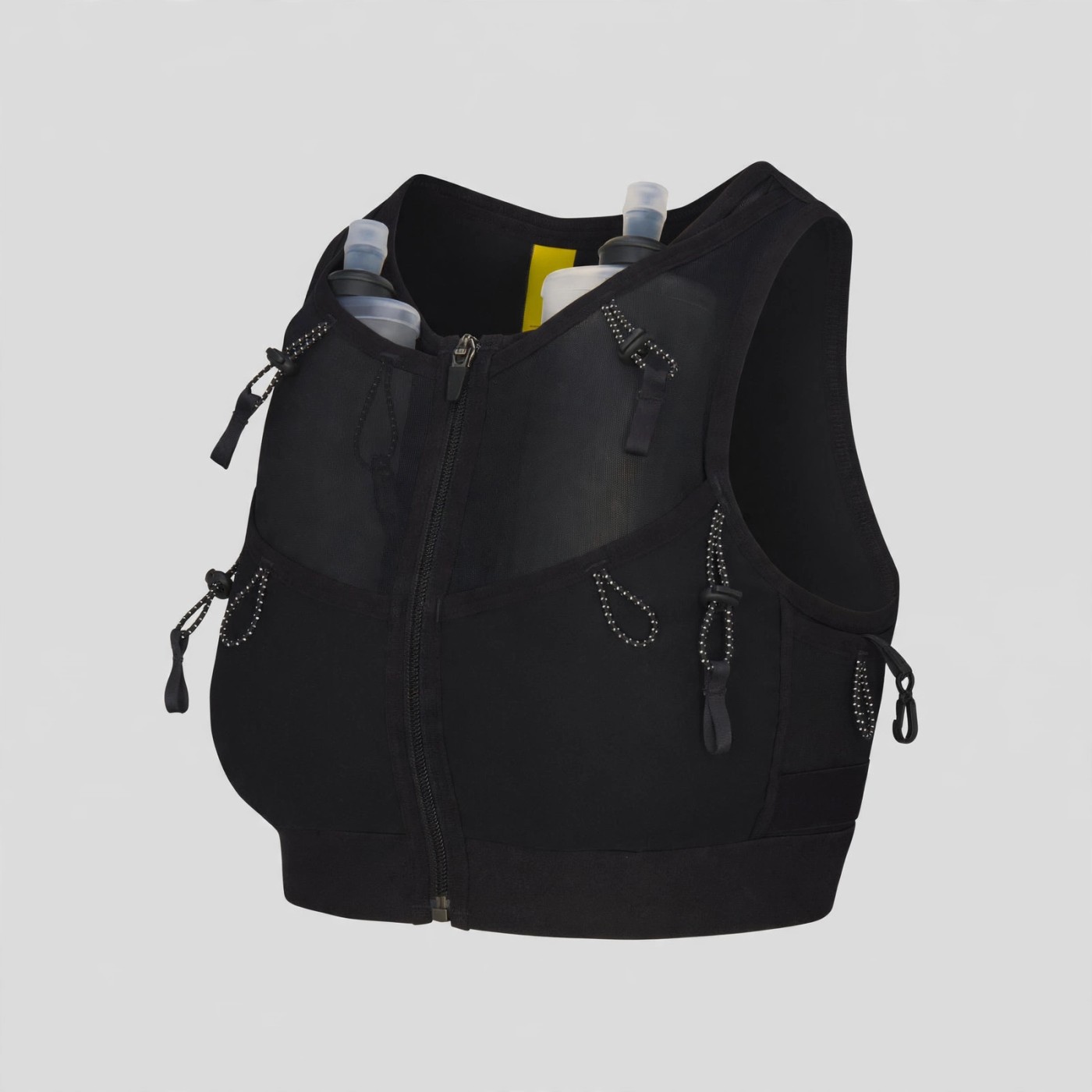
Two drop-in chest pockets carry 500 ml soft flasks. Small elastic loops hold the caps high near the mouth. Try full and partly empty flasks to see whether they need to be reseated to limit movement.
Phone and small pockets
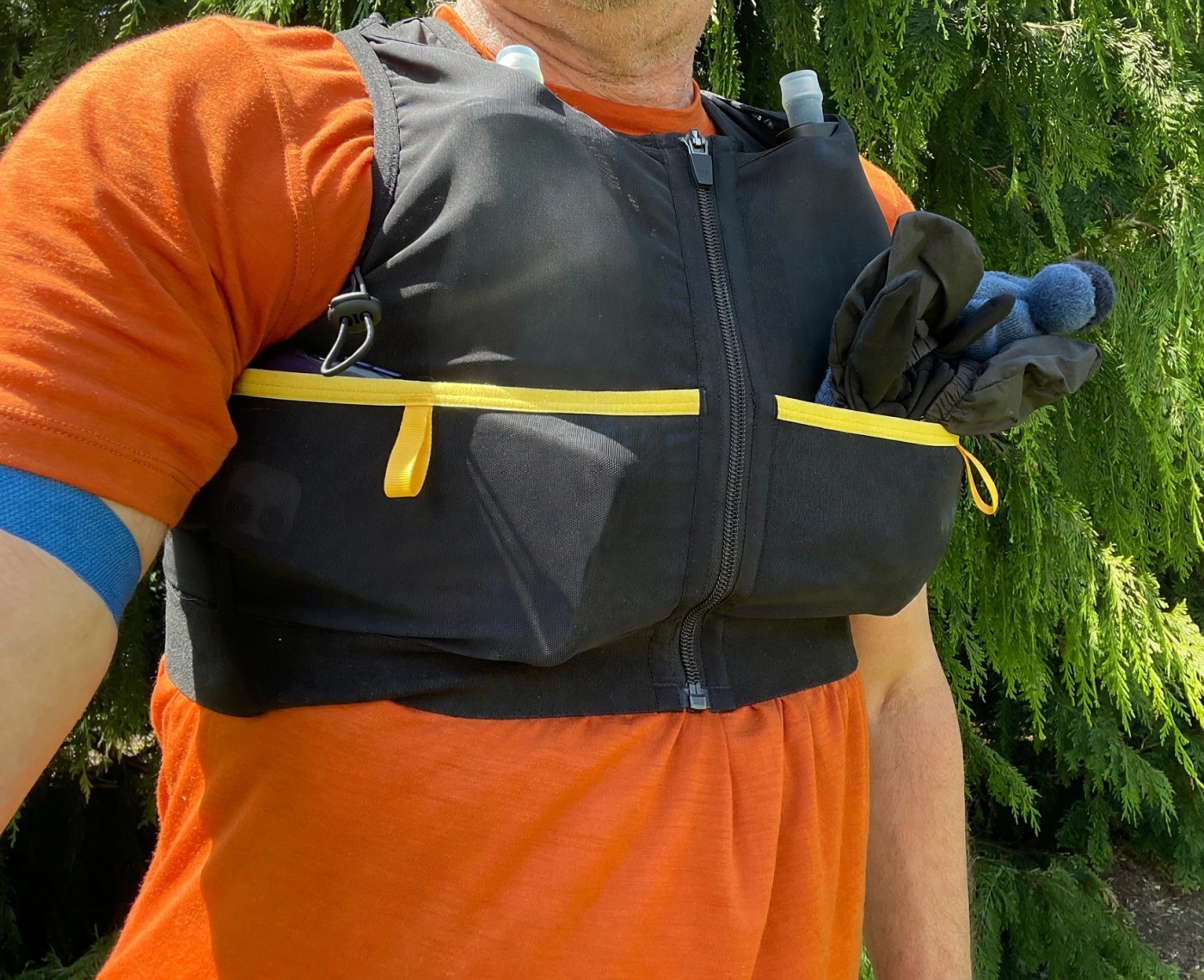
Stretch pockets next to the flasks take a phone; smaller pockets behind them take gels, keys and similar items. Use the intended phone case and check whether the pocket keeps a useful grip once the mesh is wet.
Rear pouches: a shoulder pouch and a deep drop-in pocket
Up high at the shoulders is a rear pouch with openings on either side, which works well as a place for a jacket. The runner can reach back to retrieve it or return it while running, which matters on a long run when a layer comes off halfway up a climb. Smaller items are harder to reach in this pouch without taking the vest off.
A deeper drop-in rear pouch with a top clip can take clothing or a small 1–1.5 L reservoir. It usually needs to be accessed with the vest off. A reservoir may fit geometrically, but check movement and comfort; the layout is designed around front flasks.
Trekking pole carriers
A backed stretch loop and an upper elastic loop hold folding poles at the back. Verify the grip and folded length, particularly for poles with bulky handles.
The zip is the whole closure system
A nylon front zipper with a semi-locking pull is the entire closure. Pull force can rise when the vest is full or the mesh is new. Check one-handed closing with the intended contents, and confirm that the slider stays closed in use.
The closed zipper fixes the fit. There is no separate adjustment to loosen the vest while running, so check chest expansion with both front pockets and the rear pouch loaded.
In the cut with a lower chest band, the elastic band helps distribute tension and keep the vest in position. Check whether the band stays flat across sizes and during arm movement.
Safety details and small hardware
The vest carries an emergency whistle, reflective elements for low-light visibility, an internal micro clip, a rear pocket security clip, and drink tube lock points for a reservoir hose. Small yellow webbing loops sit over the front pockets. They are handy for opening the pockets, and they are also good for clipping items to the front. None of this is heavy or complicated. The whole vest is built from a small number of parts, and every part has a job.
04
Fabric and material combinations
Thin stretch power mesh forms the body. It needs to recover after the pockets are loaded and unloaded, and retain enough tension when wet. Compare wet recovery, drying time and seam comfort on the sample.
Nylon zipper. The only hard component of note is the nylon front zipper with its semi-locking pull. There are no buckles, no cord locks of any size, and no rigid panels anywhere on the vest.
Elastic bindings. The edges of the vest use soft elastic bindings. They are wide enough to spread pressure, and they give the vest its clean, finished edge. On the women's version the lower binding does the work of a support band. Reflective print. Reflective elements are printed onto the mesh rather than sewn on as tape, which keeps the vest light and preserves the stretch.
05
Who is it for?
Minimalist racers. The obvious user is a runner who wants the smallest, lightest vest that will still carry water, a phone and food, and who hates the feeling of wearing a vest at all.
Runners who hate bounce. Anyone who has been annoyed by a pack that moves on every step will appreciate a vest that holds the load by compression alone.
Short and middle-distance trail racers. The 3 litre capacity is enough for races up to around 50 km with aid stations, and for long training runs of two to three hours.
Hot-weather runners. The thin mesh breathes well and holds very little heat, which suits warm conditions.
The slim layout can also be worn under a larger hiking pack for front access. Check overlap between the two sets of straps before using that combination.
It is less suitable for runners who need to carry a lot of warm clothing, for long ultras with heavy mandatory kit lists, and for anyone who wants a reservoir as the main water system.
06
Pain points it solves
Load movement. A close compression fit is meant to reduce movement without a separate tension system. Check full and partially empty flasks and a loaded rear pouch.
Chafing. There are no straps, buckles or hard edges to rub. The soft mesh and elastic bindings sit flat against the body.
Overheating. The thin mesh breathes, and the vest holds very little material against the skin.
Water access. The flasks sit high on the chest with their mouthpieces near the mouth, so the runner can drink without reaching or stopping.
Fit that changes with the load. As food and water are used, the mesh shrinks back and the fit stays close. There is no strap to retighten.
Excess bulk. A small vest is useful when the kit is known to fit; more capacity is preferable if the layers or water cannot be held securely.
07
Design strengths
- Low empty weight: around 99 g for the reference size shown in the specifications, without extrapolating to all sizes.
- Close fit through mesh tension instead of adjustable sternum straps.
- Nothing to fiddle with. One zip is the whole closure system.
- Water at the mouth. Flasks ride high, so drinking needs no reaching.
- Twelve sizes. Precise sizing by chest circumference, in men's and women's cuts.
- Phone disappears. Stretch pockets mould the load to the torso.
- Doubles as a front carry. Works under a bigger pack and as a light summit pack.
- Safety built in. Whistle, reflective details and a security clip.
08
Limitations to keep in mind
Small capacity. Three litres is enough for a short race, but not for long ultras with heavy mandatory kit lists or for cold weather with extra layers.
No structure. The vest is all mesh, with no rigid panels. It cannot hold its shape when empty, and it is not a layer-hauler.
Sizing is unforgiving. Try the chosen size with a full load and a deep breath; confirm that the zipper closes without overstretching the mesh or distorting the pockets.
A small reservoir can fit but can change rear load movement. Check it separately if the layout needs to support it.
The pole carriers suit slim folding poles. Try the intended handle size and check arm clearance.
Front zipper effort can increase under load. Compare first-use and repeated-cycle operation; do not depend on the fit loosening with use.
09
Design lessons
Compression can replace hardware. A stretch body that holds the load by itself can do the job of straps, buckles and cords, and it saves weight and pressure points at the same time.
Sizing is the product. When there is no adjustment, the size range has to be precise. Twelve sizes is not a luxury here. It is the fit system.
Put the water where the mouth is. Wearing the vest high on the body puts the flask mouthpieces within reach of a dip of the head, which is faster than any pocket.
Fewer parts is a feature. A vest with one zipper and no buckles has fewer failure points, fewer pressure points and a lower weight.
Design for the load to change. Mesh should recover as the pockets empty. Specify the kit the vest needs to carry rather than adding capacity the fabric cannot hold steady.
Check zipper effort early. Test a new sample at full load, then repeat after cycling and wetting it.
10
Development checklist
Record these inputs on the sample brief before approving the layout:
- Target capacity, target weight and the races or distances the vest is designed for.
- Size range and the measurement point for each size, since there is no adjustment to hide behind.
- Fabric choices: stretch mesh with real recovery, elastic bindings and zipper type.
- Hydration layout: flask pocket size and number, and whether a rear reservoir pocket is needed.
- Closure system: full-length zip, pull type and whether a locking pull is required.
- Pocket list with approximate sizes and opening directions.
- Pole carry, reflective details, safety whistle, colourways.
Related guide: Trail Vest Zipper Pulls: Reduce Chatter and Keep Grip
Discuss your bag development project
ANSON XIE
General Manager & Founder
Quanzhou Junkai Pengda Special Equipment Co., Ltd.
Email: ansonxie@jkpdtime.com
Phone: +86 177 5095 3355
WhatsApp: +86 177 5095 3355
Factory address: Floors 2–4, Building 1, Phase I, Huixin Intelligent Manufacturing Industrial Park, Hui'an County, Quanzhou, Fujian, China