
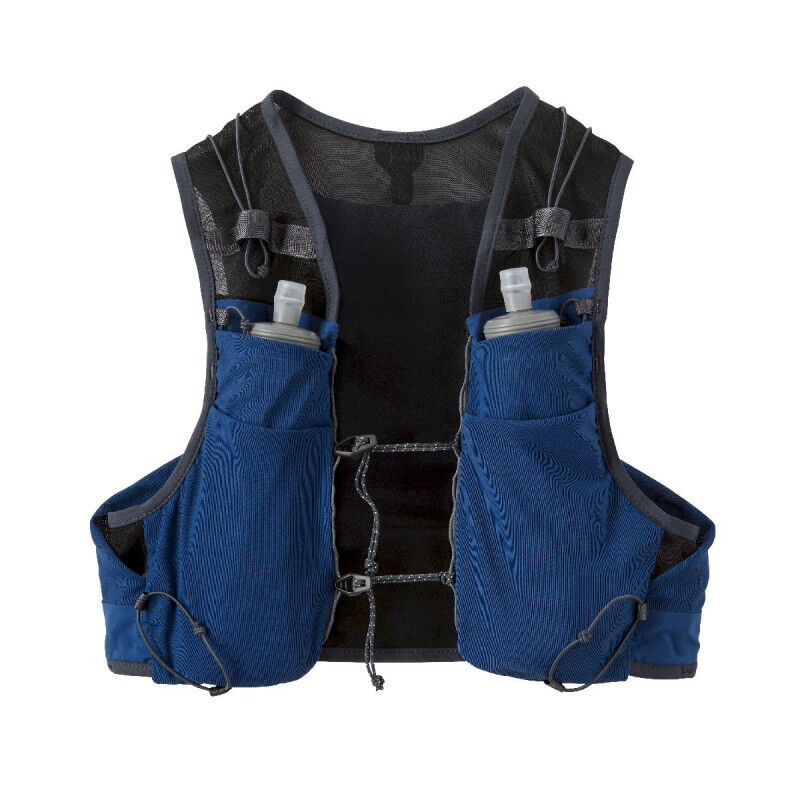
This 3-litre endurance vest uses a short back, two front flask pockets and a small rear zip pocket that doubles as a storage pouch. The design prioritises small items reached without taking the vest off.
01
At a glance
| Feature | 3 L mountain endurance vest |
|---|---|
| Type | Trail running vest, flask-first with reservoir slot |
| Capacity | 3 L |
| Front flask layout | 2 × 500 ml soft flasks |
| Reservoir | Rear vertical reservoir slot |
| Sizes | Unisex XS / S / M / L, by chest circumference |
| Closure | Dual adjustable sternum cords, plus bungee load lifters |
02
Design positioning: a vest, not a pack
The design is intended for a compact kit rather than a full all-day load. Select the actual water, food and shell before deciding whether this layout is sufficient.
That is why the back rides high and short, ending around the mid-back rather than dropping to the waist. A high, short back keeps the shoulders from tiring and leaves the lower back open to the air, which is exactly what a runner wants on a hot climb. The trade-off is capacity: a runner who packs for every contingency, dawn to dusk, will run out of room, and the vest does not pretend otherwise.
03
Functions and features
Two flask pockets, each with a stretch pocket over the top
The two most important pockets are the flask pockets, one on each side of the chest, holding the two 500 ml soft flasks that come with the vest. They sit deep enough that the flasks do not bounce, and they will take flasks of other makes too. Layered over each flask pocket is a second, elastic pocket with a wide opening: phone, gels, a headlamp, gloves, and almost anything the runner wants within quick reach. The two layers are the vest's whole front storage system — simple, with no zips to fumble with while moving.
A long horizontal pocket across the lower back
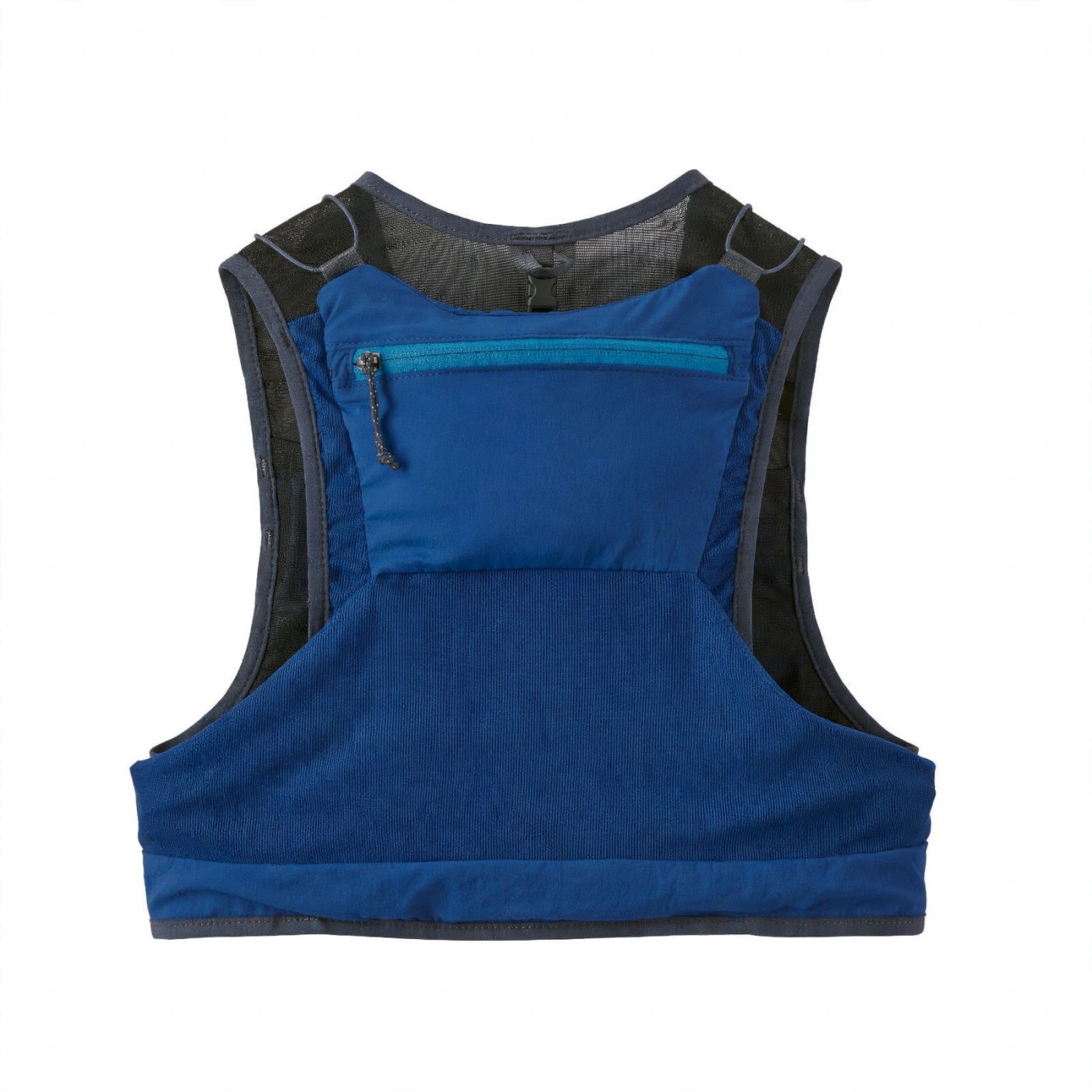
The cleverest pocket is the one across the lower back. It is a long horizontal pocket, open at both ends, that holds bulkier layers such as a rain jacket or a pair of wind trousers. Because it opens on both sides, the runner can reach back with either hand and pull a layer out without taking the vest off — and a hidden flap at the openings helps keep gear inside. It is the pocket that makes a three-litre vest work for a mountain run: the layers go in the back, the food and water stay on the chest, and nothing has to be unpacked to reach anything.
A rear zip pocket that swallows the whole vest
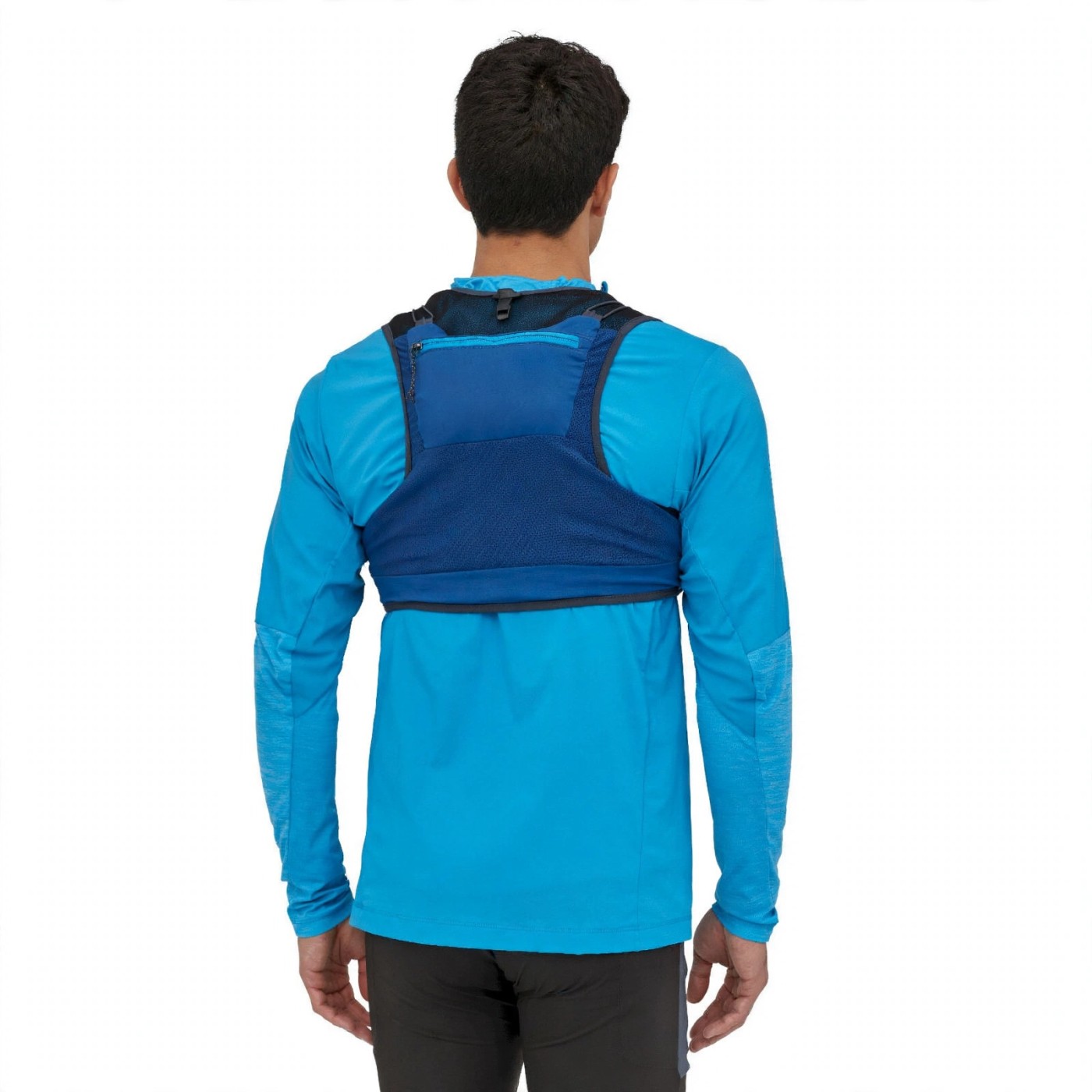
On the outside of the back panel sits a well-sized zipped pocket, for a wallet, keys, a phone, a few first-aid supplies — with a loop to keep a key secure. The same pocket doubles as a stuff sack for the entire vest: the whole thing packs down into it, which makes the vest easy to throw into a travel bag or a suitcase. For a runner who flies to races, that is a real feature, not a gimmick.
A vertical slot for a reservoir
Down the spine of the back panel runs a long vertical pocket that takes a 1 to 1.5 litre reservoir, held up by a loop so it does not slide down. The vest ships with flasks, not a reservoir, so this is a second water system the runner adds when the run needs it — up to 2.5 litres in total with the flasks. The same pocket also works for a filter bottle, a small dry bag with a phone, or a thin insulated jacket, and it can be reached over the top while the vest is still being worn.
Pole carry on the sides, and horizontally in the back
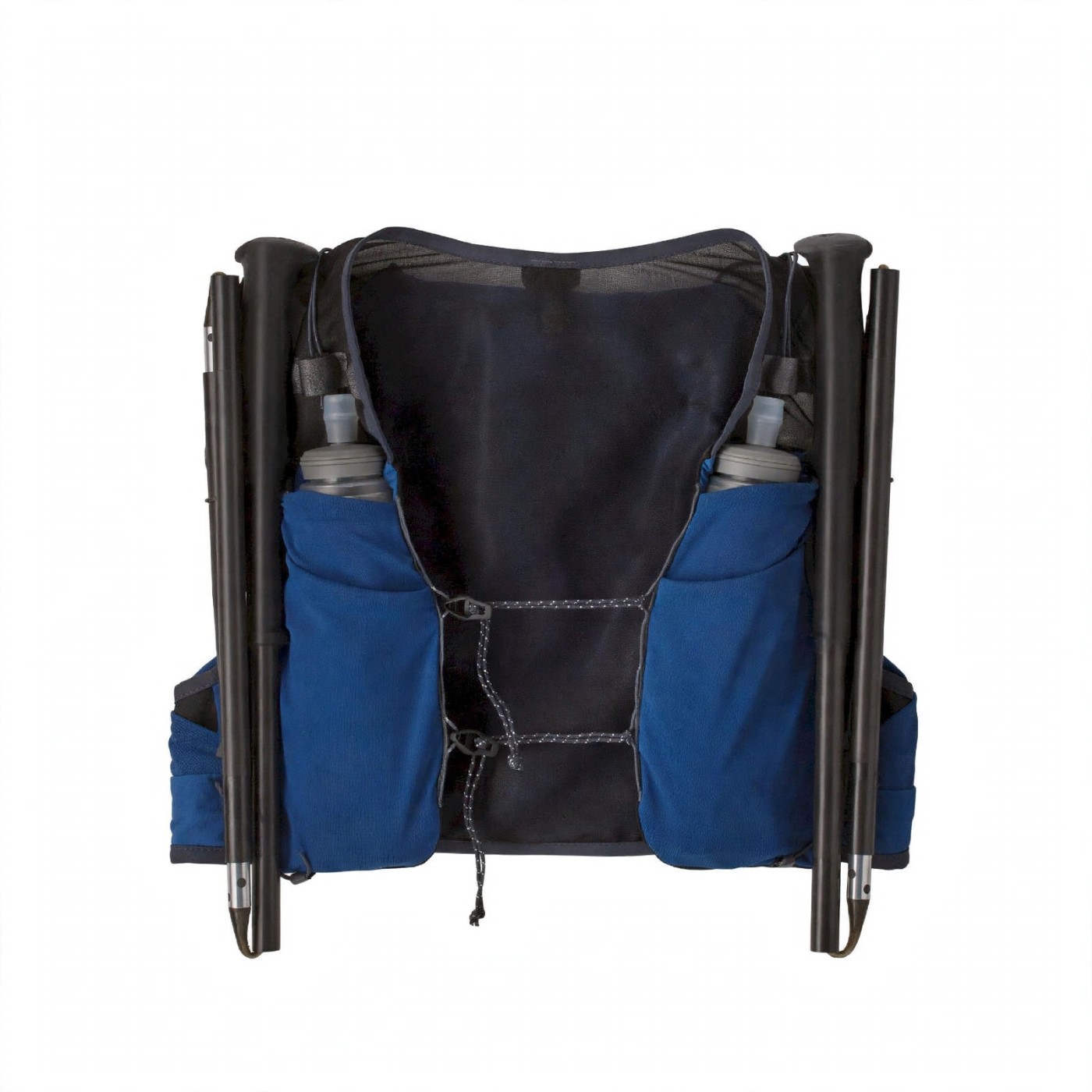
Folded poles sit beside the flask pockets on bungees. Check how the selected poles clear the cap and elbow when extracting or stowing them in a stopped comparison.
A bungee fit system, not straps and buckles
Cord adjustments across the ribs, chest and upper harness act at different points. Check how the fit changes when water is used up. The webbing can also guide a reservoir hose; check that neither the hose nor the elastic tail gets caught where the hooks close.
04
Fabric and material combinations
An open nylon mesh covers much of the body. Look at how the loaded pockets obscure the mesh when checking the ventilation area.
Light stretch panels extend over the mesh. Confirm stretch direction, fibre content and finish from the chosen material specification.
The edges use a soft binding. Check the neck and arm openings with the vest loaded and the wearer in the lightest planned layer.
05
Who is it for?
Hot-weather runners. The mesh body and the high, short back are built for heat. This is the vest for summer training, desert races and any run where overheating is the limiting factor.
Mountain runners on short to medium outings. A few hours in the hills with a light kit: water, food, a shell. The vest holds that list comfortably and stays out of the way on climbs.
Runners who travel to races. A vest that folds into its own rear pocket takes up less space when not in use.
Minimalists. Runners who have learned to carry less and want a vest that enforces the discipline will like the way three litres forces choices.
It is less suitable for dawn-to-dusk mountain days with a full contingency kit, for races with long mandatory kit lists, and for runners with larger upper bodies: the shoulder openings are fixed in size, and the vest's adjustability cannot make up for that.
06
Pain points it solves
Warm conditions. Open mesh and a short back leave more of the lower back exposed.
Flasks that bounce. Deep flask pockets and a close, stretch fit keep the flasks still, as long as the load is balanced front and back.
Poles with nowhere to go. Side bungees and the horizontal rear pocket give folded poles two homes, both reachable without stopping. A vest that is hard to travel with. The rear pocket doubles as a stuff sack, so the whole vest packs down small.
Layers that are hard to reach. The long rear pocket opens on both sides, so a jacket comes out without taking the vest off.
07
Design strengths
- Two 500 ml flasks included. A litre of water on the chest, with a reservoir slot for more.
- A back that breathes. Open mono-mesh and a high, short cut keep the runner cool.
- Pockets that work while moving. Stretch front pockets and a two-ended rear pocket, all reachable on the run.
- Separate side bungees for folded poles. Check the fit and retrieval with the same flask and outer layer that the wearer will use.
- Packs into its own pocket. The whole vest stuffs into the rear zip pocket for travel.
- A close, garment-like fit. Stretch panels and bungees instead of straps and buckles.
08
Limitations to keep in mind
Check whether the hooks stay attached when the chest cords relax or shift with a partly empty load.
Fixed shoulder openings. The vest comes in four sizes, but the shoulder openings do not adjust, so runners with larger upper bodies may struggle to find a comfortable fit even in the largest size.
Three litres is a ceiling, not a starting point. Runners who pack for every contingency will outgrow it on long mountain days; it is built for light, fast outings.
It can bounce when unbalanced. With full front flasks and little weight in the back, the vest can feel bouncy; balancing the load with a phone or keys in the rear pocket settles it.
09
Design lessons
Design the back as a pocket, not a panel. A long horizontal pocket with two openings turns the back of a vest into usable, reachable storage instead of dead space. Make the stuff sack part of the product. A rear pocket that doubles as a stuff sack costs nothing in weight and makes the vest genuinely easier to travel with.
Let the fit be adjusted by bungee, not buckles. Cords that can be tightened on the move, and that take up slack as the load empties, keep a light vest stable without adding hard parts.
Put the mesh where the body sweats. An open mesh body is a bigger comfort win than any feature added on top of a closed fabric.
Check the small hardware when its tension changes. A hook may stay seated while stretched but become loose when a flask empties.
10
Prototype brief
Useful inputs for a compact endurance vest prototype include:
- Target capacity, target weight and the runs or races the vest is designed for.
- Hydration layout: flask pocket shape, reservoir slot size, hose path and bite-valve holder position.
- Size range and the measurement point for each size, including the shoulder opening.
- Fabric choices: open mesh with real airflow, stretch panels with real recovery, soft edge bindings, and water-repellent finish positions.
- Pocket list with approximate sizes and opening directions, including a rear pocket that doubles as a stuff sack.
- Pole carry positions, whistle anchor and colour options.
Related guide: How a 3 L Zip-Front Running Vest Fits Without Sternum Straps
Discuss your bag development project
ANSON XIE
General Manager & Founder
Quanzhou Junkai Pengda Special Equipment Co., Ltd.
Email: ansonxie@jkpdtime.com
Phone: +86 177 5095 3355
WhatsApp: +86 177 5095 3355
Factory address: Floors 2–4, Building 1, Phase I, Huixin Intelligent Manufacturing Industrial Park, Hui'an County, Quanzhou, Fujian, China