
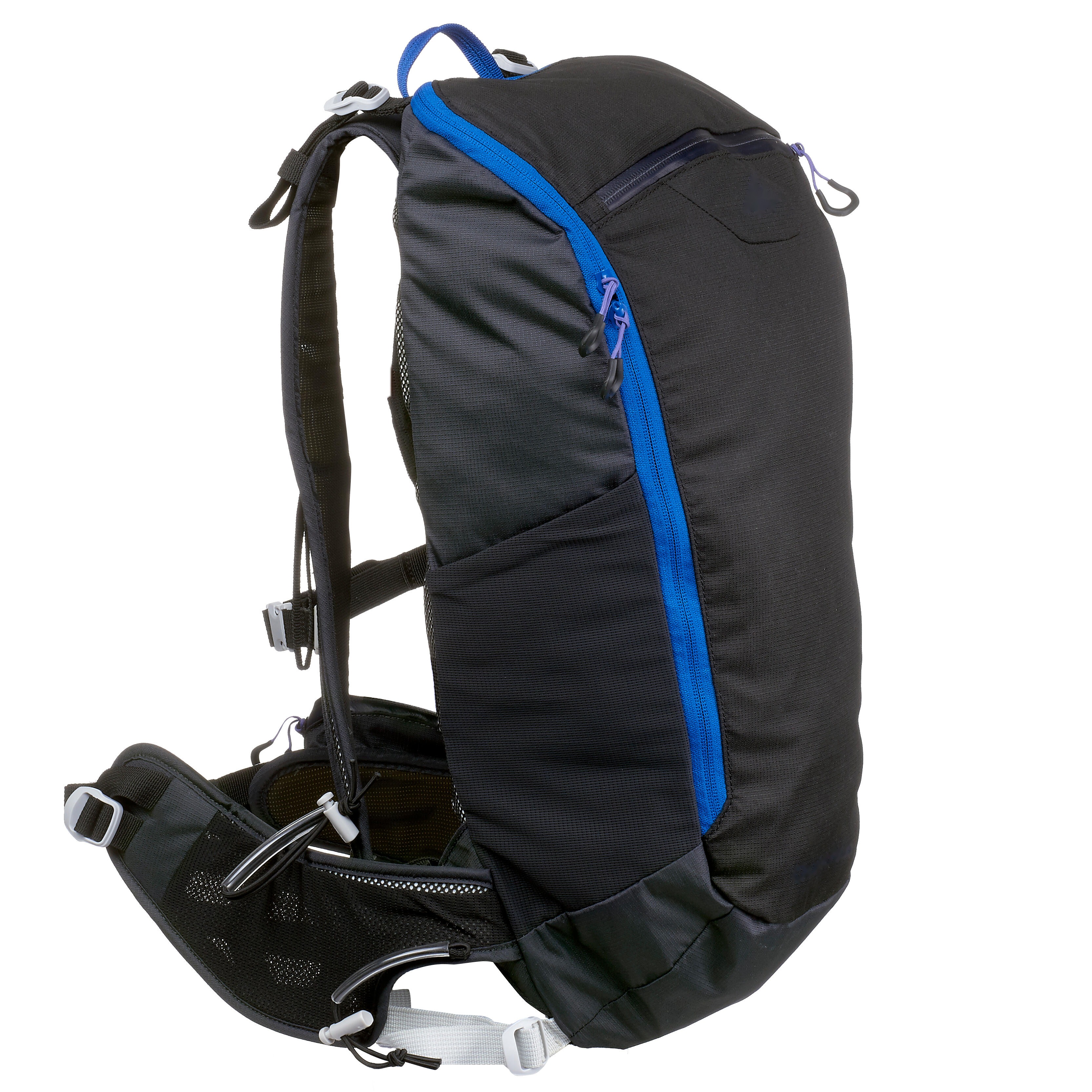
A 15 L daypack with water, poles and a shell can still move enough to matter on a steep climb. This example borrows a padded hip belt, load lifters, a sternum strap and a shaped back panel from larger packs.
The wide front opening is the other important choice: it gives access to the bottom of the load without unloading the top. The pictured daypack is a reference design, not a JKPD product.
01
At a glance
| Feature | Reference design |
|---|---|
| Type | Lightweight fast-hiking daypack with a full carry system |
| Capacity | 15 L |
| Weight | Approx. 750–780 g (depending on measurement) |
| Dimensions | 30.5 × 49.5 cm (W × H) |
| Main opening | Wide inverted-U opening |
| Back panel | Shaped foam back panel with a herringbone mesh pattern |
| Hip belt | Padded, with two pockets (one zipped, one stretch mesh) |
| Pole carry | Quick-stow pole attachment on the side |
| Hydration | Internal sleeve for a water bladder, hose routing to the shoulder strap |
02
The idea: a daypack with a real carry system
The fast-hiking category sits between trail running and traditional hiking. The pace is brisk, the pack is small, and the load is light — but it is still a load. A litre of water weighs a kilogram, and a daypack with food, a layer, a bladder and poles can easily reach four or five kilograms. On a flat path that weight disappears. On a long climb it does not.
That is the problem this pack is built around. Instead of stripping the carry system down to two shoulder straps, the designers kept the parts that matter on a climb: a padded hip belt that takes weight off the shoulders, load-lifter straps that pull the top of the pack towards the body, a sternum strap that keeps the shoulder straps in place, and tension straps on the hip belt to fine- tune the fit. The result is a 15-litre pack that carries like a 25-litre one.
The trade-off is extra weight over a simple frameless sack. The harness earns it only if the packed bag sits more securely and the belt fits.
03
Functions and features
The wide inverted-U opening
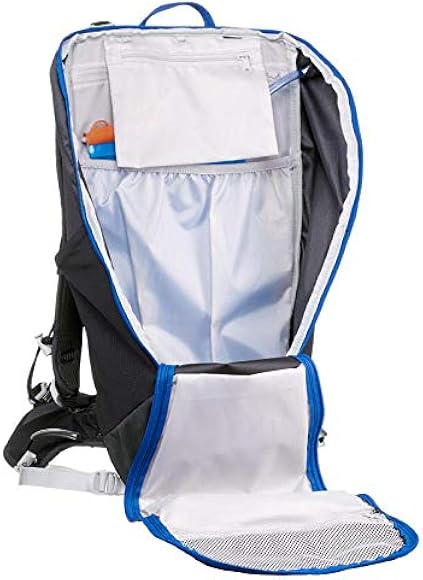
The main compartment opens with a wide inverted-U zip that runs down both sides of the front. Unzipped, the front panel falls open and the whole compartment is exposed. Packing becomes a matter of placing things where they belong rather than stuffing them through a narrow top hole, and finding something at the bottom takes seconds instead of a full unpack. Inside, the lining is a pale silver-grey, which makes dark items easy to see. There is a small zipped pocket at the top of the interior for keys, a wallet or a phone, and a sleeve for a water bladder. The bottom of the interior has a white mesh panel. The opening is the pack's single most practical feature, and it is the first thing you notice when you use it.
Pockets and storage
The storage list is short, but every pocket has a clear job:
- Small top front zip pocket. Sits on the front of the pack, big enough for a folded map, sunglasses or a snack bar. In use it holds a map flat, where it can be pulled out without opening the main compartment.
- Two side pockets. Open-topped and deep enough for a 500 ml bottle each, with elastic binding to hold the bottle in place.
- Two hip-belt pockets. One zipped, one stretch mesh with elastic binding. The zipped one takes an energy bar, a small phone or cash; the mesh one takes a gel, a lip balm or anything you want to grab without a zip.
- Internal hydration sleeve. Holds a water bladder, with a hose port that routes the drinking tube up to the shoulder strap.
- Internal top zip pocket. For keys, cards and anything small that must not migrate to the bottom of the pack.
There is no separate rain cover and no dedicated phone pocket on the shoulder strap. The pocket count is deliberately restrained: six storage spaces, each one used every time the pack goes out.
The carry system
This is where the pack earns its weight.
- Shaped foam back panel. A moulded foam panel with a herringbone mesh pattern sits against the back. The mesh creates air channels, and the foam is firm enough to keep the load from pressing through onto the spine.
- Padded shoulder straps. Broad, mesh-backed straps that spread the load across the shoulders, with a sliding sternum strap.
- Padded hip belt. The most unusual part for a 15-litre pack. The belt is padded and shaped, with tension straps to pull it snug. It carries a real share of the load, which is exactly what makes the pack comfortable on a climb.
- Load lifters. Straps from the top of the shoulder straps to the top of the pack pull the load in towards the shoulders and stop it swaying.
- Hip-belt tension straps. Let the wearer tighten the belt independently of the shoulder straps, so the fit can be tuned on the move.
Check a loaded sample against a simple webbing belt. Note whether the padded belt improves stability without restricting the wearer's stride or making the pockets harder to reach.
Trekking-pole carry
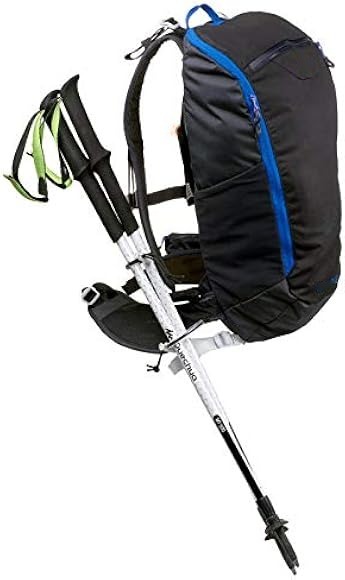
The pack has a quick-stow pole attachment on the side, in the style used by larger hiking packs: the tip of the pole drops into a loop low on the pack, and the shaft is caught by an elastic loop higher up. Poles can be stowed and retrieved without taking the pack off, which matters on a fast hike where the terrain changes every few minutes — poles in hand on the climb, poles on the pack on the flat.
The same elastic loop also holds a hydration hose in place in the mesh side pocket, keeping the bite valve where it can be reached without fishing around.
04
Materials and construction
No detailed fabric specification is published for this version of the pack, so the honest description is what can be seen and felt:
- Body fabric: a tightly woven, smooth synthetic fabric in black, with a bright blue diagonal zip as the only strong colour accent. The fabric looks and feels dense enough to resist scuffs from rock and branches, without the stiffness of a heavy canvas.
- Back panel: moulded foam with a herringbone mesh face. The mesh is the part that touches the back; the foam underneath gives the panel its shape.
- Hip belt and shoulder straps: padded, with breathable mesh on the body side and smooth fabric on the outside.
- Side and hip-belt pockets: stretch mesh with elastic binding, so the pockets grip their contents instead of gaping open.
- Lining: pale silver-grey synthetic, with a white mesh panel at the base of the main compartment.
- Hardware: light-coloured plastic buckles, including white buckles on the hip belt, and a blue fabric top handle.
The colour scheme is restrained: black everywhere, with the blue diagonal zip, blue top handle and pale buckles as the only accents. It is a working pack, not a fashion statement, and the lack of decoration is part of the point.
05
Who is it for?
- Fast hikers and brisk day walkers who want a small pack that still carries properly on climbs.
- Hikers who use trekking poles and want to stow them without stopping.
- Walkers who carry a water bladder and want the hose routed and held in place.
- Anyone who has been put off 15-litre packs by sore shoulders, and wants a hip belt without moving up to a 25-litre pack.
06
Pain points it solves
- Shoulder pain on climbs. The padded hip belt and load lifters move weight off the shoulders.
- Digging for gear. The wide inverted-U opening exposes the whole main compartment.
- Lost small items. The internal top zip pocket and the zipped hip-belt pocket keep keys, cards and snacks where they can be found.
- Poles in the way. The quick-stow attachment parks poles on the pack in seconds.
- Bottles falling out. Deep side pockets with elastic binding hold 500 ml bottles securely.
- Sweaty back. The herringbone mesh back panel creates air channels between the pack and the body.
07
Design strengths
- A genuine carry system in a 15-litre pack. Padded hip belt, load lifters, sternum strap and shaped back panel — features that are rare at this size.
- The wide opening. Packing and finding gear is noticeably easier than with a top-loading sack.
- Complete pocket set. Six storage spaces, each with a clear purpose, and nothing superfluous.
- Pole and hydration integration. Both are built in, not added on.
- Honest weight. About 750 grams, with every gram spent on comfort rather than decoration.
08
Limitations to keep in mind
- At approximately 750–780 g, the reference is not ultralight. The full harness and wider opening add parts; compare a simpler pack under the same load.
- 15 litres is a firm limit. A full day kit fits; an overnight kit does not. There is no expansion collar and no roll-top to add volume.
- One small design wish. A horizontal strap across the side pocket, positioned mid-to-high, would help secure long items such as a folded jacket or a tripod in the side pocket. As it stands, long items rely on the pocket's depth and elastic binding alone.
- No stretch front pocket. The front of the pack has a small zip pocket rather than a large stash pocket, so a wet layer has to go inside the main compartment.
- Dark colour, pale lining. The black body shows dust and light scuffs, although the pale lining makes the interior easy to search.
09
What the wide opening teaches
The most transferable idea in this pack is not the hip belt or the pole attachment. It is the opening. A 15-litre pack is small enough that its contents are always close at hand, yet most 15-litre packs still make you dig. The inverted-U zip solves that with a single design decision: the front of the pack becomes a door instead of a lid.
Treat the opening as part of the brief. A drawcord top can use fewer parts, while a wide front zipper gives clearer access. Compare access with the exterior pockets filled, and check whether the panel drops forward without spilling contents.
At 15 L the hip belt is not intended for expedition loads. Check whether it controls side-to-side movement with a normal day load and whether it still allows the wearer to take a high step.
10
Development checklist
Record these inputs on the sample brief before approving the layout:
- Capacity and target empty weight; say which one takes priority.
- Whether the pack needs a padded hip belt, and what share of the load it should carry.
- Opening style: wide front zip, top loading, or a combination.
- Pocket list, including hip-belt pockets and whether they should be zipped or mesh.
- Pole carry and hydration routing, and whether they must work without taking the pack off.
- Back panel construction: moulded foam, mesh, or a suspended mesh panel.
- Fabric choice by zone, including abrasion resistance for the base and breathability for the body side.
Related guide: Hiking Pack U-Zips: Reach the Middle of the Load
Discuss your bag development project
ANSON XIE
General Manager & Founder
Quanzhou Junkai Pengda Special Equipment Co., Ltd.
Email: ansonxie@jkpdtime.com
Phone: +86 177 5095 3355
WhatsApp: +86 177 5095 3355
Factory address: Floors 2–4, Building 1, Phase I, Huixin Intelligent Manufacturing Industrial Park, Hui'an County, Quanzhou, Fujian, China