
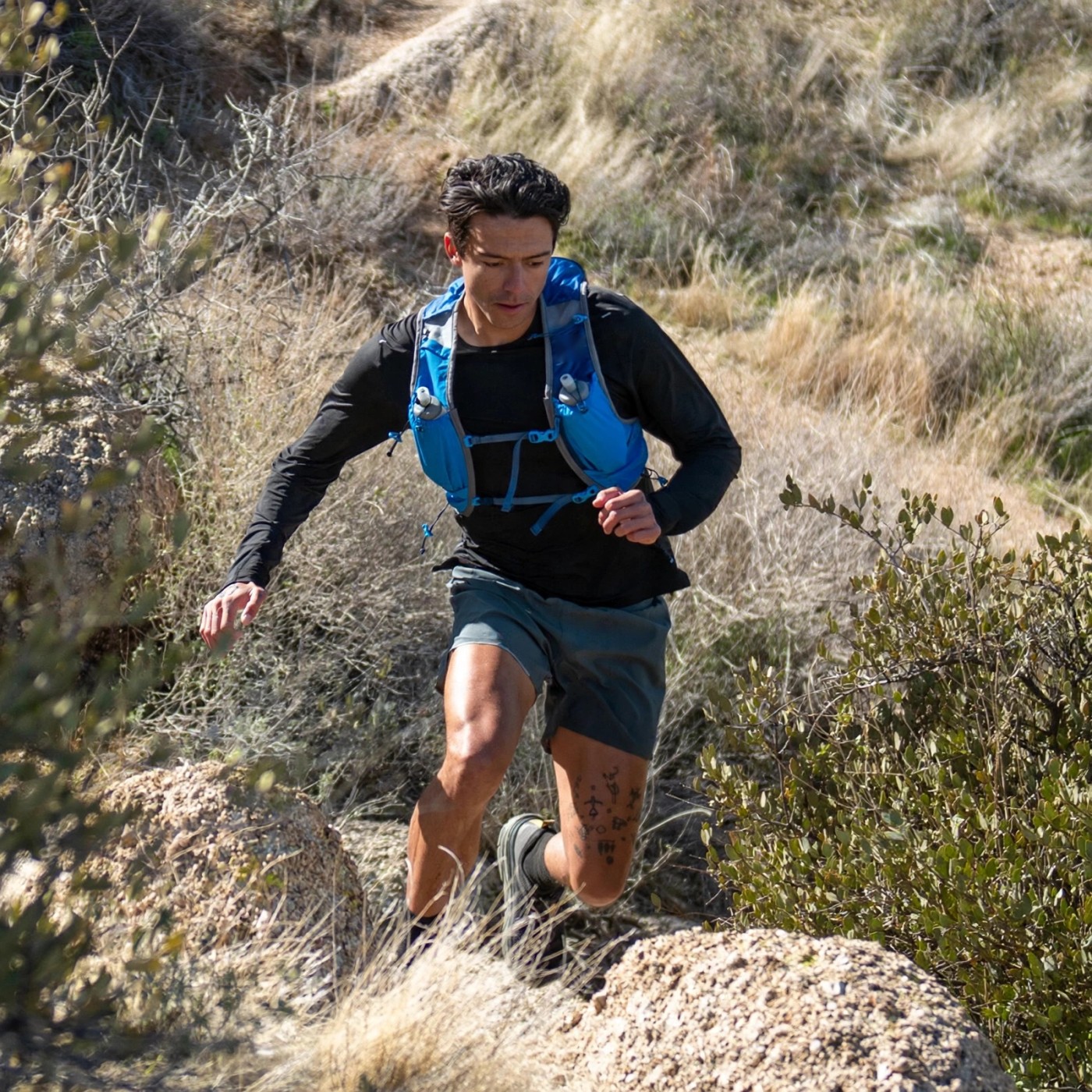
At a short trail race, the vest only needs to carry a litre of water, a few gels and a light jacket. At a 100 mile mountain ultra, the list is very different. Runners may be out for 24 hours or more, through a cold night and changing weather, and race organisers require a long list of mandatory kit: a waterproof jacket and trousers, a warm mid-layer, gloves, a hat, a headlamp with spare batteries, an emergency blanket, a phone, food and water capacity. All of it has to be carried on the body, for many hours, while running and hiking over mountains.
This 13.4 L reference vest shows how to organize mandatory kit, food, water and spare layers without building a small backpack on narrow straps. It is a design example, not a JKPD product.
01
At a glance
| Feature | Reference design |
|---|---|
| Type | Running vest for long-distance and 100 mile ultras |
| Capacity | 13.4 L (817 cubic inches) |
| Weight | 230 g (8.11 oz) without bottles |
| Exterior pockets | 13 |
| Hydration | Two front holsters sized for 500 ml soft flasks |
| Reservoir | Dedicated compartment for up to 2 L |
| Sizes (measured at the bottom ribs) | SM 58–81 cm, MD 76–99 cm, LG 94–117 cm, XL 112–132 cm |
| Materials | Nylon and spandex stretch fabric; silicone-coated nylon |
Measure around the bottom of the rib cage over the intended running layers, not around the fullest part of the chest. Compare empty and loaded fit: filled pockets can reduce the effective adjustment range.
02
Design positioning: maximum kit, minimum bag
There are two common ways to build a large running pack. One is to take a small backpack and add running-style straps. The other is to take a running vest and scale it up. This vest follows the second path.
The front is a true vest: wide, wrap-around panels that cover the chest and sides, with pockets spread across them. The back carries the bulk, but it is shaped and tensioned so that it sits close to the spine instead of hanging like a sack. The result is a product with about the capacity of a small daypack and the fit of a running vest.
At around 230 g empty for 13.4 litres, the vest is very light for its size. That weight figure is important for long races. Every gram is carried for 100 miles, and a heavy empty pack means less room in the runner's weight budget for food, water and warm clothing.
The design also accepts that 100 mile racing is not all running. Runners hike steep climbs, eat on the move, change layers in the dark and use poles. Many of the features below exist to make those tasks possible without stopping or taking the vest off.
03
Functions and features
Thirteen exterior pockets
The headline feature is the number of exterior pockets: 13 in total. On a long race, the problem is not only how much a vest carries, but how quickly a runner can find and reach each item. Thirteen separate places let the runner build a fixed system: gels in one pocket, salt in another, phone in a third, gloves in a fourth. After a few training runs, the runner can reach for anything without looking.
Front panels
The front of the vest has two water-resistant shoulder stash pockets, a zipped water-resistant chest pocket that fits a large smartphone, and seven front storage pockets in total. This front area is where everything the runner needs while moving is kept: soft flasks, food, phone, map and small items.
A phone pocket that is both zipped and water-resistant matters more on long races than on short ones. Over 24 hours, a runner may face rain, heavy sweating and river crossings, and the phone is often a piece of mandatory safety kit.
Sternum straps on sliding rails
Two buckle sternum straps close the front of the vest. They are mounted on sliding rails, so each strap can be moved up or down to suit the runner's chest shape and the height of the load. The vest also carries a safety whistle.
Pole attachment
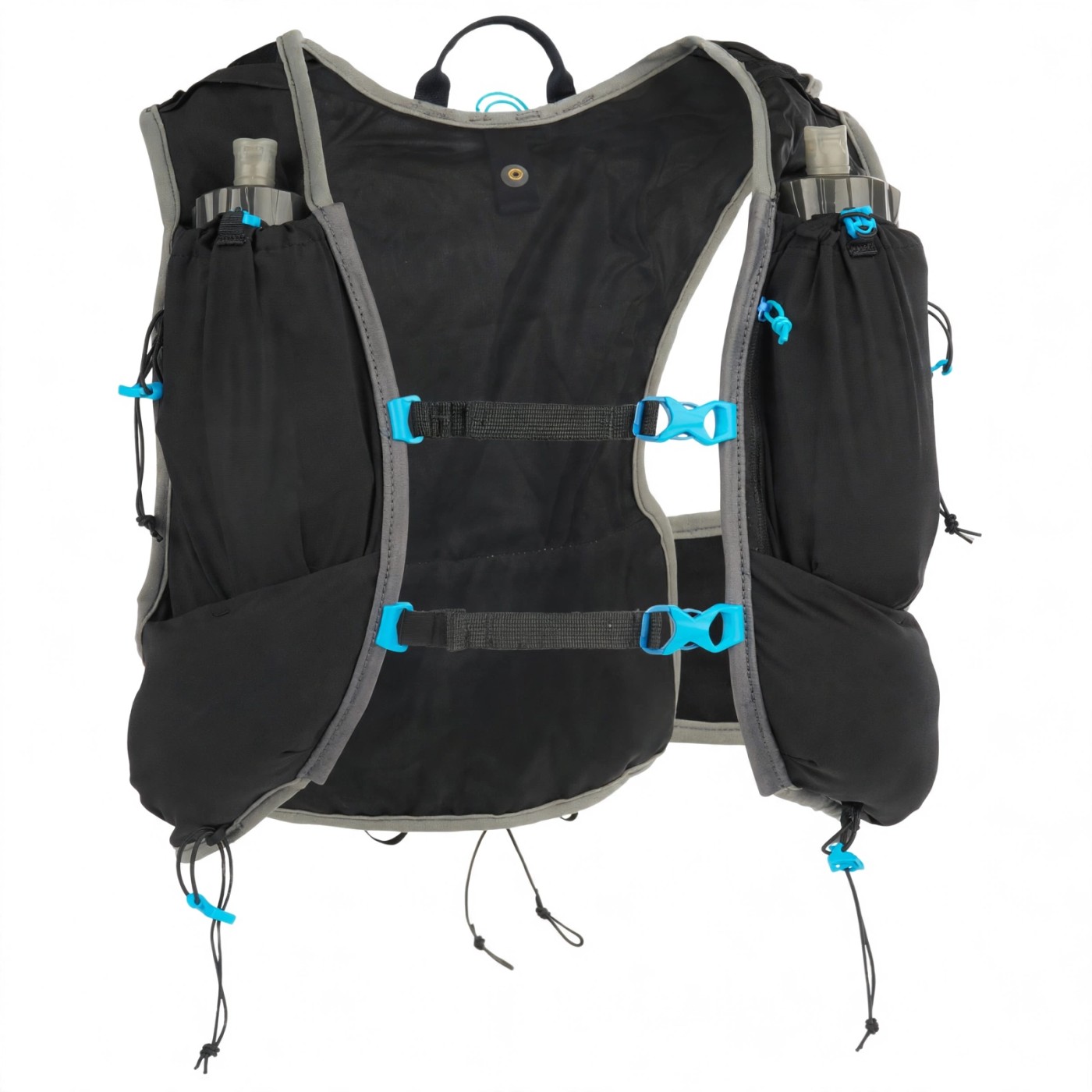
The vest includes six removable hooks and bungee loops for carrying trekking poles. They can be moved between the front and the back, so the runner can choose to carry folded poles across the front of the vest or on the back. Poles are common on long mountain ultras, especially on steep climbs, and being able to stow them quickly is a real time saver.
Rear cinch adjustment
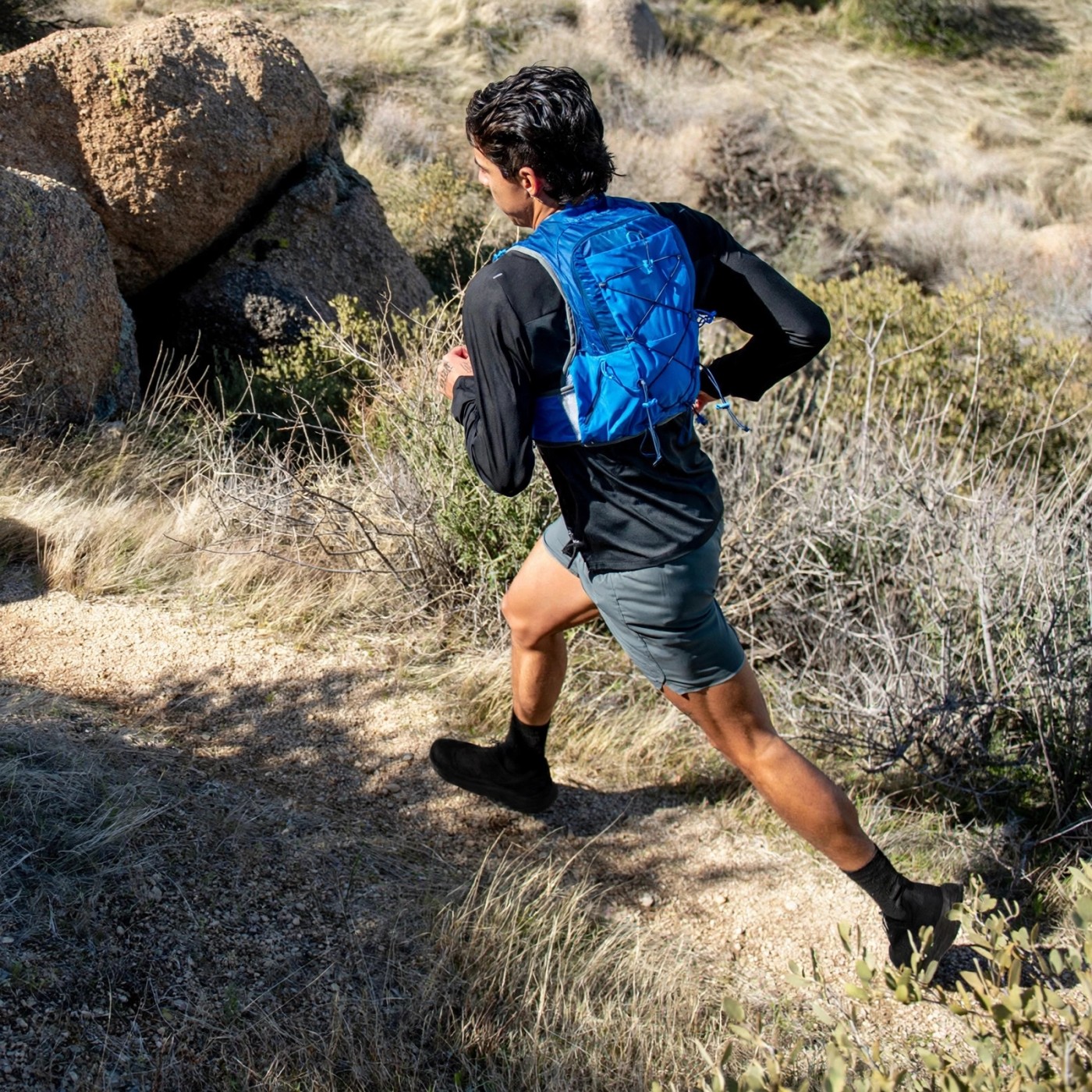
At the back, a cinch system lets the runner tighten the vest around the load. It uses a high-molecular-weight polyethylene cord and an air-mesh panel that prevents chafing. As food is eaten and water is drunk, the volume of the vest changes. The cinch lets the runner pull the vest back into a close fit without stopping.
Large rear compartment with clamshell opening
The main rear compartment is water-resistant and opens with a 270° clamshell zip. This is a practical choice. With a top-loading pocket, the jacket packed at the bottom is always the hardest item to reach. With a clamshell opening, the whole compartment opens like a book, so the runner can see and reach everything inside. An internal zipped pocket with a key clip keeps small valuables separate.
Reservoir compartment
A dedicated rear compartment fits a reservoir of up to 2 L. With two 500 ml front flasks, the layout can carry up to 3 L of water; test front-to-back balance at full and partial fill.
Stretch mesh back pocket with bungee compression
On the outside of the back there is an open-top stretch mesh pocket with an external bungee compression system. This is the place for wet or bulky items: a jacket taken off halfway up a climb, a hat or a pair of gloves. The bungee holds it all tight, and can also hold a layer that is too bulky for the pocket.
Rear lateral pockets
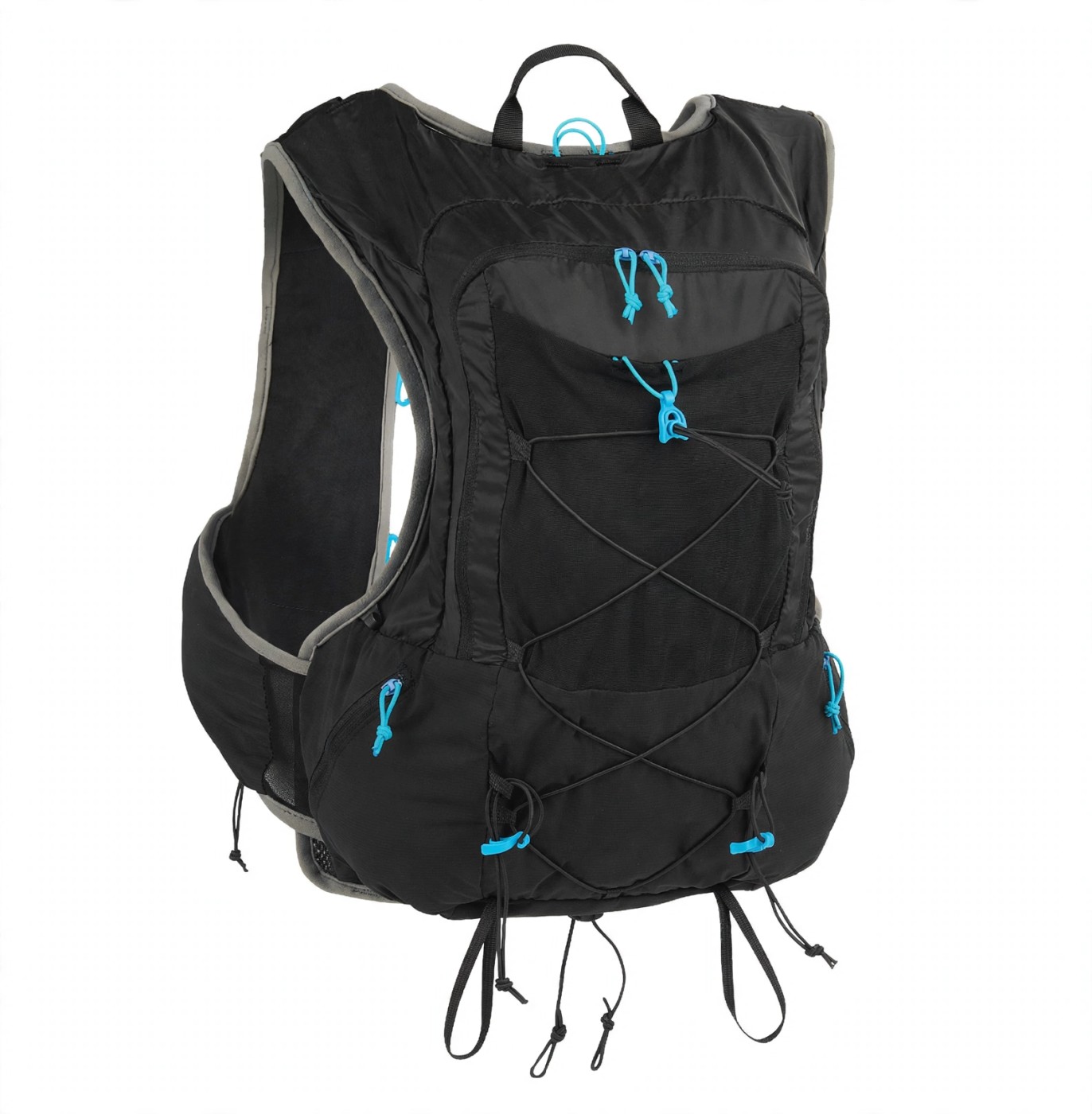
Two zipped lateral pockets on the back can be reached while the vest is being worn. They are useful for items the runner needs occasionally but not constantly, such as a spare headlamp battery, a buff or a small first aid kit.
Back panel and visibility
The back panel is water-resistant yet breathable, and there are reflective details at the front and the back. The men's and unisex cut has a roomier back and larger arm openings than the women's version of the same vest.
04
Fabric and material combinations
Stretch nylon and spandex. The main body uses a blended stretch fabric for fit and recovery as layers and pocket loads change. Confirm the actual blend and recovery for the specified material rather than treating all nylon-spandex blends as equivalent.
Silicone-coated nylon is used in compartments intended to resist rain. Coated fabric does not make the finished pocket waterproof: seams and zippers need separate checks. Stretch mesh serves a different purpose in open pockets, giving drainage and visibility.
Air mesh. At the rear cinch, an air-mesh panel sits between the cord system and the runner's back to prevent chafing.
Polyethylene cord and bungee. The rear cinch uses a high-molecular-weight polyethylene cord. This type of cord is very strong for its weight and does not stretch much, which makes it good for a tension system. Elastic bungee is used for compression and pole loops.
Buckles on rails. The sternum straps use buckles that slide on rails rather than being sewn in one fixed position.
Use stretch where the vest wraps and coated fabrics where the contents need protection. Check both jobs on the assembled vest, including seams and pocket entries.
05
Who is it for?
100 mile and long mountain ultra runners. This is the main audience. The vest is designed to carry the full mandatory kit required by many 100 mile races.
Runners in races with strict kit checks. Many international mountain races check mandatory kit before the start and sometimes during the race. A vest with enough capacity makes it easier to pass those checks without squeezing everything into a small pack.
Fast-packers and long-day mountain runners. Runners doing long self-supported days in the mountains, or light multi-day trips, need more capacity than a race vest offers but do not want a full backpack.
Cold-weather and night runners. Extra layers, a spare headlamp and warm gloves take space. A 13 litre vest gives room for them.
It is less suitable for short races where a 5 litre vest is enough, and for runners who prefer the minimum possible volume on their back.
06
Pain points it solves
Not enough room for mandatory kit. Load the actual event list into the vest, with water and layers alongside it, rather than relying on the 13.4 L volume figure.
Not being able to find things. In a large backpack, small items disappear. The 13 exterior pockets give every item a fixed place.
Digging for a jacket. The 270° clamshell opening gives direct access to the main compartment.
A load that changes over the race. As food and water are used, the rear cinch pulls the vest back into a close fit.
Carrying poles. Movable hooks and elastic loops offer front or rear positions. For wet kit, check how coated pockets and zippers protect contents and use a separate dry pouch where needed.
Different chest shapes. Sternum straps on sliding rails adapt to different bodies.
07
Design strengths
- Large capacity at a very low weight. 13.4 litres for around 230 g empty.
- Thirteen exterior pockets. Organised storage for long races.
- Clamshell main compartment. Direct access to bulky kit.
- Up to three litres of water. Two 500 ml soft flasks at the front plus a 2.0 L reservoir compartment.
- Adjustable fit. Sternum straps on rails and a rear cinch.
- Flexible pole carry. Six removable hooks and bungee loops.
- Water-resistant protection. Phone pocket, shoulder pockets and main compartment.
- Visibility. Reflective details front and back.
08
Limitations to keep in mind
More vest than many runners need. For races under around 50 km, the capacity and pocket count may be more than necessary.
Many pockets need a system. Thirteen pockets are an advantage once the runner knows where everything is, but can be confusing at first.
Sizing needs attention. Sizes are measured at the bottom ribs and overlap, and a loaded vest fits smaller than an empty one. Runners should try it with a full load.
09
Design lessons
Scale the vest, not the backpack. A large running pack works best when it keeps the wrap-around fit of a vest.
Organise for long hours. Many dedicated pockets are better than a few large ones on a long race.
Design for access. A clamshell opening, lateral pockets that can be reached while running and quick-access front pockets save time over many hours.
Plan for a changing load. A rear cinch or similar system keeps the fit stable as the load drops. Mix stretch and protection. Use stretch fabrics for fit and coated fabrics for kit that must stay dry.
Make adjustment simple. Sliding sternum straps and movable pole hooks make one design work for more runners.
Give clear sizing advice. Show where to measure and how a full load changes the fit.
10
Development checklist
Record these inputs on the sample brief before approving the layout:
- Target capacity, target empty weight and the races or kit lists the vest is designed for.
- Size range and the measurement point for each size.
- Fabric choices by zone: stretch body, coated compartments, mesh pockets and contact areas.
- Hydration layout: soft flask holsters and reservoir compartment.
- Opening style for the main compartment, such as top-loading or clamshell.
- Adjustment systems: sternum straps, rails, rear cinch and compression.
- Pocket list with approximate sizes, closures and water-resistance requirements.
- Pole carry, reflective details, safety whistle, colourways.
Related guide: Trail Vest Zipper Pulls: Reduce Chatter and Keep Grip
Discuss your bag development project
ANSON XIE
General Manager & Founder
Quanzhou Junkai Pengda Special Equipment Co., Ltd.
Email: ansonxie@jkpdtime.com
Phone: +86 177 5095 3355
WhatsApp: +86 177 5095 3355
Factory address: Floors 2–4, Building 1, Phase I, Huixin Intelligent Manufacturing Industrial Park, Hui'an County, Quanzhou, Fujian, China