
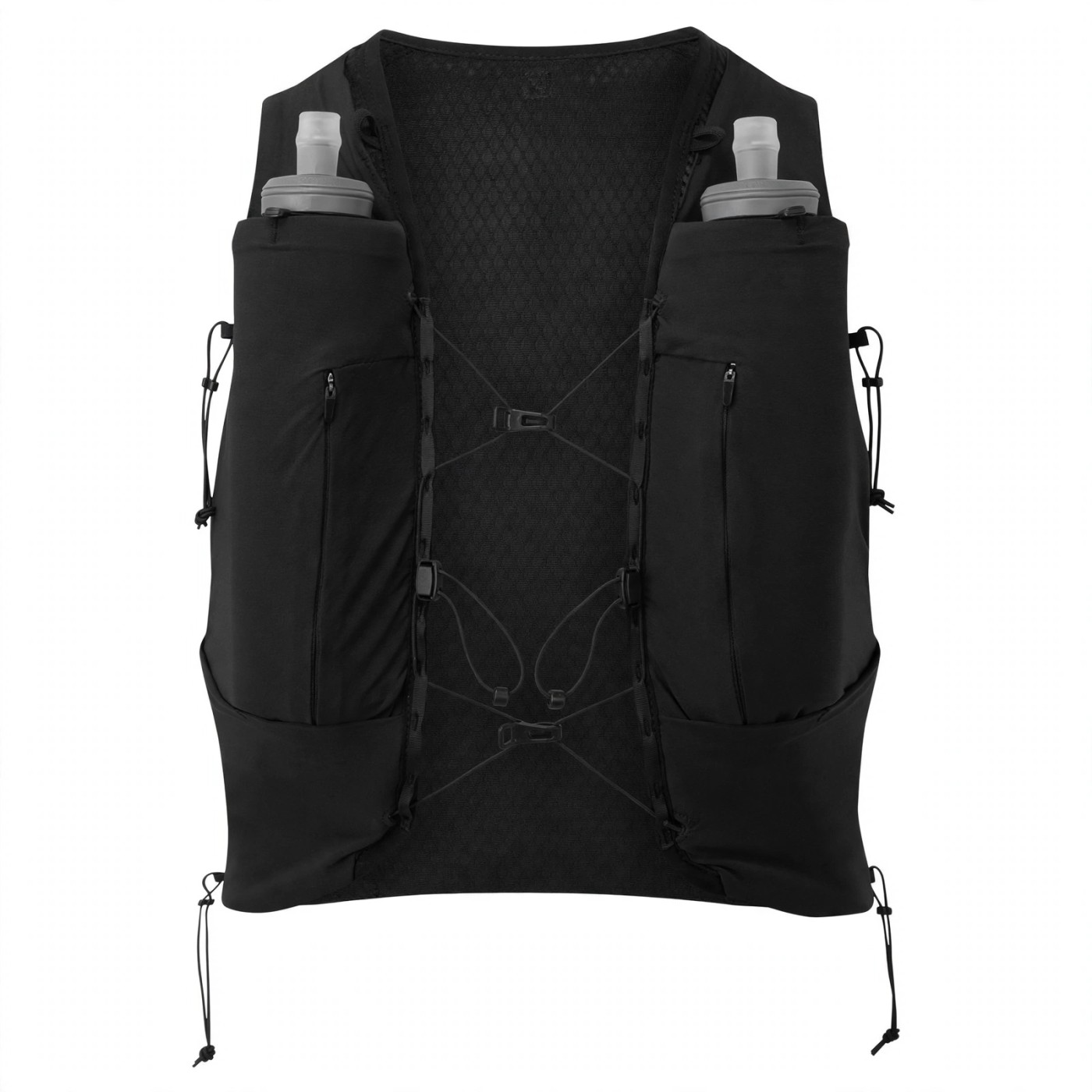
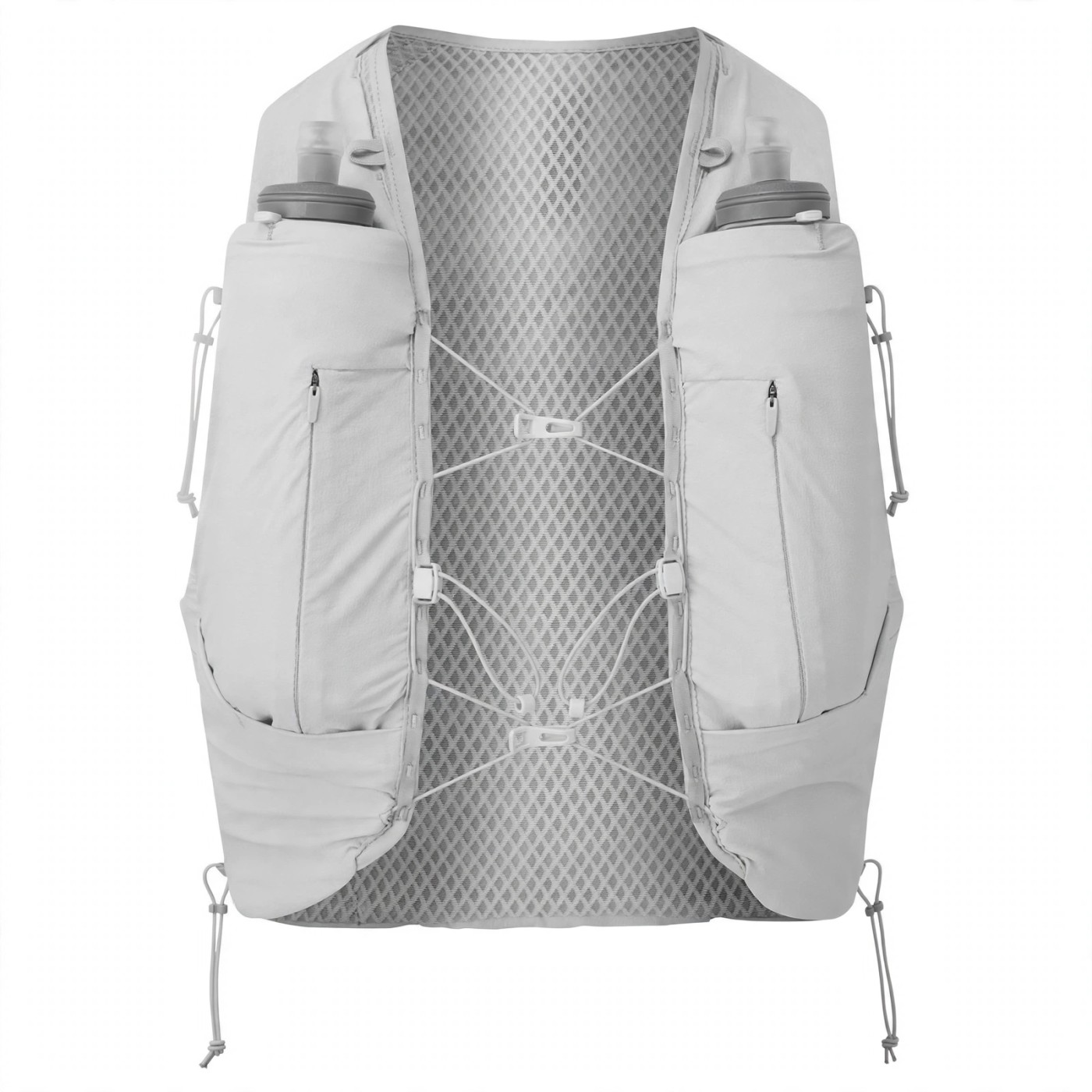
A 12-litre trail vest makes room for the layers, food and emergency gear of a long mountain day. This layout carries two soft flasks on the chest and reserves a rear sleeve for an optional reservoir.
01
At a glance
| Feature | 12 L ultra-distance vest |
|---|---|
| Type | Trail running vest, flask-first with reservoir sleeve |
| Capacity | 12 L |
| Front flask layout | 2 × 500 ml soft flasks |
| Reservoir | Rear sleeve takes a reservoir; not included in the box |
| Total liquid | 1 L with flasks; more with a reservoir added |
| Sizes | Unisex S / M / L, by chest circumference |
| Closure | Elastic cord system with two hook clasps across the chest |
02
Design positioning: a vest, not a pack
The design question this vest answers is what a runner actually carries on a mountain ultra: a waterproof jacket, a warm layer, food for eight or twelve hours, a headlamp, a first-aid kit, a phone, a map, spare socks, gloves and a hat. Twelve litres is the size for that list: a five-litre race vest cannot hold it, and a twenty-litre pack is a different kind of product. Twelve litres sits in between, big enough for a mandatory kit list and small enough to wear like clothing.
The vest wraps closely around the torso and divides the load between front pockets and rear storage. Check the fit with the actual layers and a full kit before adjusting the chest cords.
03
Functions and features
Two flask pockets on the chest
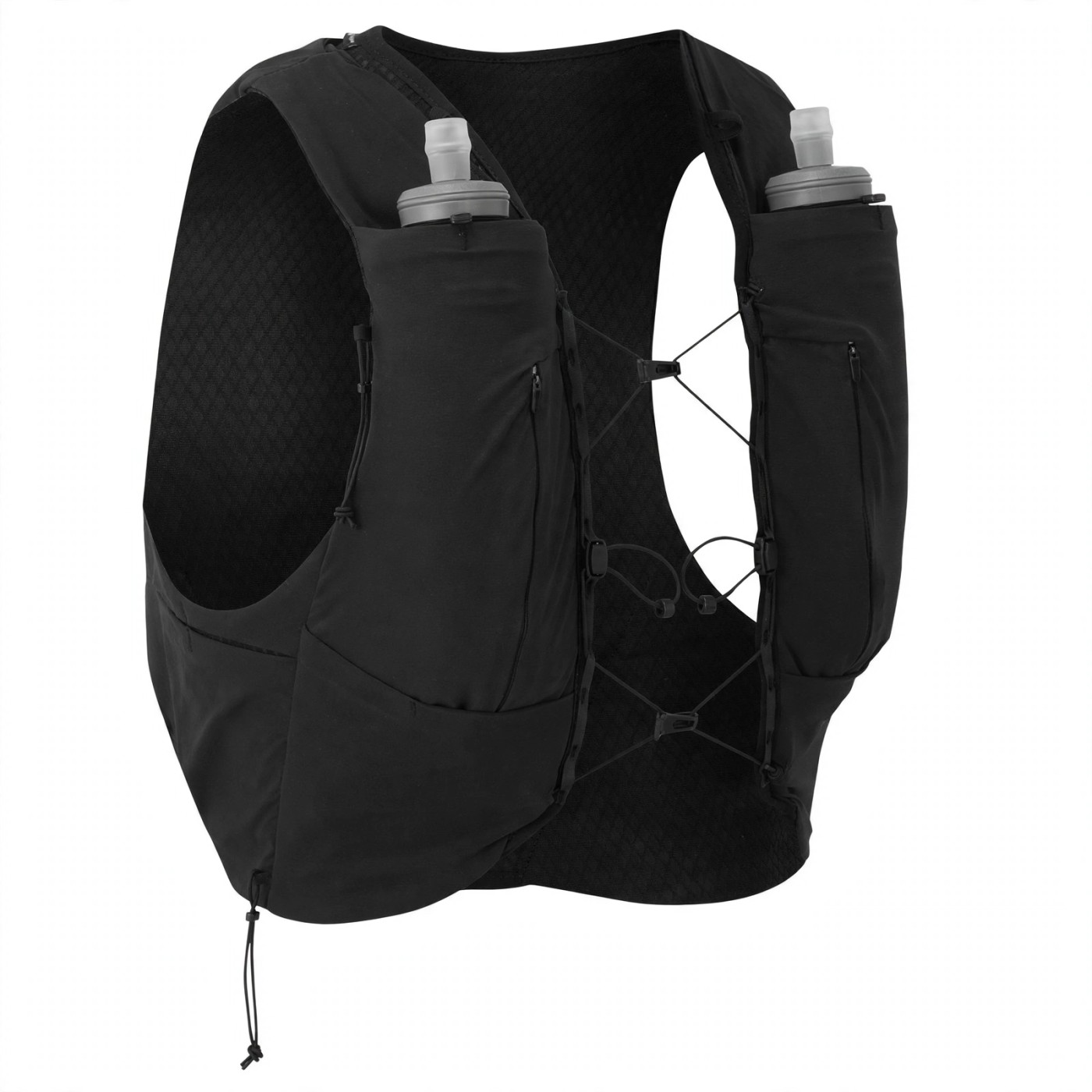
The two most important pockets are the flask pockets, one on each side of the chest. Put the flasks in them and check grip and drinking access with both full and partially empty bottles.
Two zipped pockets below the flasks
Directly below each flask pocket sits a zipped pocket, for a phone, a map and a compass, and for snacks such as trail mix. They are deep enough to hold a 500 ml bottle as well, and they have small holes at the top to thread a straw through. One of these pockets is also where the whistle lives: removable, on a cord, and a real piece of mandatory kit in many mountain races. Putting it in a pocket the runner opens all day means it is always carried.
Four stretch mesh pockets for food and layers
Beyond the zipped pockets, the vest carries four stretch mesh pockets: one on either side of the base of the harness, and one under each armpit. These are the pockets for gels, bars, a cap, gloves, or a lightweight waterproof jacket. They are open-topped and elastic, so the runner can pull food out with one hand while moving. Two of them run from under the chest around to the back, so they hold more than they look like they should. The point of having four of them, rather than one big one, is organisation: food goes in one, gloves in another, a hat in a third, and the runner can find each thing by feel.
A large zipped rear compartment and a reservoir sleeve
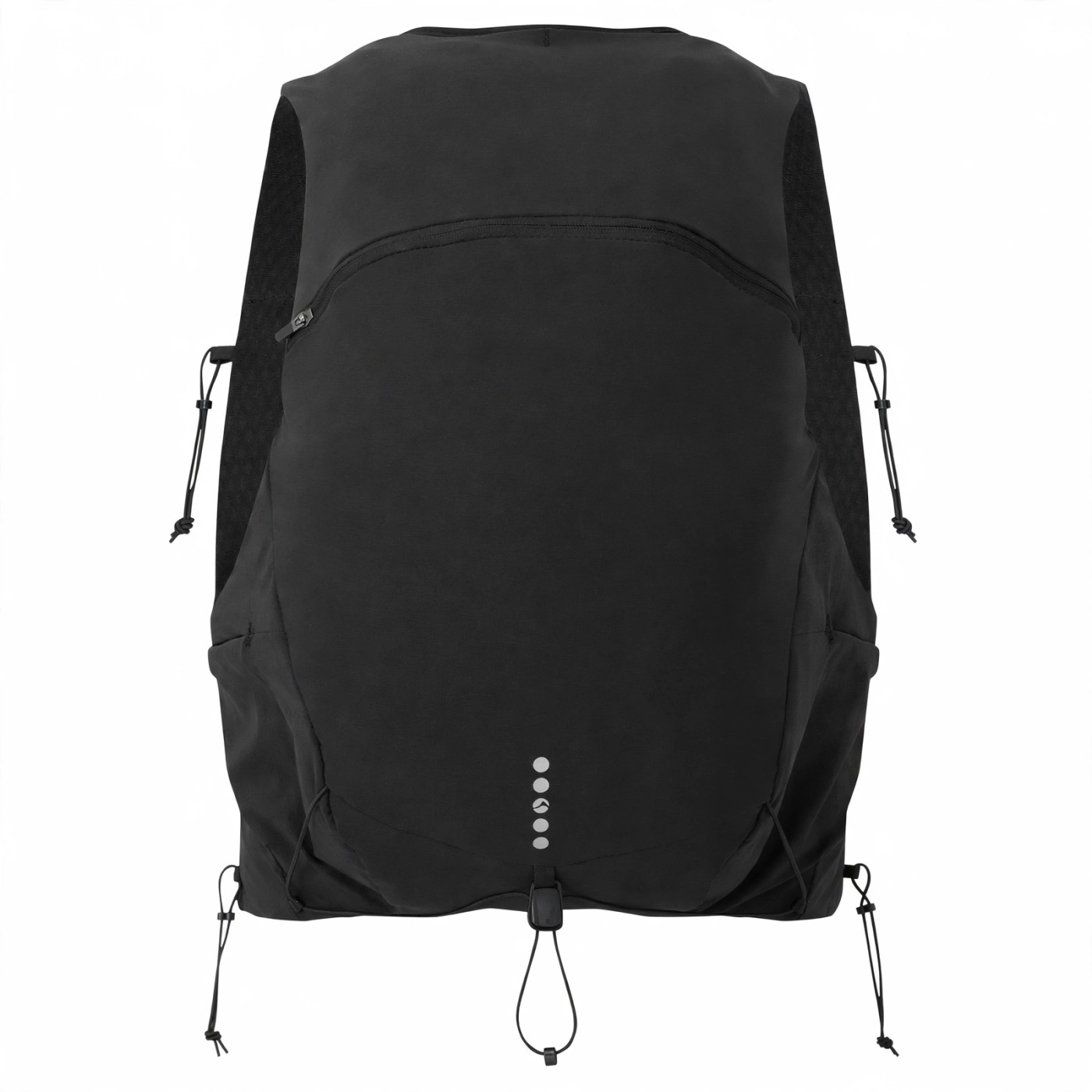
The back of the vest carries the bulk of the gear. There is one large zipped rear compartment that swallows the sort of kit specified in the compulsory lists of most ultras: emergency layers, a waterproof jacket and rain trousers, food, spare socks, a hat and gloves, a headlamp and a first- aid kit. It zips securely shut, so nothing falls out on a descent. Against the back sits a second, larger compartment, for a reservoir or a warm layer: it cannot be fully sealed, but a small tab keeps it from gaping open. An internal key clip keeps keys safe. Between the shoulder blades there is also a flat stretch sleeve pocket, reachable over the shoulder, for a light waterproof. The reservoir sleeve is the vest's second water system: the vest ships with flasks, not a reservoir, but the sleeve is built in.
External bungee for compression and extra carry
A bungee cord runs across the outside of the vest, on the front and on the back, and it does two jobs. Pulled tight, it compresses the load and stops it shifting as the vest empties. Left loose, it is a place to strap extra kit on the outside: a waterproof jacket fits under it perfectly. The system sits on the outside of the vest, where it can be adjusted on the move, so the vest can be tightened with one hand as the food and water disappear.
A cord closure instead of a waist belt
Two hook clasps and crossed elastic cords draw the front panels together. The clasp positions can be changed. Check whether cord travel still allows comfortable breathing when the front flasks and the rear compartment are full.
Pole carry on the front, the sides and the back
The front, sides and back offer possible pole positions. Compare each one for reach and clearance from the drinking points, zips and arm path.
Safety details
A vertical row of reflective details sits low on the back. The vest has places for a whistle and small tracker; check retrieval and avoid covering the reflective area with an external layer.
04
Fabric and material combinations
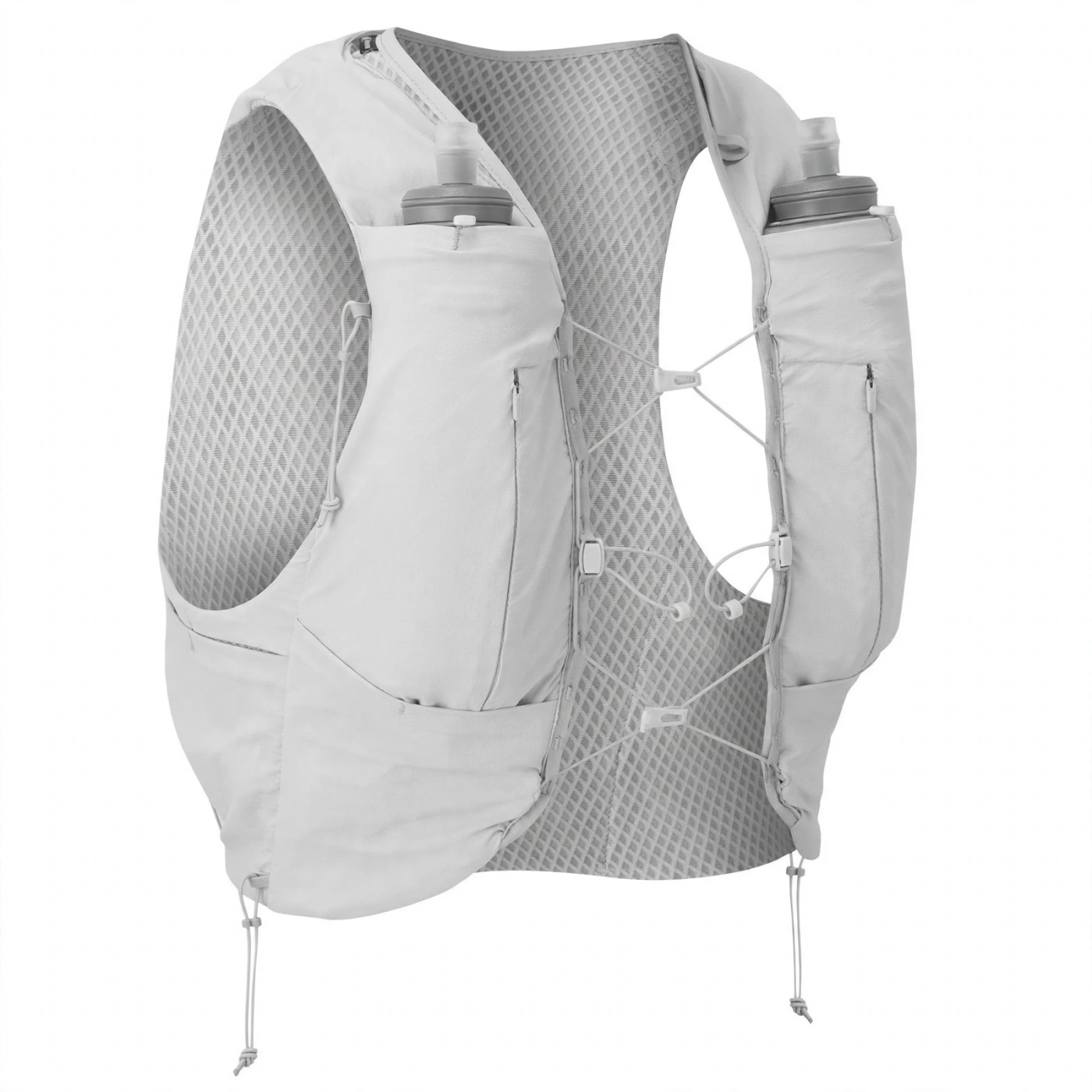
Stretch body fabric. Sideways give helps the vest wrap around the torso as the load changes. Less vertical movement is a useful goal for the support areas; check the two directions on the chosen fabric.
Body-facing mesh. A diamond-pattern mesh lining separates the body from the outside fabric and leaves open space for airflow.
Zips and elastic bindings. The rear pocket has a zip and the vest edges use soft elastic bindings.
05
Who is it for?
Ultra runners. This is the vest's home ground: races of fifty miles and beyond, with mandatory kit lists and aid stations far apart. The twelve litres hold the kit, and the flasks hold a litre of water.
Mountain runners and fastpackers. The same capacity and pocket layout suit long days in the mountains and minimalist fastpacking where the vest is the only bag.
Runners moving up in distance. A runner going from marathons to fifty-kilometre races and beyond needs more capacity and more water than a five-litre race vest holds. Twelve litres is the step up.
It is less suitable for runners who want the lightest possible race vest, or for short road runs, where twelve litres is simply more vest than the run needs.
06
Pain points it solves
Not enough space for a mandatory kit list. Twelve litres holds the layers, the food, the headlamp and the first aid that a long race requires.
Flasks that bounce. The tight stretch pockets grip the flasks as they empty, and the cord closure spreads the tension across the chest.
Food that is hard to reach. Four mesh pockets and two zipped pockets put food on the chest, reachable with one hand while moving. A vest that gets looser as the day goes on. The external bungee and the cord closure can both be tightened on the move.
Poles with nowhere to go. Front, side and rear carry options mean the poles can be stowed in the position that suits the terrain, and reached without stopping.
07
Design strengths
- Twelve litres of nominal gear capacity. Confirm the space needed for the intended kit and hydration configuration.
- Two 500 ml flasks included. A litre of water on the chest, visible and reachable.
- Lightweight layout. Record the vest and flasks separately when comparing samples.
- Pockets everywhere it matters. Flask pockets, zipped pockets, four mesh pockets and a large rear compartment.
- A closure that spreads the load. Elastic cords and two hook clasps, with no waist belt and no hard buckles.
- Pole carry in three positions. Front, side and back, so the poles can be reached or stowed as the terrain demands.
- Safety kit built in. Reflective details on the back, a removable whistle and a tracker pocket.
08
Limitations to keep in mind
Check reservoir fit independently. Fit the intended filled reservoir and confirm how much usable gear space remains.
The elastic cord closure can adapt to different loads, but it cannot be locked down like a broad non-stretch belt. Compare the fit with a loaded rear compartment and again after some supplies are removed.
09
Design lessons
Design for the kit list, not the capacity number. Its pockets are shaped around the actual list: layers in the back, food on the chest, phone and whistle in the zipped pockets. Capacity follows the list, not the other way around.
Spread the tension. Check whether the crossed cord distributes pressure evenly when the rear compartment is loaded.
Make stretch directional. Check the balance between room for breathing and support along the loaded pocket.
Put the whistle where the phone lives. A whistle in the pocket the runner opens all day is always carried; in a separate pocket, it is often forgotten.
Give poles three homes. Poles are used differently on different terrain, so one carry position is never enough.
10
Prototype brief
Useful inputs for a 12-litre trail vest prototype include:
- Target capacity, target weight and the races or distances the vest is designed for.
- Hydration layout: flask pocket size and number, reservoir sleeve size, hose path and bite-valve holder position.
- Size range and the measurement point for each size.
- Fabric choices: stretch mesh with real recovery, elastic bindings, cord and cord-lock types, and reflective print positions.
- Pocket list with approximate sizes and opening directions, including a secure pocket for phone and keys.
- Pole carry positions, whistle attachment and colour options.
Related guide: Trail Vests That Switch Between Flasks and a Rear Reservoir
Discuss your bag development project
ANSON XIE
General Manager & Founder
Quanzhou Junkai Pengda Special Equipment Co., Ltd.
Email: ansonxie@jkpdtime.com
Phone: +86 177 5095 3355
WhatsApp: +86 177 5095 3355
Factory address: Floors 2–4, Building 1, Phase I, Huixin Intelligent Manufacturing Industrial Park, Hui'an County, Quanzhou, Fujian, China