
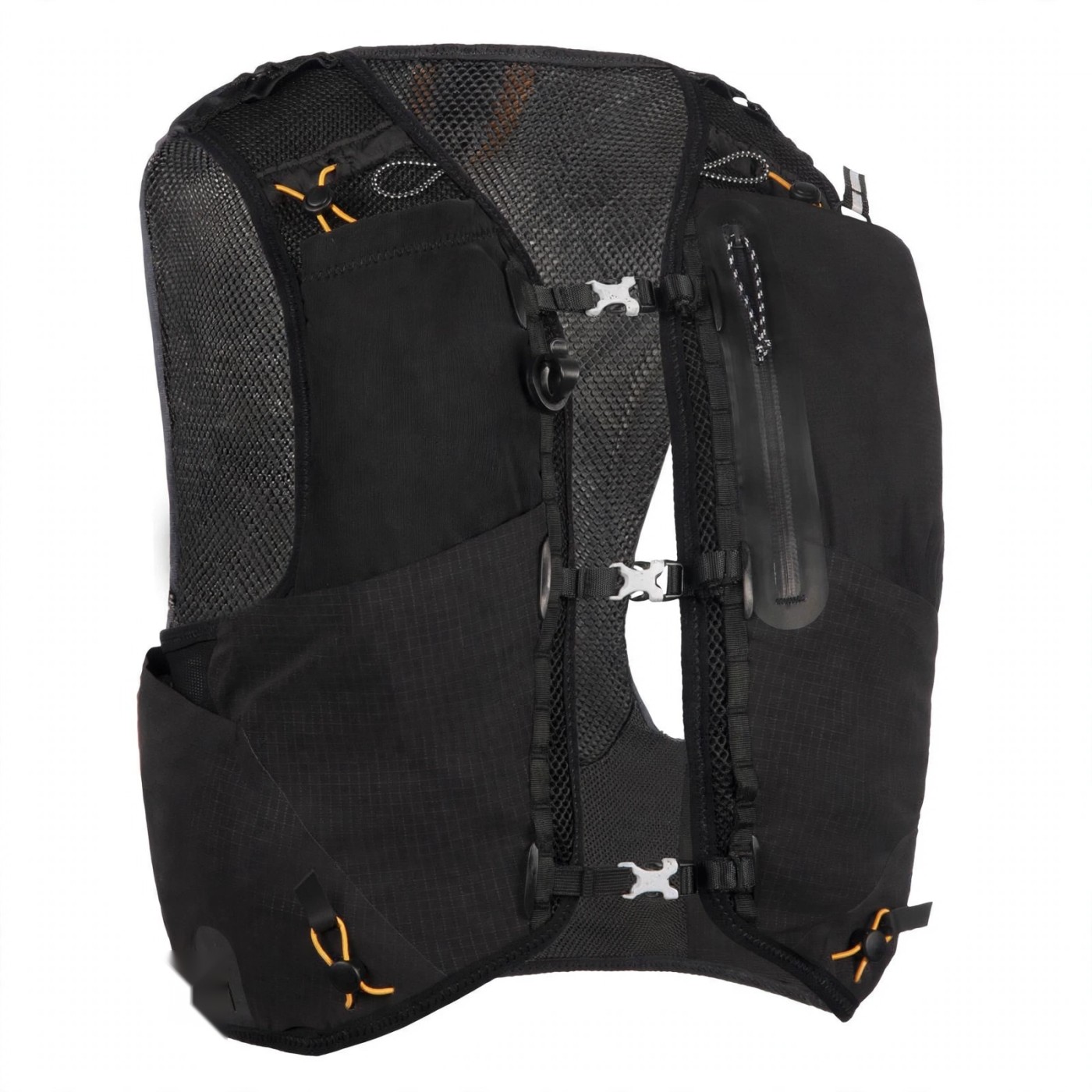
This 10-litre trail vest locates water in a rear sleeve, snacks and a phone on the harness, and a layer in a pocket near the bottom of the back. That division matters more than the pocket count if a runner needs to reach one item without disturbing the others.
01
At a glance
| Feature | Reference layout |
|---|---|
| Type | Trail running vest, bladder-first with flask pockets |
| Capacity | 10 L |
| Rear hydration | Reservoir sleeve and hose path |
| Flasks | Front pockets shaped for 0.5 L soft flasks |
| Sizes | XS/S, M/L, XL; unisex |
| Closure | Three adjustable sternum straps, the bottom one elastic; side tightening system |
| Materials | Polyester, elastane and polyamide; breathable open mesh against the body |
02
Design positioning: the cargo van of running vests
The storage brief includes water, food, a layer, phone and first-aid basics. The key is keeping the layer's exit route separate from the reservoir sleeve and the small items that should stay in a zipped pocket.
A stretch shell and a lateral adjustment let the runner set the tension with different loads. Compare the vest with its sleeves empty and with the reservoir and front pockets filled.
03
Functions and features
A rear reservoir and magnetic hose clip
A rear sleeve takes a 1 L reservoir. Its hose routes over the shoulder, with a magnetic clip to locate the bite valve when stowed. Check reseating with gloves and with the pocket beside the clip filled.
Two flask pockets on the chest
The two front pockets are shaped for 500 ml soft flasks. Bungees locate the upper ends and pull tabs help open the pockets. Confirm flask retention when full and when the body collapses.
Separate openings for frequently used items
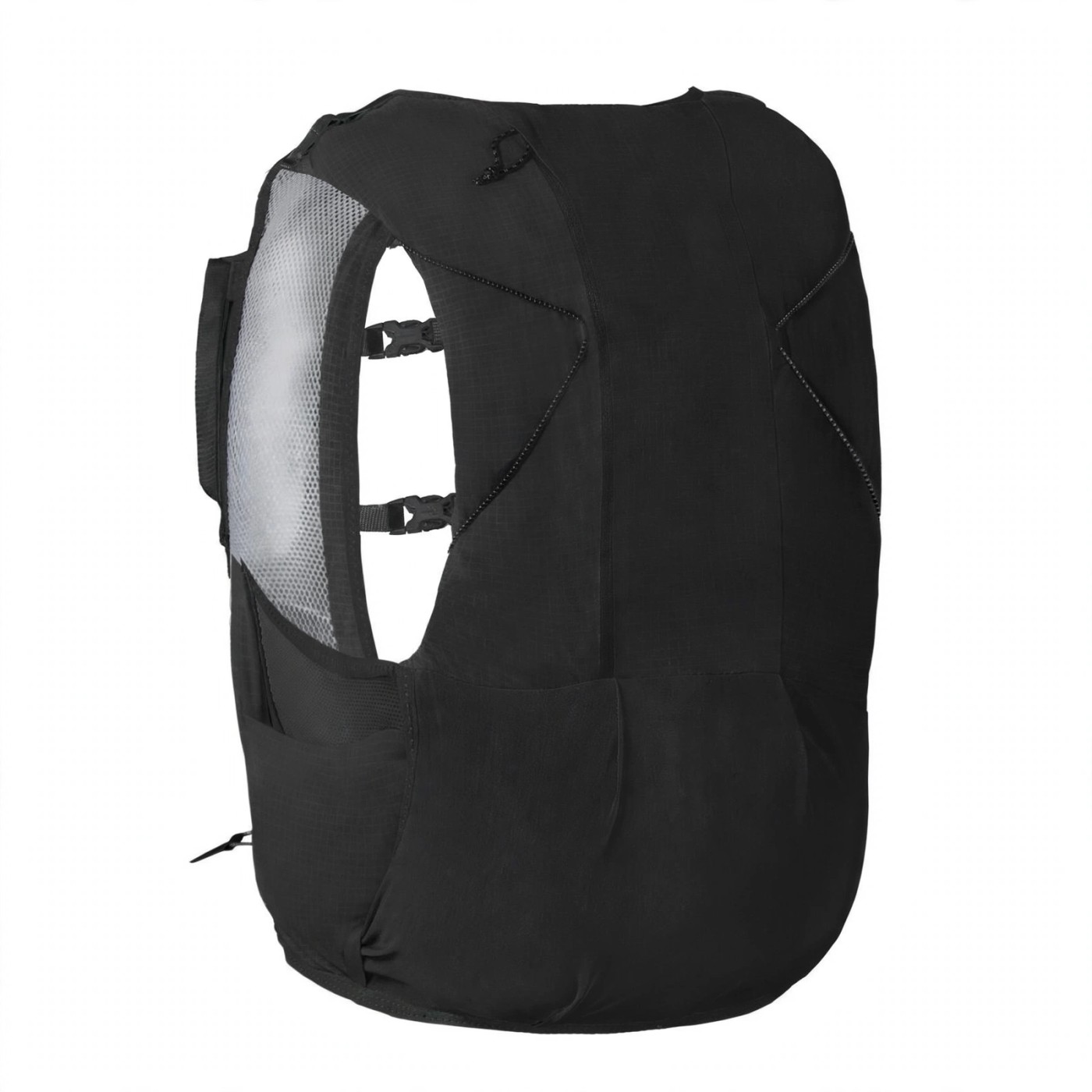
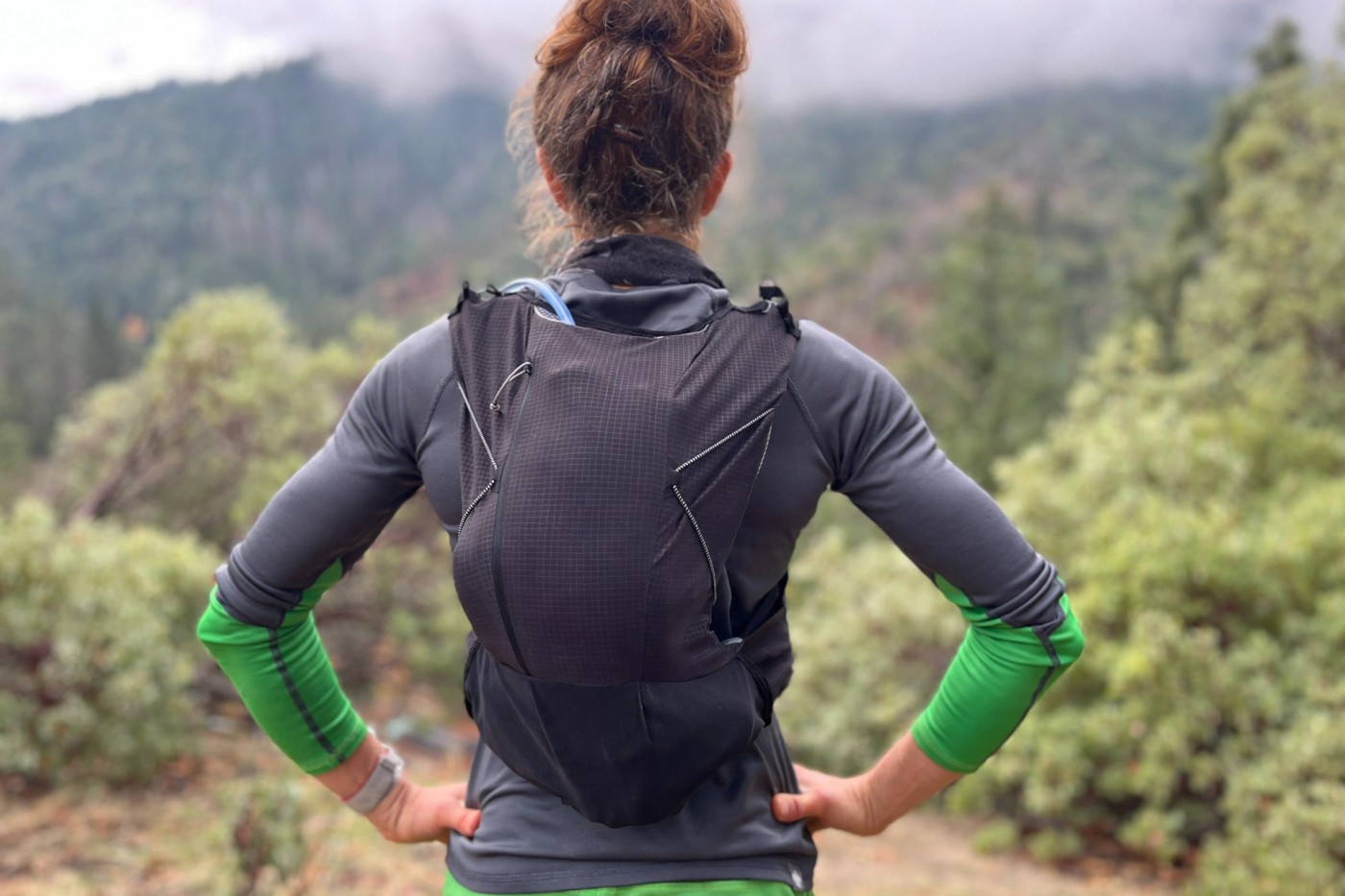
The front groups flask pockets, a zipped pocket, a phone pocket and small food stashes. Side pockets keep gloves and snacks within reach. At the back, the lower layer pocket, main compartment, reservoir sleeve and internal zip pocket separate bulky layers, water and small essentials.
A kangaroo pocket that earns its name
The angled lower opening lets a runner reach for a jacket without opening the main compartment. Confirm reach with both hands, over a thicker top and with the rear sleeve filled.
A zipped phone pocket on the front
A zipped front pocket makes it possible to reach the phone without opening the main compartment. It is next to a flask, so verify the opening with that flask full. Do not infer waterproofness from the closure alone.
A fit with three straps and a side pull
The chest closes with three adjustable straps; the lowest is elastic. Shoulder toggles and lateral adjustment set the fit near the upper load and around the torso. Check rub points and load movement at different tensions.
Two ways to carry poles
The side slots provide places to attach a quiver, while vertical front straps offer a separate attachment position. Check pole clearance during arm swing and whether the attachment blocks a pocket opening.
04
Fabric and material combinations
The construction uses polyester, elastane and polyamide. Confirm which fabric is used at each panel rather than inferring stretch or abrasion resistance from the fibre names alone.
A stretch shell gives the main compartment room to expand, while a lateral adjustment takes up slack. Compare the fit and any shift as the reservoir empties.
Open mesh sits against the body. Mesh openness does not establish comfort on its own; check seam contact and friction over the intended base layer.
05
Who is it for?
Longer runs with a layer and several small items benefit from a store-and-retrieve order that can be repeated. Confirm the intended capacity with the actual kit.
Runners who separate keys, food and first aid can assign them to different openings rather than stacking them in the main compartment.
A shorter run may not need the extra pockets. The main question is whether the storage is usable and the vest remains adjustable with a light load.
06
Pain points it solves
A pocket shell that feels loose with little gear. Lateral adjustment and shell stretch are the two features to check when the vest is nearly empty.
A displaced hose. The shoulder clip gives the bite valve a repeatable place to return to.
Small items scattered through the main compartment. Outer stashes separate food, a phone and a layer from first-aid items inside.
A jacket with nowhere to go mid-run. The angled lower rear opening gives the layer its own route.
Skin contact at the back panel. The open mesh separates the outer shell from the body; check seams and binding under load.
07
Design strengths
- A rear reservoir sleeve and magnetic hose clip.
- Nominal 10-litre volume with separate access for water, food and layers.
- A stretch shell with side tension adjustment.
- Zipped phone pocket on the front.
- An angled lower opening for layers.
- Two pole-carry options. Quiver slots on the sides or vertical straps on the front.
08
Limitations to keep in mind
The phone opening sits next to a flask. A full flask can narrow the access path; check a large phone in its case before approving the layout.
Only the bottom chest strap is elastic. Verify whether the other two can be set without uncomfortable pressure over different layers.
09
Design lessons
Design the pockets as a system rather than as a count. Specify the drinking position, route the hose and assign each opening to a group of items.
Put the phone where the runner can reach it, then verify water resistance separately if it is required.
Check the vest near empty as well as full, so the side adjustment can be used through the range of loads.
10
Prototype brief
For a 10-litre vest with a rear reservoir, a prototype brief should identify the water path, the opening for layers and the loaded body fit.
- Target capacity, target weight and the runs or races the vest is designed for.
- Hydration: reservoir dimensions, hose route, clip location, front flask size and total fluid requirement.
- Opening direction and size for phone, layers, side stashes and the small internal items.
- Fit system: number of sternum straps and which are elastic, shoulder toggles, and the side tightening system.
- Size range and the measurement point for each size, including whether a women's version is a separate pattern.
- Fabric choices: shell stretch and recovery, mesh openness and softness against the skin, and the material blend.
- Pole carry, colourways and branding positions.
Related guide: Trail Vest Design: Keep the Reservoir Clear of the Zipper
Discuss your bag development project
ANSON XIE
General Manager & Founder
Quanzhou Junkai Pengda Special Equipment Co., Ltd.
Email: ansonxie@jkpdtime.com
Phone: +86 177 5095 3355
WhatsApp: +86 177 5095 3355
Factory address: Floors 2–4, Building 1, Phase I, Huixin Intelligent Manufacturing Industrial Park, Hui'an County, Quanzhou, Fujian, China