
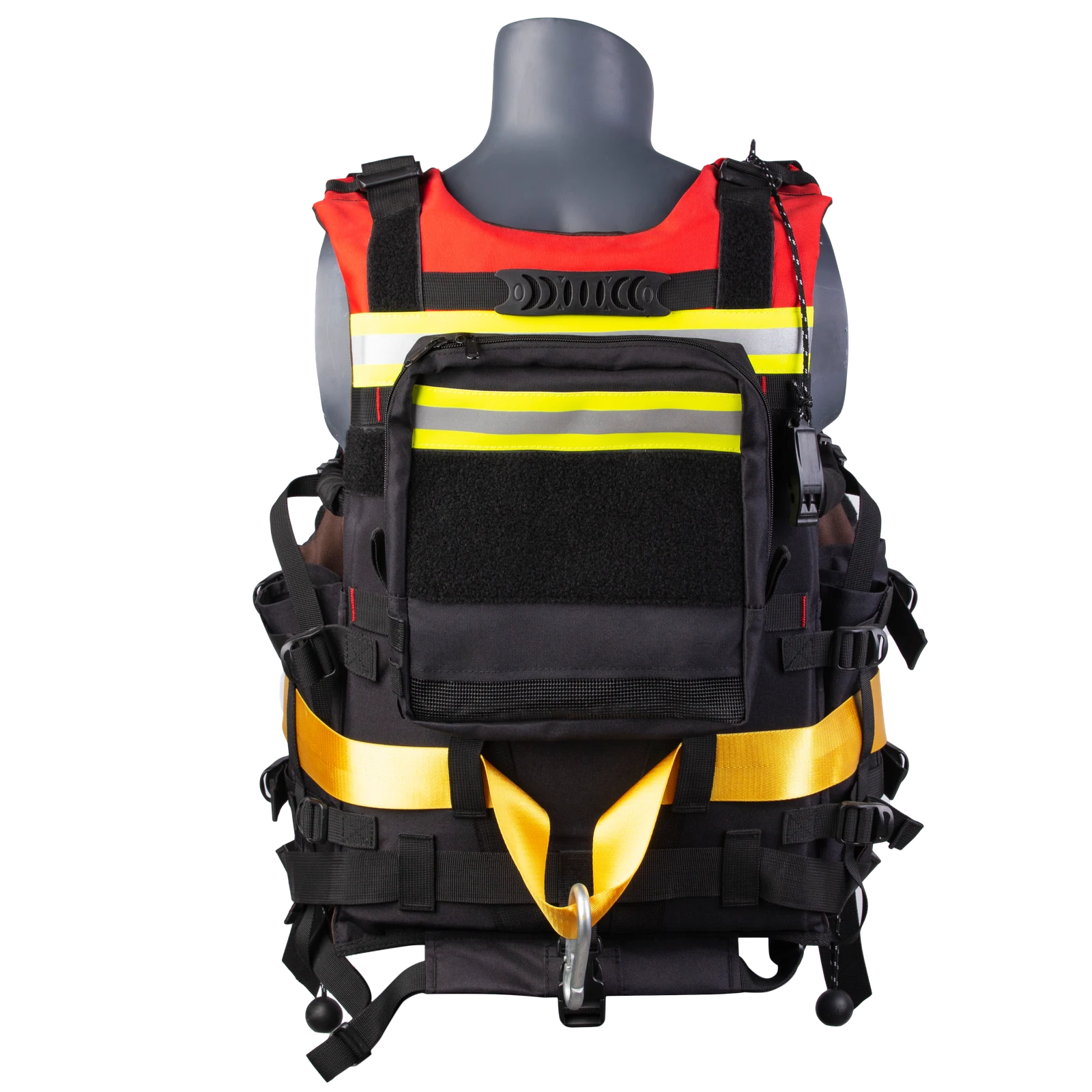
A utility vest’s rear pocket needs a defined person and condition for access: the wearer, an assistant or someone organizing the vest after removal. Each arrangement changes the practical opening direction and distribution of contents. A pocket’s rear location alone does not establish convenient access.
Define who opens the pocket, in which state, what is removed and who closes it again. This article concerns textile storage layout, without assessing flotation, protection, load capacity or rapid removal.
01
Decide what belongs behind the wearer
Assign contents around their access frequency and the intended operator. If an item needs frequent personal checking, compare a front location or separate pouch before asking the wearer to reach repeatedly behind. If the pocket is organized after removal, develop the arrangement around a laid-flat condition.
Distinguish soft and rigid contents as well as size. A cleaning cloth and a hard case can occupy similar plan dimensions while producing different projections. Provide reference objects and their storage directions before deciding pocket depth or internal subdivision.
02
A rear view does not establish personal reach
The flat position is only part of the access condition. Clothing layers, shoulder movement, nearby equipment and puller location affect whether the wearer can approach the opening. This article does not provide or verify a behind-the-back retrieval procedure.
The rear photograph locates a rectangular pocket among surrounding webbing, without showing a hand action. For an assisted arrangement, document left and right directions and the intended grasping position. If personal access is required, conduct a separate human handling review rather than inferring it from this view.
03
Match the opening to the chosen state
The direction in which the panel opens should suit the intended operating condition. With the vest laid down, observe the space available for the opened panel and whether the edge hides the contents. An assistant approaching from behind needs a separate review of object positions; the laid-flat arrangement cannot automatically stand for it.
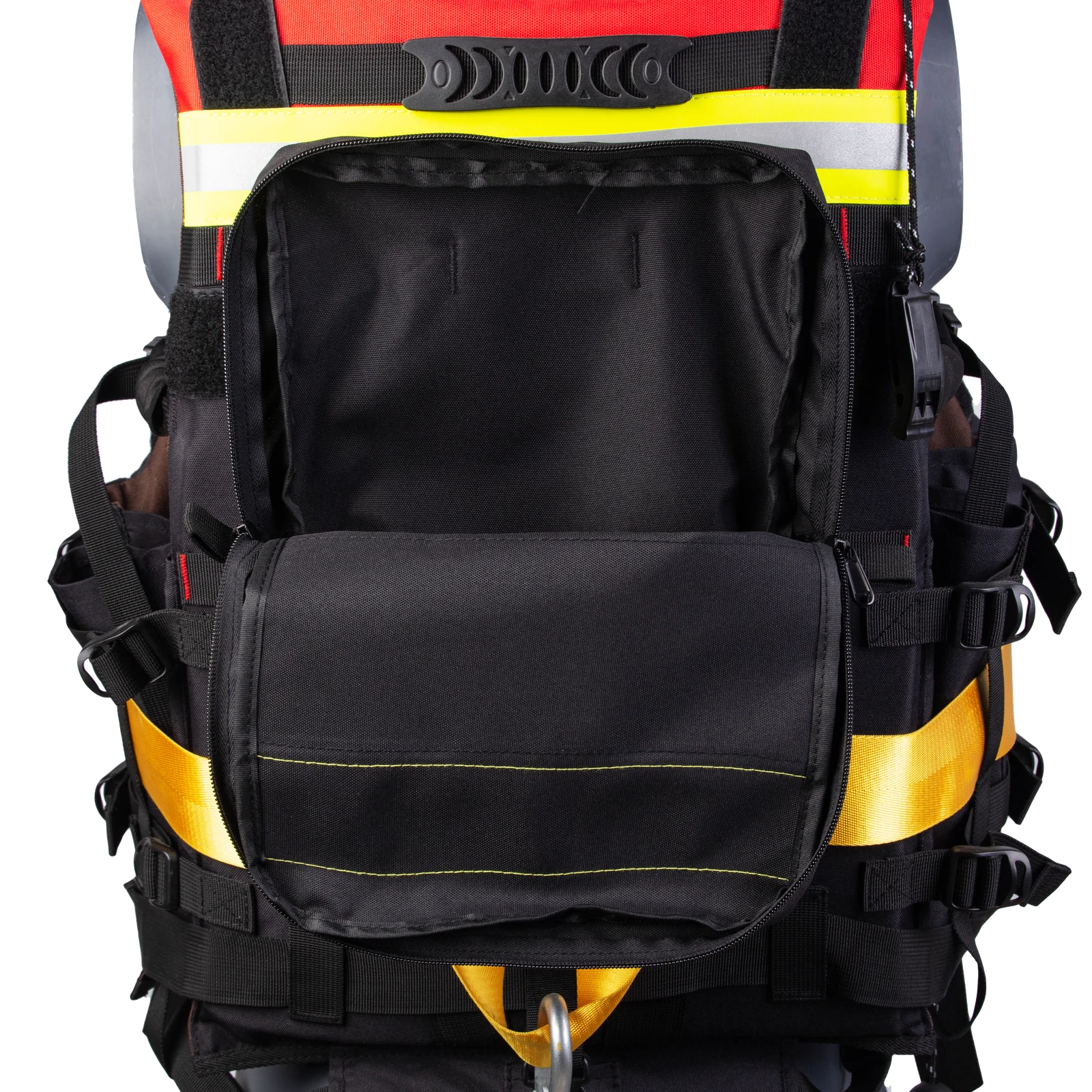
The open photograph shows a panel folded downward and an empty interior. It does not demonstrate retention of any contents. It can support discussion of visibility and hand entry, without establishing that items stay inside when the opening faces downward.
04
Review the loaded side profile
Loading changes the projection at the rear. Observe the normally packed pocket relative to side straps, upper structures and the intended surroundings. The empty photographic outline does not define a maximum load. Thicker objects can also change how the panel bends when returned to its closed position.
If more room is proposed, compare reorganizing the reference contents with increasing pocket depth. A longer zipper alone does not define additional usable capacity.
05
Assign the closing confirmation
The selected workflow needs a person responsible for returning the pocket to its closed state. Assisted access calls for a recognizable closing end point and puller position. A vest organized after removal needs its corresponding check before being put on again. Recording the presence of a zipper leaves that completed state unspecified.
Include every added divider, inner pocket or retaining strap in the sequence. More restraint does not automatically suit frequent retrieval. The brand should decide which additional actions are acceptable for its intended contents arrangement.
06
Begin the handover with roles and states
Record what the approved sample must show
Give the sample team the operator, opening condition, reference contents, storage directions and closed-state photographs alongside dimensions. After changing depth, internal layers or a puller, revisit the same conditions. This separates a construction revision from a change to the intended use arrangement.
These are independent development proposals based on visible corporate-library construction. Mannequin photographs are not presented as wearing tests. More textile-product layout topics are available in the JKPD blog.
Discuss your bag development project
ANSON XIE
General Manager & Founder
Quanzhou Junkai Pengda Special Equipment Co., Ltd.
Email: ansonxie@jkpdtime.com
Phone: +86 177 5095 3355
WhatsApp: +86 177 5095 3355
Factory address: Floors 2–4, Building 1, Phase I, Huixin Intelligent Manufacturing Industrial Park, Hui'an County, Quanzhou, Fujian, China