
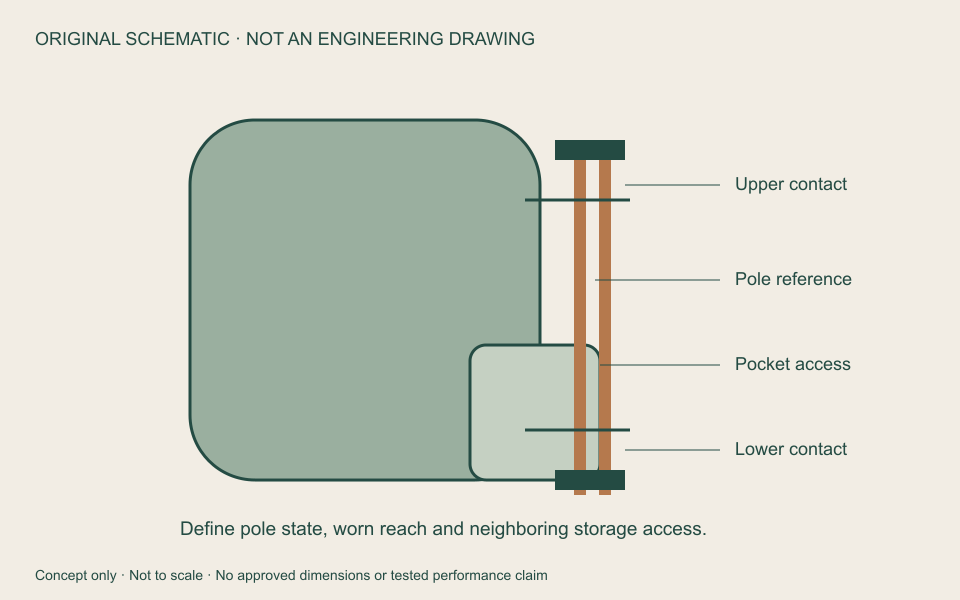
Develop trekking pole attachments around the intended poles and handling sequence. For a brand buyer, attachment and access while wearing the pack are separate review questions. Define the desired action before deciding where attachment points belong.
01
Establish a physical pole reference
Provide the intended poles and identify the model, folded or collapsed state, handle and tip forms, and single or paired carrying requirement. Photograph each reviewed state with a scale reference. Do not transfer attachment spacing from an unrelated product.
A pole occupies different space when deployed and folded. Specify the state covered by the drawing. Review every model on the compatibility list separately rather than extending one approval to all poles.
02
Define retrieval before reviewing location
State whether the wearer removes the pack to operate the attachment. Distinguish one-handed removal, two-handed reinsertion and readjustment of retention. Have reviewers follow the same sequence and record which loops or components must first be released.
Use agreed clothing layers, harness adjustment and packing conditions to observe reach. Record turns or supporting actions that are required. A point near the shoulder does not establish access without removing the pack.
03
Mark contact and projection
Mark the handle, shaft and tip positions in review photographs. Check their relationship to the pack, wearer and adjacent equipment. Include intended tip protection when specified and follow the pole manufacturer's storage instructions.
The original schematic distinguishes upper and lower contact from a side pocket. It does not prescribe universal mounting positions. Holding ability and performance in movement require separately agreed verification conditions.
04
Include neighboring storage in the review
With poles attached, retrieve side-pocket contents, open nearby zippers and adjust the harness. Record whether the poles must move first, whether pulls are obscured and whether loose cord enters the retrieval path.
Replace vague comments with repeatable observations. A hypothetical note might read: “With the agreed packing arrangement, the upper loop must be released before bottle removal.” This is a reporting example, not a product test result.
05
Preserve the approved combination
Record pole model, folded state, mounting direction, pack revision, worn and packing conditions, and completed actions. Recheck affected combinations after changes to retention, location or the harness.
Send pole references and handling requirements through the JKPD inquiry page. Limit compatibility wording to reviewed combinations and support handling claims with the relevant records.
Discuss your bag development project
ANSON XIE
General Manager & Founder
Quanzhou Junkai Pengda Special Equipment Co., Ltd.
Email: ansonxie@jkpdtime.com
Phone: +86 177 5095 3355
WhatsApp: +86 177 5095 3355
Factory address: Floors 2–4, Building 1, Phase I, Huixin Intelligent Manufacturing Industrial Park, Hui'an County, Quanzhou, Fujian, China