
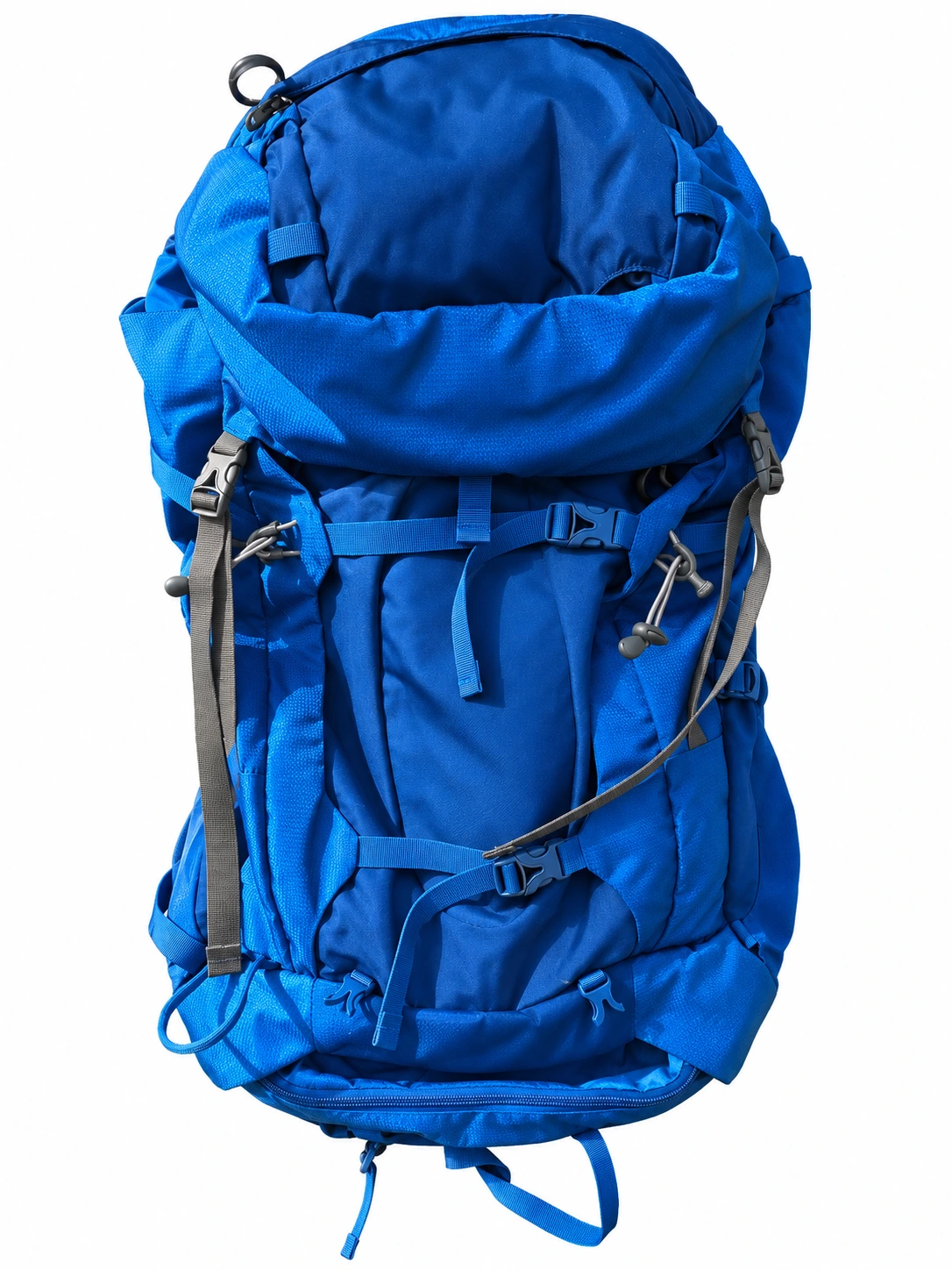
Coordinate a trekking pack lower entrance with external straps, any internal divider and the intended sleeping-system bundle. Review the complete retrieval and repacking action with the pack loaded.
Photo: Sea Cow · Source · CC BY-SA 4.0. Ordinary product branding/background cleaned with AI; visible structure reference only. Adaptation under the same license.
01
Give the lower entrance a specific retrieval task
A lower entrance provides another route to equipment near the base of a trekking pack. Name the intended sleeping bag, stuff sack or camp item and record its place within the full packing arrangement. The useful outcome is less disturbance of the upper load, beyond adding another zipper.
The blue reference photo shows the lower panel boundary, front buckles and nearby pullers. Its period product manual treats the sleeping-bag entrance, internal divider and external sleeping-pad straps as separate features. The closed photograph does not reveal the divider connection or the shape of the open entrance.
02
Assign each external strap its own role
A strap near the opening may compress the body or secure external equipment. State its purpose, occupied condition and relationship to lower access. On the sample, follow the proposed sequence through buckle, puller and opening panel, noting where one part blocks the next action.
If an external roll must be removed before the entrance can open, document that tradeoff or revise the routing. A longer zipper alone cannot resolve a strap crossing its path. Retain the closing sequence too, including restoring compression and parking the remaining strap tails after retrieval.
03
Define what happens above an internal divider
For a design with a divider, review its supported, folded or removed configurations as applicable. Observe whether upper contents enter the lower region when the soft bundle is removed. The divider attachment and permitted states need their own definition; exterior styling cannot establish them.
A fixed boundary needs room for the intended bundle. A connected compartment needs a packing arrangement that keeps other items manageable during access. Describing a sleeping-bag compartment should not imply an unverified sealed boundary, water barrier or load-support function.
04
Read lower panels, buckles and entrances separately
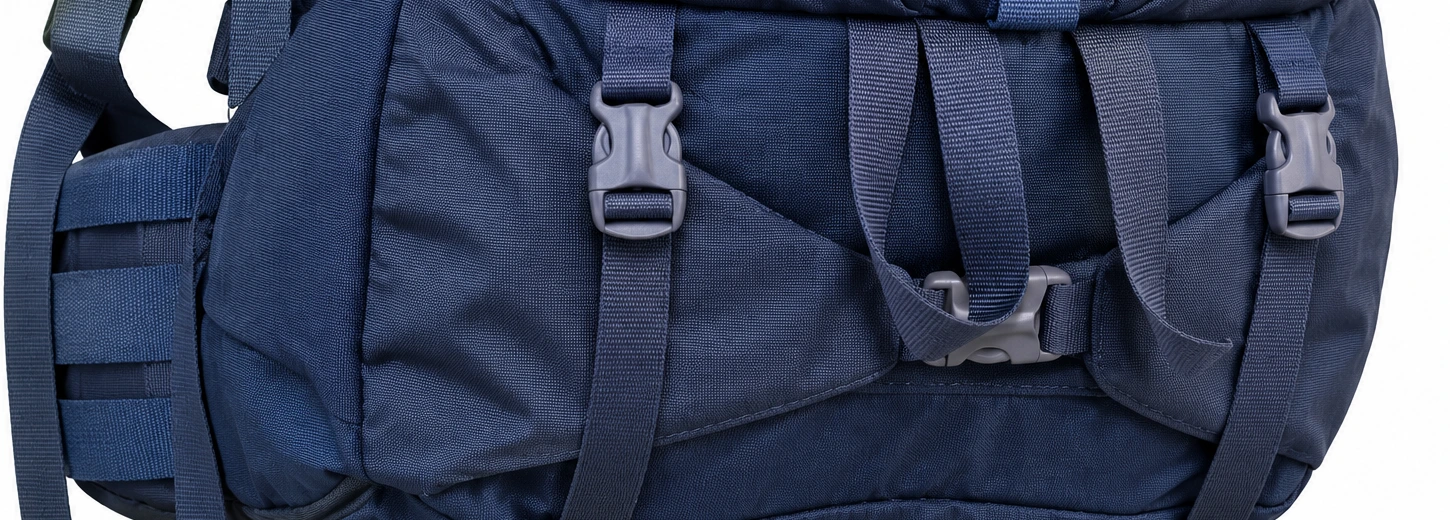
The second photograph is a lower-front detail of another dark blue trekking pack, showing a transverse boundary, buckles and nearby strap routes. Their relative positions are useful references. They do not establish the same divider, volume or opening mechanism as the first pack.
During development, record the same sample closed, with external restraints released, and with the entrance unfolded. Then record the intended object passing through it. Different products' static photographs cannot form an opening sequence. These reference photographs describe only their respective visible exterior arrangements.
05
Review the shape passing through the opening
A sleeping bag is compressible, while its stuff-sack end and handles still have a definite shape. Use a representative bundle to review withdrawal, insertion, panel support and puller access with neighboring equipment in place. Give the pattern team the operating position, rather than only a zipper-length request.
Discuss panel materials, seam edges and local reinforcement around expected ground contact or hard edges. Neither photograph establishes abrasion, tear or water-resistance performance. Confirm those through the actual materials and finished configuration, alongside the opening review.
06
Hand over a repeatable camp-access sequence
Keep the contents list, divider state, external equipment, opening sequence and required operating space together. Record the upper load after retrieval and the closure after repacking. When something catches, identify the component and action so the team can revise the route or panel.
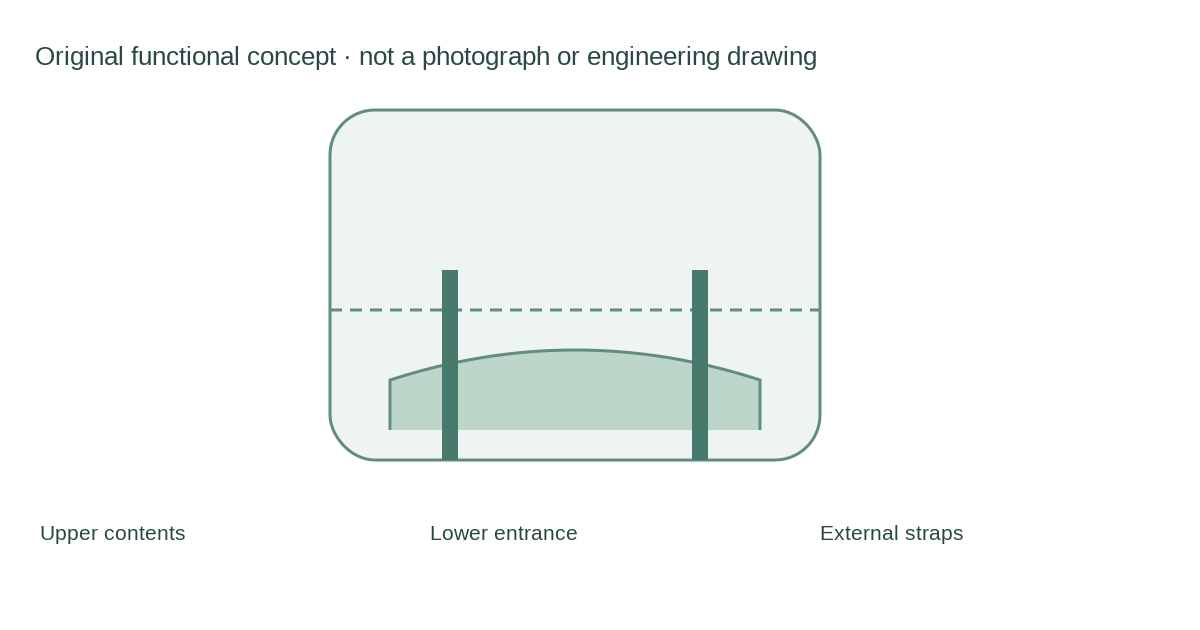
The independent schematic separates external straps, the lower entrance and an internal divider as design subjects. It is not dimensioned engineering or a reconstruction of hidden reference-product structure. Approval should cover the selected configuration's complete retrieval and repacking action.
Discuss your bag development project
ANSON XIE
General Manager & Founder
Quanzhou Junkai Pengda Special Equipment Co., Ltd.
Email: ansonxie@jkpdtime.com
Phone: +86 177 5095 3355
WhatsApp: +86 177 5095 3355
Factory address: Floors 2–4, Building 1, Phase I, Huixin Intelligent Manufacturing Industrial Park, Hui'an County, Quanzhou, Fujian, China