
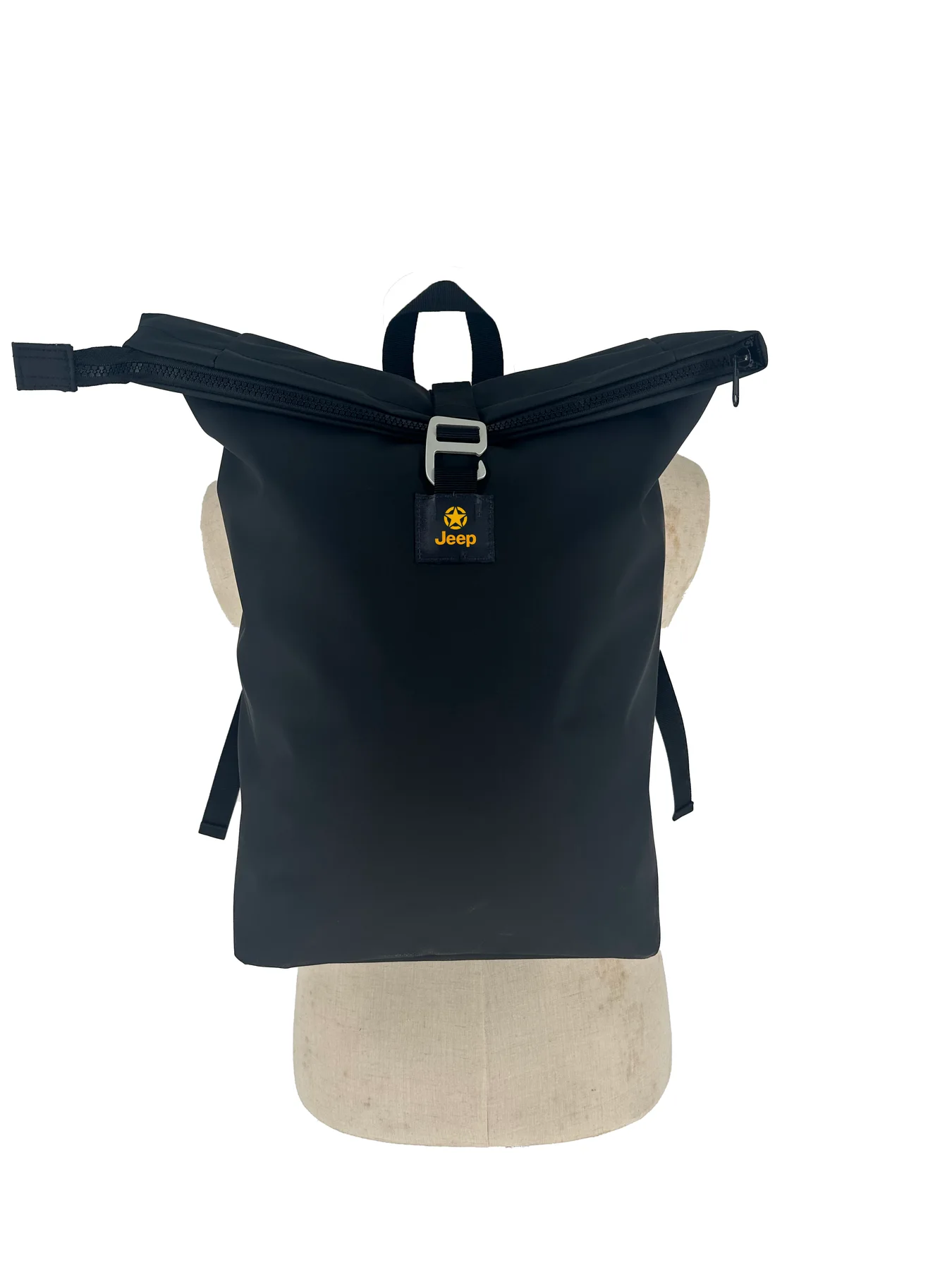
A roll-top travel backpack can look weather-ready while its material paperwork answers only a narrow question. Before approving a shell fabric, establish which material was tested, which face met the water, and whether the specimen was new or pretreated. A hydrostatic pressure result belongs to that specimen and test configuration. It is not a promise that a packed bag will keep every item dry.
The roll-top product photograph illustrates the distinction: a broad shell panel, folded opening, stitched attachments and access points are different parts of the water-entry problem. No pressure rating is claimed for the photographed bag. This review is a proposed purchasing workflow for a travel backpack shell, not a report of a JKPD laboratory test.
01
Start with the purchase decision, not the largest number
Write down what approval will allow. Are you selecting between two coated fabrics, releasing a replacement coating batch, or supporting a particular claim on a finished bag? Those decisions need different evidence. A supplier's best result from an unidentified sample does not establish what is arriving on the cutting table.
For a material comparison, hold the method and preparation consistent and identify both constructions. For a batch release, connect the submitted specimen to the actual delivery. For a finished-bag claim, add a separate evaluation of the assembled product. Do not let a fabric report silently become approval of the opening, seams or accessories.
There is no universal pass value offered here. The buyer and supplier should agree the requirement before testing, with the laboratory confirming whether the requested method and reporting range are suitable. A threshold selected after seeing the results turns a specification into a moving target.
02
Know what the method describes
ISO 811:2018 concerns textile resistance to water penetration under hydrostatic pressure. Its public scope addresses fabrics intended to resist water, rather than the water protection of a complete backpack. Confirm the edition and applicable procedure with the testing laboratory; the public catalogue is not the full operating method.
RISE's service description describes testing material specimens under increasing pressure until water penetrates. It also distinguishes a static-pressure option and notes that seams or pretreatment may be included. These are reasons to read the test configuration, not treat every water-related result as interchangeable.
A pressure that rises to an endpoint and a selected pressure held for a stated time answer different questions. Do not rank those reports by placing their headline numbers in one column. Ask the lab which comparison is valid and retain the complete reports beside the purchasing decision.
03
Identify the actual shell and its water-facing side
A useful sample label connects the roll number, supplier material code, colour, coating description and construction revision. Keep a physical reference with the report. A generic description such as black polyester may cover multiple finishes and cannot resolve a later substitution dispute.
Mark the intended outside and inside of the bag on a companion swatch or submission drawing. Ask the laboratory to record which face is exposed in the test. Do not mark or damage the test area itself unless the laboratory instructs you to. A coating side and a textile face can be difficult to distinguish after samples have been cut and passed between teams.
Record how the specimen was selected. A development swatch, production roll sample and piece taken from a sewn bag have different histories. The report should not imply random production sampling if someone deliberately selected a clean development offcut. Keep that limitation visible when deciding how much confidence to place in the result.
04
Separate new-material evidence from conditioned evidence
A new specimen and a specimen after an agreed treatment should be separate entries in the review. If the intended care or use raises a durability question, define that question before choosing a treatment. Do not add an arbitrary wash or abrasion sequence and then describe it as a universal simulation of travel.
Ask for the treatment method, sequence, conditions and specimen identity to be recorded. If one fabric is tested as received and another after treatment, the difference cannot simply be attributed to their coatings. For a meaningful comparison, keep the preparation matched or explicitly explain why it differs.
Retain the untreated reference as well as the treated result. A change may justify investigating the finish, substrate or processing history, but the pressure result alone does not diagnose the cause. The follow-up should be a targeted investigation with the supplier, not an unsupported claim that one fibre type always performs better.
05
Read results, limits and exceptions together
Check the reported unit before comparing values. Keep the original unit in the approval record, even when a second unit is added for a buyer's spreadsheet. A converted value does not cure a different method, exposure side or endpoint. Ask the laboratory to clarify ambiguous notation instead of guessing.
Request the specimen results and the reported summary, not only a pass stamp. Note exceptions, invalid tests and any limit of the equipment or agreed test range. If the report says the material exceeded a limit, do not invent an exact value above that limit for a catalogue or comparison chart.
Resolve a weak result without hiding it
First check identity and procedure. If a handling problem or invalid test is suspected, agree the reason and resampling plan with the lab. Keep the original result and explanation attached to the retest. Repeatedly selecting a new swatch until one passes destroys the traceability that made testing useful.
06
Give seams and openings their own approval line
The flat shell sample does not contain the entire bag. A roll-top opening depends on its folded configuration; a side access opening adds another route; a stitched attachment interrupts the panel. Those features need an assembled-product review appropriate to the proposed claim and use.
Map the construction before commissioning further work. Identify the panels, joins and openings that need evaluation, then agree the packed state and exposure conditions for the finished bag. Keep any seam-specimen result labelled as seam evidence. It should not be presented as if every seam and opening on every production bag was tested.
For the broader wording distinction, see water-resistant versus waterproof backpacks. The purpose here is narrower: make the material report usable and traceable before it enters the approval package.
07
Release the material with a controlled evidence pack
The final pack should connect the selected material and batch to the report, sample reference, agreed requirement and decision. Include any separate assembly review and the exact claim it supports. Purchasing, cutting and quality teams should be able to identify the approved construction without relying on the person who originally requested the test.
When a supplier proposes a coating, colour or substrate change, reopen the relevant evidence rather than carrying forward the old headline value automatically. Ask what has changed, which earlier findings still apply, and what needs confirmation. A controlled report is useful because its limits are clear, not because it contains an impressive number.
Discuss your bag development project
ANSON XIE
General Manager & Founder
Quanzhou Junkai Pengda Special Equipment Co., Ltd.
Email: ansonxie@jkpdtime.com
Phone: +86 177 5095 3355
WhatsApp: +86 177 5095 3355
Factory address: Floors 2–4, Building 1, Phase I, Huixin Intelligent Manufacturing Industrial Park, Hui'an County, Quanzhou, Fujian, China