
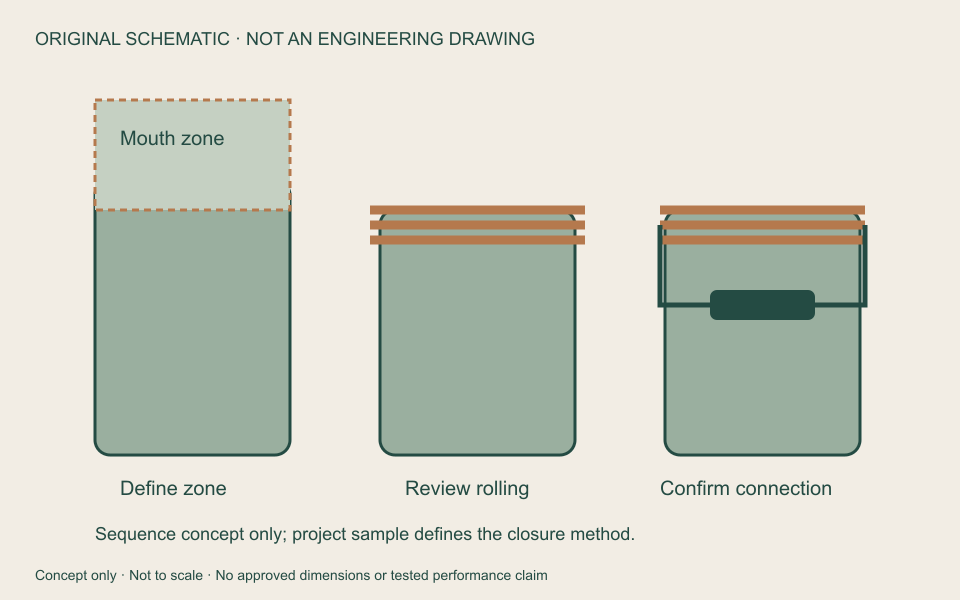
Define the rolling zone, closure connections and the operating sequence under each agreed packing state.
01
Define the rolling zone
Separate the packing region, the rolling zone required by the project and the final connecting components. Identify any mouth strip or other local part in the sample design without inferring hidden material from a photograph.
Do not treat fully extended height as a fill-to-use height. Confirm packing list, rolling requirements and closed outline together. This article prescribes no universal roll count or dimensions.
02
Give each closure arrangement its own path
Record the starting state, rolling direction, end connections and webbing-adjustment sequence. Joining the ends together and connecting to bag sides are different configurations; document and review them separately rather than mixing alternatives in an unidentified photograph.
The original diagram relates mouth region, rolled state and connected state. It does not reproduce a brand’s particular method. Use it for discussion and document confirmed steps with the project sample.
03
Close the bag across defined packing states
Choose reduced, target and any other required packing states. Give each an identifiable contents list and arrangement. Check whether the rolling zone remains usable, connections remain accessible and the main compartment needs rearrangement.
A sample requirement may be to pack the target list while preserving the agreed rolling zone and completing the connection. Record the outcome, steps and observations. A tidy outline does not establish retention of contents.
04
Review reopening and adjacent attachments
Reopen the bag and check whether a top cover, external attachment or excess webbing must move first. Opening and closing belong to the same operating sequence. A simplified sample without specified attachments does not confirm the final arrangement.
For two closure configurations, record reopening separately. Do not describe a rolled appearance as waterproof, airtight or all-weather protection. Such results need evidence for the complete construction under agreed conditions.
05
Handover the approved closure states
Include the mouth drawing, rolling zone, connection arrangement, packing states and operating photographs. Identify the measurement state for closed dimensions so extended and closed dimensions are not confused. List pending verification separately.
Recheck closing and opening after changes to mouth components, side connections or the target packing list. Buyers then have an identifiable approved state rather than an instruction to roll it like the previous sample.
Share material references and sample requirements through the JKPD inquiry page.
Discuss your bag development project
ANSON XIE
General Manager & Founder
Quanzhou Junkai Pengda Special Equipment Co., Ltd.
Email: ansonxie@jkpdtime.com
Phone: +86 177 5095 3355
WhatsApp: +86 177 5095 3355
Factory address: Floors 2–4, Building 1, Phase I, Huixin Intelligent Manufacturing Industrial Park, Hui'an County, Quanzhou, Fujian, China