
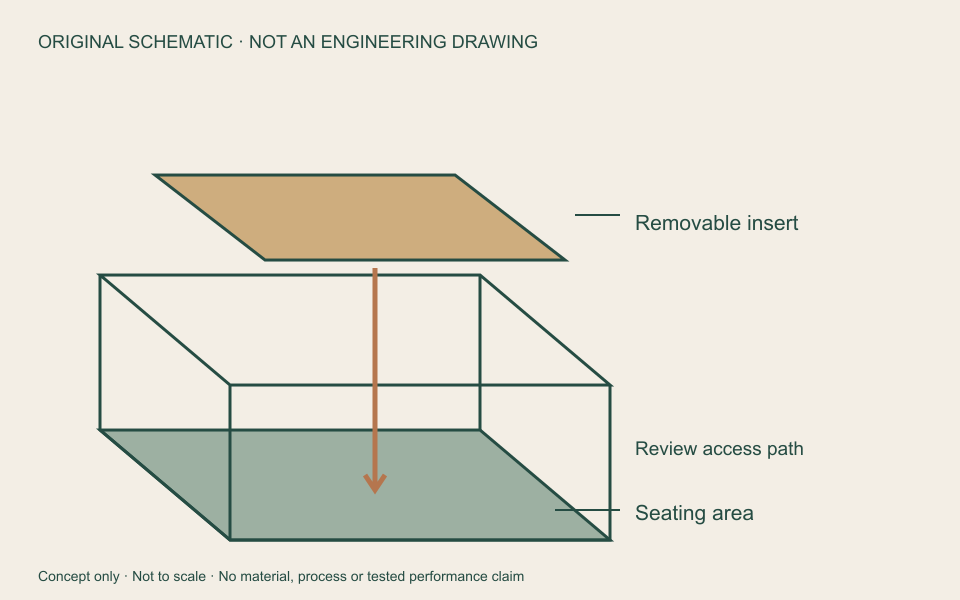
Review a removable base insert with the bag, internal space and removal task. A sheet-material swatch supports an initial material discussion but cannot establish finished fit. For sports equipment bags, travel bags and equipment cases, define why the insert must be removable before setting sample requirements.
01
Define the removal task
Is removal intended for folding, organizing components or accessing the inner base? Describe the actual task. If cleaning is a goal, confirm suitable materials and care separately; a removable insert does not establish that the whole bag is washable.
State how the bag will be used without the insert. Empty storage and continued loaded use are different review conditions and should not share an assumed approval.
02
Measure the finished combination
Define insert measurements, the access opening and the intended seating area. Distinguish cut-panel dimensions, finished internal space and insert dimensions. Include any covering in the insert's approved outline.
Trial-fit the insert in an empty bag, then pack the intended items. Look for pressure against seams, interference with dividers and unwanted projections. A flat photograph does not determine final fit dimensions.
03
Check edges and the removal path
Observe edges, corners and covering ends during insertion and removal. Check contact with lining, zippers and adjacent components. Discuss corner shape and finishing against the actual space rather than imposing a universal radius or allowance.
If the insert must bend to pass through the opening, establish whether that action is intended and review the actual material and structure. A material name alone does not establish repeated bending suitability.
04
Specify position and orientation
State whether the insert sits freely or uses a dedicated sleeve or other locating construction. If direction matters, provide matching orientation marks. Do not leave assembly direction to an undocumented verbal instruction.
Review packing, retrieval, setting down and movement with intended contents. Record unwanted shifting, lifting or interference. One successful movement does not establish stability under every transport condition.
05
Match approval to evidence
Separate outline fit, handling, material confirmation and requirements needing further verification. An insert is not evidence of a protection level or load rating. Establish relevant methods and evidence before making such claims.
Keep insert identification, material records, bag revision, installed and removed views and issue records together. Recheck affected combinations after material or interior-space changes. The illustration shows a general relationship, not a documented JKPD product interior.
Share intended contents, removal purposes and internal-space requirements through the JKPD inquiry page to discuss a removable-insert bag sample.
Discuss your bag development project
ANSON XIE
General Manager & Founder
Quanzhou Junkai Pengda Special Equipment Co., Ltd.
Email: ansonxie@jkpdtime.com
Phone: +86 177 5095 3355
WhatsApp: +86 177 5095 3355
Factory address: Floors 2–4, Building 1, Phase I, Huixin Intelligent Manufacturing Industrial Park, Hui'an County, Quanzhou, Fujian, China