
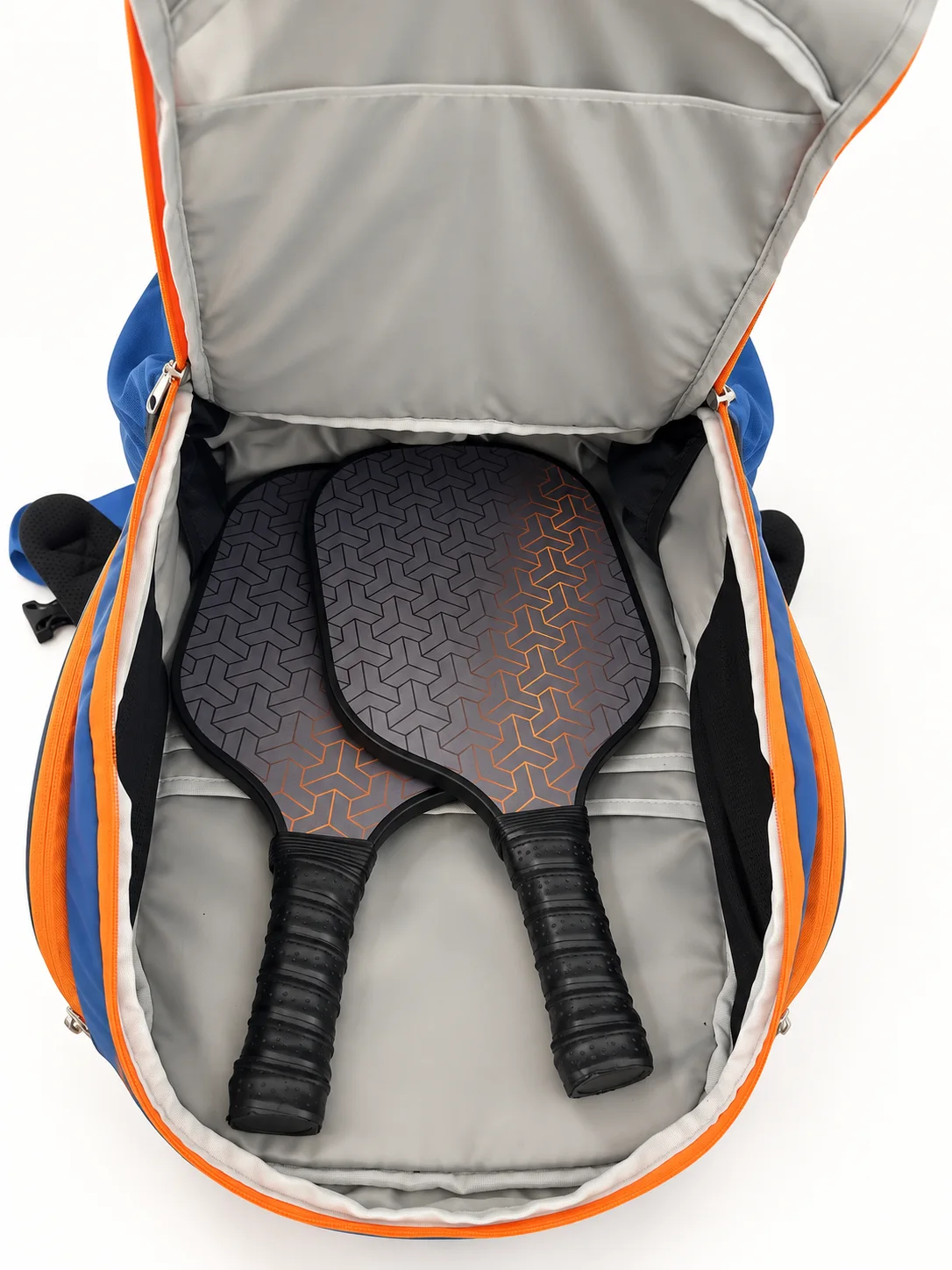
A paddle sleeve should be developed around the equipment it must carry, including the edge guard, grip and any cover. The outside dimensions of the bag cannot tell a buyer whether a paddle will enter smoothly or remain separated from a second one. Specify the occupied shape and insertion route before approving the pocket outline.
For a new pickleball backpack, start with a named paddle set rather than the promise “fits standard paddles.” Record which combinations must fit together and whether handles remain exposed. Then check the sewn sleeve inside a normally packed bag. The following workflow concerns storage compatibility; it does not certify a paddle for competition or establish impact protection.
01
Why aren't equipment-rule limits a sleeve pattern?
The USA Pickleball Equipment Standards Manual, January 2025 revision 3.0, section 2.E.3, limits combined paddle length and width to 24 inches, including the edge guard and butt cap. It limits length to 17 inches and does not impose a thickness restriction. These are equipment rules in that cited edition, not pocket dimensions or clearance recommendations.
Even within those limits, different outlines can occupy a sleeve differently. A broad head and a longer narrow head need different checks at the opening and corners. The manufacturer's stated length and width also do not describe every protruding or curved feature relevant to an insertion path.
Use rule information only to explain the category context. For compatibility approval, obtain actual reference equipment or an agreed dimensional model. If the product is meant to support a changing range, define that range and the review process. Avoid turning a few successful sample fits into a claim that every paddle will fit.
02
Define the equipment envelope and combinations
Measure each reference paddle as it will be stored. Record maximum length, width and thickness, plus relevant edge and handle features. Note whether an overgrip or protective cover is included. A covered and uncovered paddle should not silently share the same approval condition.
For two-paddle storage, define the orientation of both pieces. Handles together, handles opposed and heads separated by a divider create different arrangements. Select the intended arrangement before comparing pocket depth or closure position. Otherwise, two reviewers can reach different conclusions while both believe they are testing the same capacity.
Keep a compatibility matrix
- Identify each reference paddle and its storage accessories.
- Name the permitted single- and two-paddle combinations.
- Record the intended orientation and handle position.
- Mark combinations not yet evaluated as unconfirmed.
Attach photographs to the matrix and retain the sample references where practical. Measurements support communication, but the physical equipment remains useful for checking corners, grip texture and handling. If the reference changes, update its identifier instead of leaving a familiar model name attached to a different setup.
03
Distinguish usable space from the cut pattern
Specify the finished usable sleeve dimensions separately from the pattern pieces. Seams, binding, padding and lining occupy space after assembly. A flat drawing of the outer panel cannot establish the internal clearance available to a rigid paddle head.
Build an early sewn sample using representative layer thicknesses and edge construction. A thin temporary lining can make a trial fit look easier than the production assembly. Conversely, an unusually bulky prototype may create a false need to enlarge the whole bag. Identify these differences before approving a dimensional change.
Review the head corners and the transition toward the handle. The largest flat width is only one checkpoint. A curved seam or binding turn may constrain the paddle before it reaches the bottom. Mark the contact position on a photograph and relate it to the pattern, rather than asking for an unspecified increase in pocket size.
04
Check the complete insertion and removal path
An object can fit inside a cavity yet be difficult to move through its opening. Follow the intended insertion sequence with the actual paddle and the bag held in its expected position. Note whether the user must flex the sleeve, rotate the paddle or move another component aside.
Pay attention to the zipper ends and corners when a zipped opening is used. The usable opening depends on where the slider stops and how the surrounding panels can move. A nominal zipper length is not the same as an unobstructed passage of that length.
Repeat removal as a separate task. Ask the reviewer to take out one paddle while leaving the other equipment in place. Record interference with a handle, a divider or the closure. Decide which handling steps are acceptable for the intended use before describing the sleeve as quick-access storage.
05
Evaluate separation with the bag packed
Check the paddle compartment alongside the intended main-compartment contents. Clothing, footwear and other equipment can press against shared walls. A sleeve demonstrated in an otherwise empty bag may have less usable clearance once neighboring spaces are occupied.
Use a consistent packing list and arrangement for comparisons. If a new sample appears tighter, verify that the packed contents have not changed before revising the pattern. Include the condition after a frequently used item has been removed, because an unsupported divider may settle differently.
For two paddles, inspect whether the divider stays between the intended contact areas throughout insertion and removal. Do not assume a short fabric strip separates the full heads. The pickleball compartment design article addresses broader storage allocation; this review focuses on the sleeve's occupied shape and handling path.
06
Separate fit claims from protection claims
A successful fit check establishes only the evaluated compatibility and handling conditions. It does not demonstrate that the sleeve protects a paddle against impact, abrasion or pressure in every use situation. Any such claim needs a separately defined assessment suited to the finished bag and intended use.
Describe padding by its identifiable construction rather than by an unsupported protective rating. Record where it covers the paddle and where seams or openings interrupt that coverage. If the brand requires a particular protective function, agree the test configuration and acceptance criteria before using that function in product copy.
Keep moisture management separate as well. A paddle sleeve is not automatically a drying compartment because another part of the bag uses mesh. Review the actual storage conditions and consult the equipment supplier's care guidance. Related ventilation-panel design involves a different set of assembly questions.
07
Approve a repeatable sample, not a loose promise
The handover should include the sleeve drawing, finished dimensional references, material stack, zipper or closure reference and compatibility matrix. Add photographs showing the packed bag, insertion route and final paddle positions. Keep the sample revision visible in every record.
When materials or construction change, repeat the affected fit conditions. A lining substitution, thicker binding or altered zipper stop can change handling without changing the advertised bag size. Check the approved equipment combinations before deciding that the change is minor.
A precise result is more useful than a broad claim: the identified paddle combinations fit the identified sample, in the documented orientation and packing condition. The JK-103 pickleball backpack is a product-format reference, not evidence that a specific paddle pairing has passed this workflow. Confirm that pairing on the physical sample before publishing compatibility claims.
Discuss your bag development project
ANSON XIE
General Manager & Founder
Quanzhou Junkai Pengda Special Equipment Co., Ltd.
Email: ansonxie@jkpdtime.com
Phone: +86 177 5095 3355
WhatsApp: +86 177 5095 3355
Factory address: Floors 2–4, Building 1, Phase I, Huixin Intelligent Manufacturing Industrial Park, Hui'an County, Quanzhou, Fujian, China