
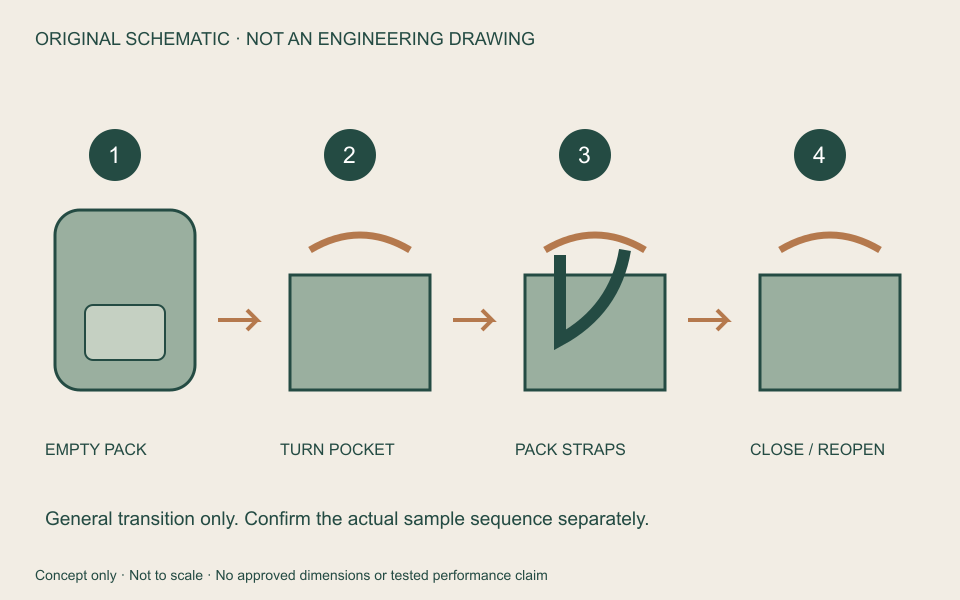
Develop a packable backpack stow pocket around the full transition: empty, arrange, pack, close and deploy again. A photograph of the final bundle does not establish whether an ordinary user can reproduce it. Deliver the sequence alongside packed-size records so the requirement can be reviewed consistently.
01
Define the method and starting condition
Specify a separate storage pouch or an integrated pocket that reverses for storage. For a separate pouch, define how it stays with the pack. For a reversing pocket, identify opening, inside and outside faces, and closure locations in both states.
Specify an empty starting condition and which accessories remain attached. If support pieces or accessories must be removed, include this in the requirement rather than omitting them when photographing the packed sample.
02
Record the packing sequence
On the sample, document pocket reversal, body folding or arrangement, strap insertion and closure in order. Photograph each actual state and mark the grasping locations. Expanded and packed photographs alone leave the intermediate operation undefined.
The original sequence diagram explains a general transition. It is not the confirmed method for an existing product. Check the instructions against the intended sample and resolve any difference before approval.
03
Include straps, hardware and cord ends
After arranging the body, check that straps, adjusters and cord ends enter the intended locations. Record components pressing against the closure, entering a zipper path or remaining outside the bundle. Review again after adding sternum adjustment or accessories.
Do not size the stow pocket from fabric alone without retained hardware. Every component included on the finished sample belongs in the packing combination used for review.
04
State packed-size measurement conditions
Measure the outside after completing the agreed sequence and closing the pocket. Record compression, continued hand support and measurement locations. Consistent conditions make different sample revisions comparable.
Document closure actions separately from dimensions. A target size may still require extra squeezing, repeated rearrangement or an external strap. Report those actions rather than using the final dimensions as evidence of easy packing.
05
Deploy the pack before closing the review
Reopen the stow pocket, remove the body and restore straps and adjustment components. Confirm intended compartment and pocket access. Record tangles or steps that are difficult to reverse. Agree cycles and acceptance conditions separately for repeated conversion requirements.
Retain pack revision, included accessories, sequence photographs, measurement conditions and unresolved issues. Provide the intended storage space and carrying scenario through the JKPD inquiry page to define packable backpack sampling requirements.
Discuss your bag development project
ANSON XIE
General Manager & Founder
Quanzhou Junkai Pengda Special Equipment Co., Ltd.
Email: ansonxie@jkpdtime.com
Phone: +86 177 5095 3355
WhatsApp: +86 177 5095 3355
Factory address: Floors 2–4, Building 1, Phase I, Huixin Intelligent Manufacturing Industrial Park, Hui'an County, Quanzhou, Fujian, China