
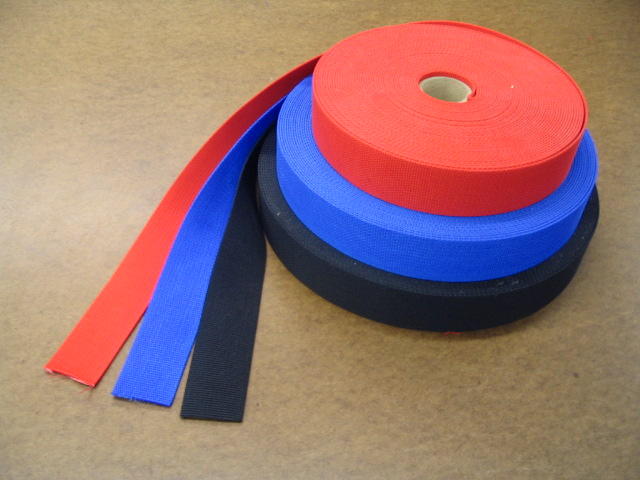
Photo: Scottanon (English Wikipedia). Public domain (author dedication) · Original source. Unmodified for this article. The image remains under its stated license; no endorsement or JKPD material use is implied.


01
Which names identify composition, and which describe appearance?
Nylon is a polyamide and polyester belongs to a different polymer family. Terms such as imitation nylon, seat-belt style or heavy duty do not independently establish fiber content. Separate composition from appearance, weave and hand feel when requesting a supplier declaration and article number.
Bally Ribbon Mills explains the respective fiber classes in its nylon and polyester references. Its values are guides that vary with yarn and manufacturer. They cannot directly rank two unidentified rolls of finished webbing.
Also separate elastic from non-elastic constructions. If elastic yarn is present, request its identity and the required extension and recovery behavior. A seller’s nylon label alone does not establish a pure-nylon, non-elastic strap.
02
What can the roll photograph establish?
The photograph shows red, blue and black rolls, with loose lengths and visible edges. It illustrates the supplied form of narrow webbing. There is no composition, dimensional or test identification, so none of the colors can responsibly be labeled nylon or polyester from the image.
Build a sample card around the article number, lot, width, thickness, mass per meter, composition and finish. An unlabelled colored strip makes a later repeat order difficult to compare with the approved material.
Separate similar appearance from equivalent specification. Even when colors match, compare edges, weave, handling and recorded measurements. Use photography to track appearance while keeping material identity and performance evidence in the supplier file.
03
Why separate moisture absorption from surface wetting?
Nylon is hygroscopic, whereas the polyester reference describes low moisture absorption. That is a fiber-level distinction, not proof that a finished strap cannot retain water. Its construction, overlaps, sewing thread and finish create a more specific practical question.
For an outdoor bag, compare dry samples with samples wetted under an agreed procedure. Review length change, adjustment feel and color transfer against the intended adjacent fabric. Record wetting and recovery conditions instead of using an ambiguous label such as “after washing.”
If a supplier claims fast drying, ask for the comparison material, specimen dimensions and conditions. Low fiber moisture absorption does not establish a drying-time guarantee for the strap or the complete bag. Confirm the proposed construction rather than extending a generic fiber advantage.
04
How does breaking elongation differ from usable strap length?
Elongation at break describes behavior near rupture. Everyday bag use raises different questions: extension under the use load, movement at an adjuster and recovery after unloading. Comparing peak breaking force alone can miss a strap that repeatedly needs tightening.
The nylon reference discusses extension and energy absorption; the polyester reference lists dimensional stability and controlled elongation. These are useful selection directions, not proof that every nylon article is softer, stronger or more slippery than every polyester alternative.
Ask for load-extension behavior, breaking force and residual change after unloading as separate results under comparable conditions. Repeat the assessment with the intended adjuster. Record movement of the strap through the hardware so that buckle slip is not mistaken for fiber extension.
05
Why do weave and finishing belong in the comparison?
Evaluate construction and finish alongside fiber identity. Narrow webbing can take flat or tubular forms, as outlined in Bally Ribbon Mills’ webbing introduction. The same polymer name does not settle thickness, bending behavior or fit through a particular hardware slot.
Screen each material against its intended task. An adjustable strap needs a hardware-fit assessment; a handle needs a grip and foldback review; binding needs a separate corner and coverage assessment. Approval for one function should not silently become approval for every location.
Before sewing, confirm cutting, end finishing and the complete stack. Thermal cutting requires an article-specific process window. A finish that changes stiffness or surface condition also warrants another check of sewn appearance and hardware behavior instead of inheriting conclusions from an earlier sample.
06
Related manufacturer video
Related video:Beginner’s Guide to Webbing: How to Pick the Right Type of Webbing · Sailrite Workbench
Supplementary viewing only. The video does not certify the illustrated material or the proposed bag assembly. Use current article-specific documentation for approval.
07
How can the purchase inquiry create a fair comparison?
Put the candidates on one requirements sheet: functional location, fiber content, article, width and thickness tolerances, mass per meter, color, weave, finish and hardware model. Add the dry and wet conditions to be assessed. If these cannot be matched, state the differences rather than declaring a simple winner.
Keep combination samples of each candidate and its adjuster. After approval, retain identified material and sewn samples. A later substitution should explain changes in composition, weave, finish or dimensions as well as price, followed by review of the functions those changes could affect.
This framework does not prescribe one fiber for every bag. It gives the purchasing team a reasoned basis for selecting a particular article and a clear record of what still needs confirmation.
Related reading: backpack webbing development.
Share the application, candidate material articles and available records through the JKPD project inquiry page.
Discuss your bag development project
ANSON XIE
General Manager & Founder
Quanzhou Junkai Pengda Special Equipment Co., Ltd.
Email: ansonxie@jkpdtime.com
Phone: +86 177 5095 3355
WhatsApp: +86 177 5095 3355
Factory address: Floors 2–4, Building 1, Phase I, Huixin Intelligent Manufacturing Industrial Park, Hui'an County, Quanzhou, Fujian, China