
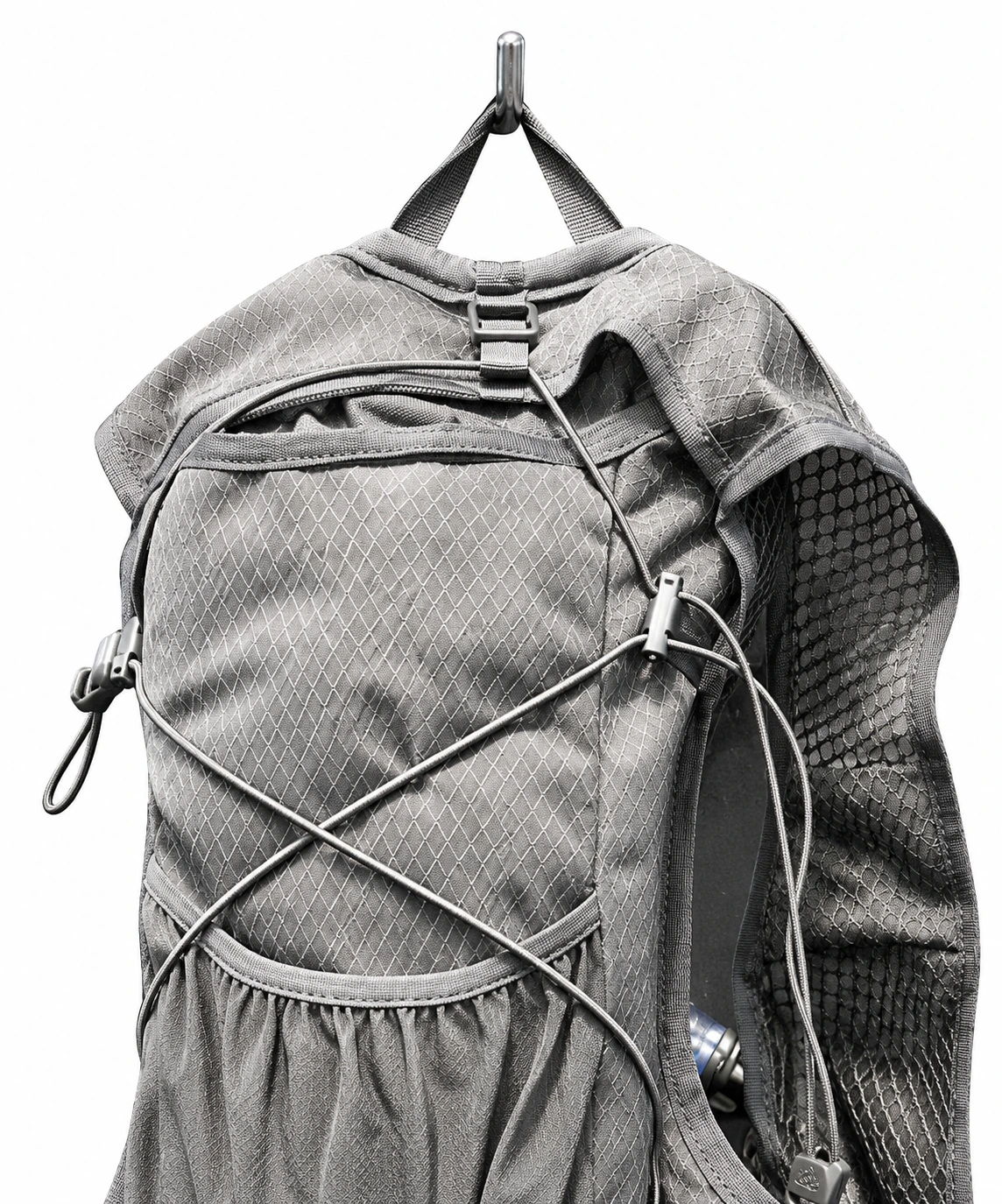
Review upper packing volume together with closure position and head movement. Treat added capacity as a different loaded configuration, then confirm the space around the user on the actual sample.
Photo: Matti Blume · Source · CC BY-SA 4.0. Upper-pack detail crop; ordinary branding/background cleaned with AI. Adaptation under the same license.
01
Added volume creates a different upper shape
The ability to fit an object into the top of a mountain pack does not establish a suitable worn configuration. Soft clothing and rigid objects create different upper shapes. Define the packing range, the closed outline and the required head movement together before describing an extension as usable capacity.
The grey upper-pack detail shows overlapping panels, a handle, a front zipper pocket and cord. No wearer or head clearance is shown. Hidden closing steps are not established. The exhibition hanging point is part of the display, rather than evidence of a carrying test.
02
Describe separate packing configurations
Review ordinary, reduced and extended upper packing as separate configurations. List the objects near the top, including rigid edges and items that can shift. A label such as fully loaded is incomplete without a contents list and a record of how the objects are arranged.
If extension requires a different lid-strap length or upper closure position, check whether the operating action and intended coverage remain available. Added nominal volume should not silently assume that the user accepts a new projection behind the head. Record the changed outline alongside the capacity description.
03
Treat head movement as part of packing design
For the intended activity, have a fit reviewer wear the target clothing and use the specified torso and shoulder adjustments. Observe the top edge during ordinary head turns and upward movement. Products intended for helmet use need review with the target equipment by appropriate personnel, rather than a deduction from an empty pack.
When contact appears, identify whether it comes from the body, lid or external equipment before changing the arrangement. Tightening shoulder straps is not a universal correction. This is a development review of available space, not climbing instruction or guidance on the use of protective equipment.
04
Compare the visible upper boundaries separately
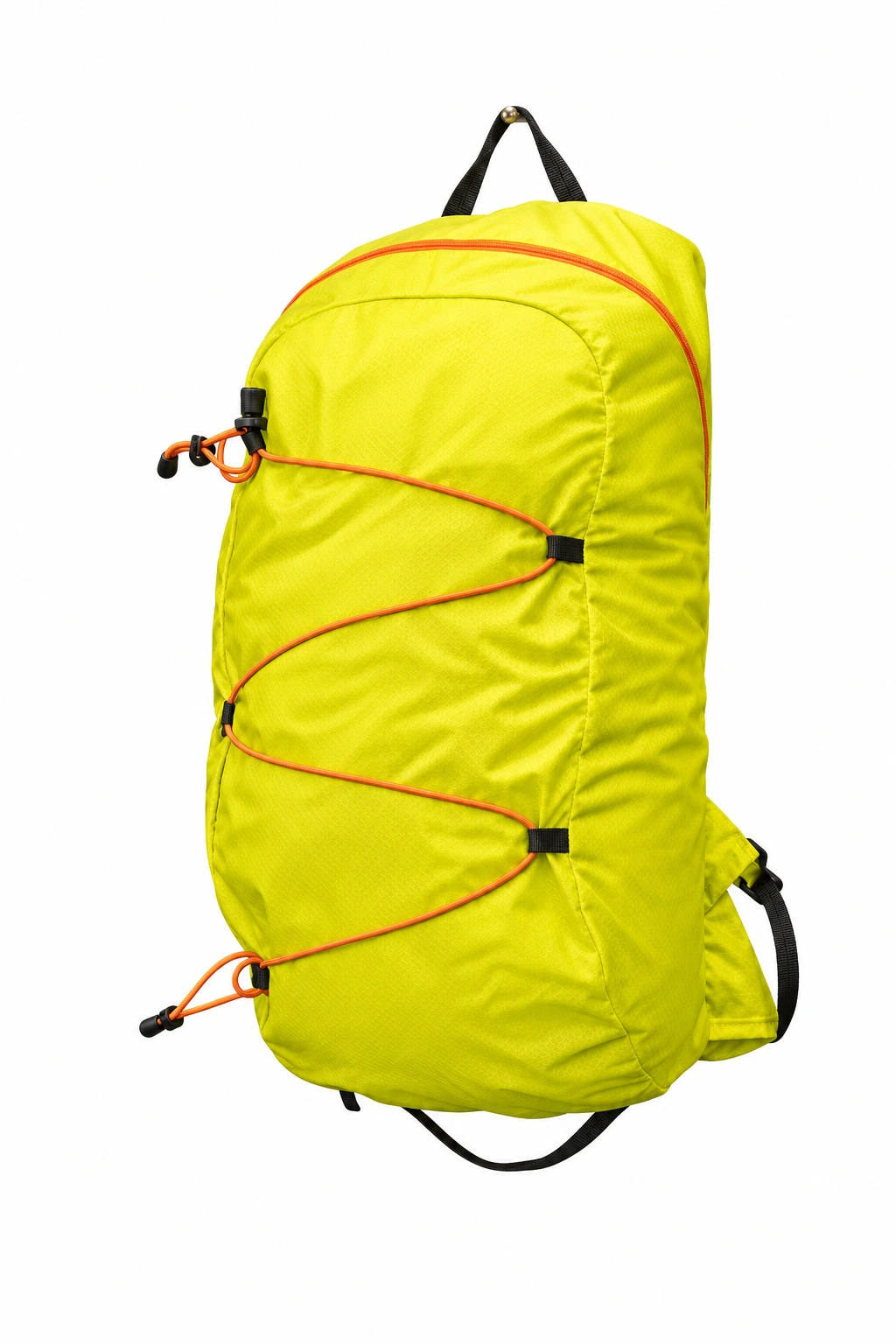
The yellow reference photograph shows another product, with a curved upper edge, an orange zipper route and front cord. It is not an alternative state of the grey pack. Wrinkles in either picture do not reveal the contents, remaining capacity or an unseen closure mechanism.
The pair illustrates why the upper boundary needs width, depth and height, rather than a single maximum-height line. A curved upper edge and overlapping upper panels create different questions. Confirm the geometry with front, side and worn views of the same sample and packing configuration.
05
Match upper materials to the intended contents
A flexible panel can change shape with its contents. Whether it needs local support or reinforcement depends on the closure arrangement and expected contact locations. Neither a thin-looking surface nor a firm-looking outline establishes the material construction. Give the supplier the actual composition and use requirements to resolve.
If the intended contents have rigid corners, define their location and protection before selecting nearby panels. These photographs establish no puncture, abrasion or water-resistance rating. Logo-cleaned surface texture cannot identify a coating. Material claims require evidence tied to the actual textile and finished configuration.
06
Deliver the extension limits with the capacity claim
Record the acceptable upper shape, closing action, target clothing and equipment combination, together with observed limitations. If only certain packing arrangements have been reviewed, preserve that qualification. A capacity figure alone does not explain how the additional space should be occupied while the pack is worn.
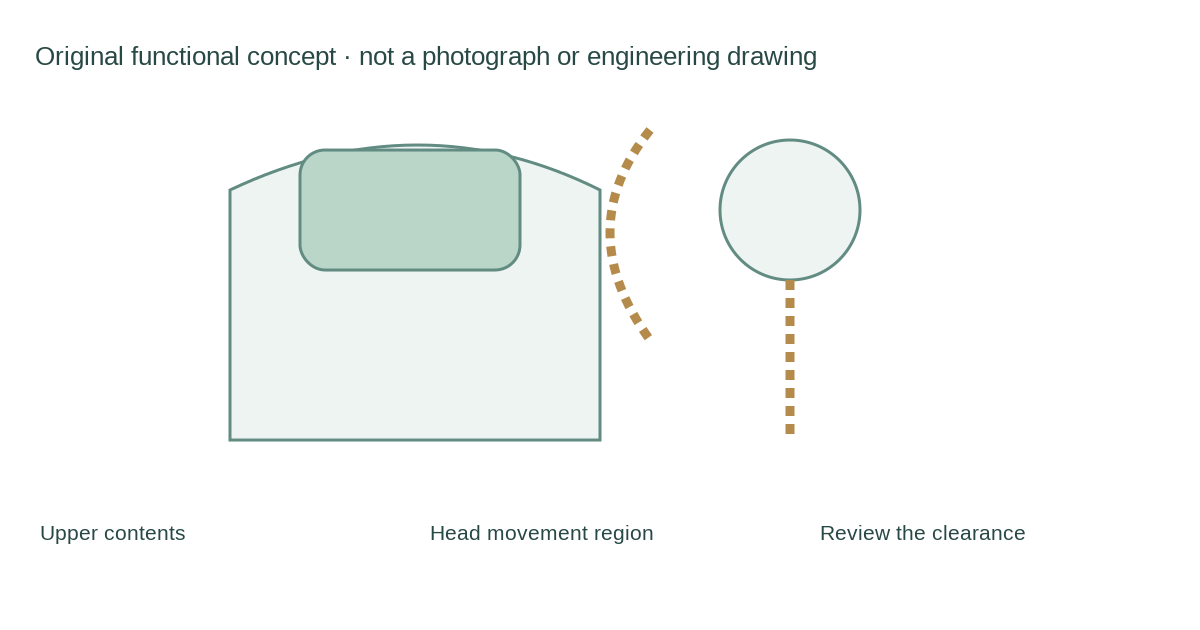
The original schematic separates upper contents, a head-movement region and the boundary needing review. It is not dimensioned engineering or a reconstruction of either photographed product. The development objective is useful, defined additional space, rather than simply making a sample taller for a photograph.
Discuss your bag development project
ANSON XIE
General Manager & Founder
Quanzhou Junkai Pengda Special Equipment Co., Ltd.
Email: ansonxie@jkpdtime.com
Phone: +86 177 5095 3355
WhatsApp: +86 177 5095 3355
Factory address: Floors 2–4, Building 1, Phase I, Huixin Intelligent Manufacturing Industrial Park, Hui'an County, Quanzhou, Fujian, China