
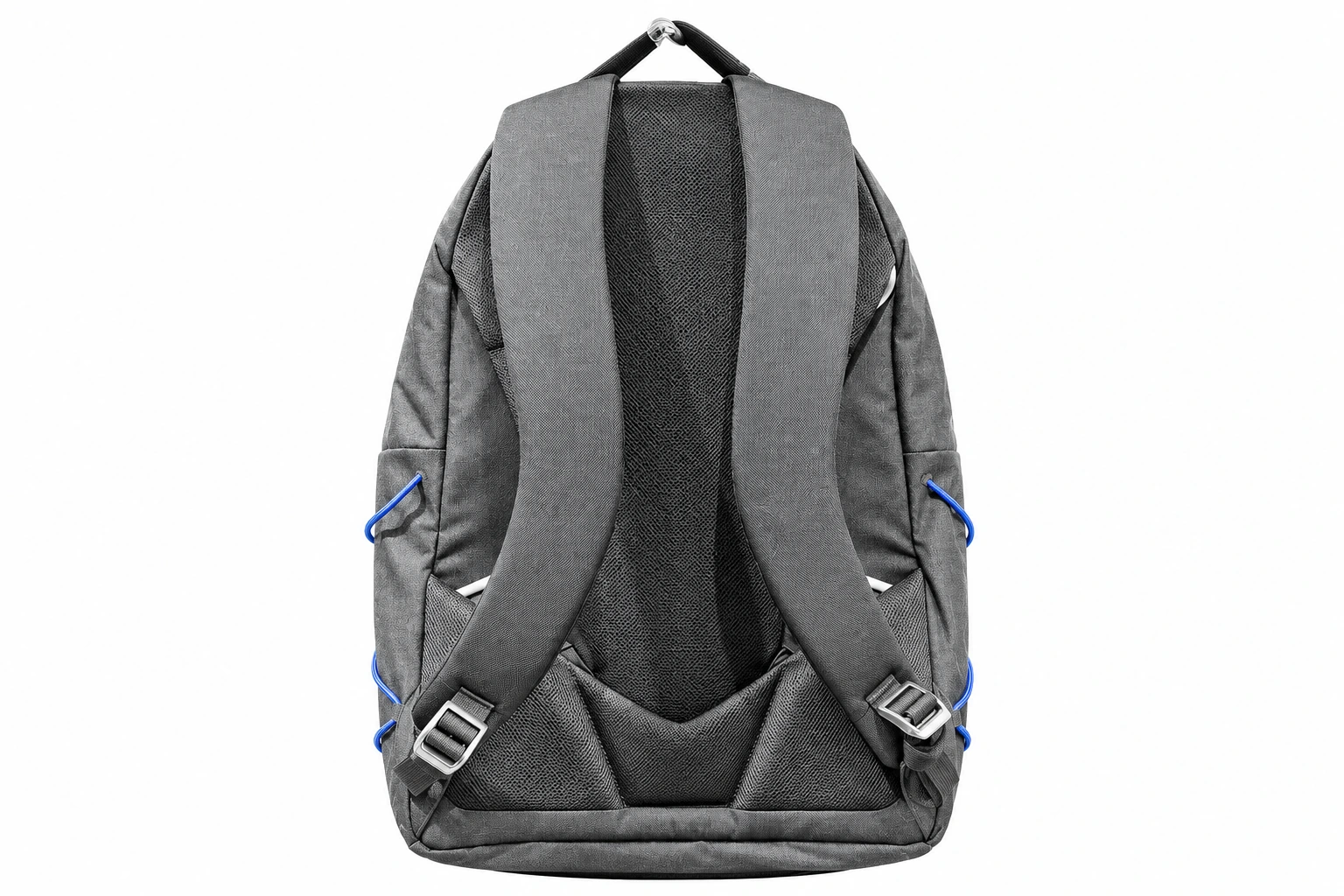
Plan inspection and cleaning access around back-panel surfaces, shoulder straps and overlapping layers. Separate visible gaps from concealed construction and verified ventilation.
Photo: Matti Blume · Source · CC BY-SA 4.0. Ordinary product branding/background cleaned with AI; visible structure reference only. Adaptation under the same license.
01
A back panel needs access as well as a carrying shape
Hiking-pack development usually starts with the worn outline. The contact region also needs to be inspected, cleaned and dried after use. A shoulder strap covering a surface or a hipbelt overlapping an edge changes where a hand or cloth can reach. Include those actions in the design brief before writing the final care instructions.
The first photograph shows a grey pack with shoulder straps, a central mesh region and lower adjusters. It documents visible surface positions, not internal support, concealed attachment, removability or load capacity. Ordinary branding and the exhibition background have been cleaned. Local surface reconstruction is not manufacturing evidence.
02
Separate surface inspection from disassembly
A visible seam is not permission to open it. Define the areas that users should reach without tools, then identify work reserved for appropriate repair. Cleaning a small contact region should not require an improvised change to a connection that locates the harness or supports the bag.
Where adjustment is intended, preserve the approved threading arrangement and provide a return reference. Instructions must match the actual construction. This article does not direct disassembly of either reference pack or identify an exposed component as removable. A different model's maintenance procedure cannot establish the correct method here.
03
Include edges and overlapping layers in the access route
The middle of a surface can be easy to see while a shoulder-strap underside, pad edge or webbing crossing remains obstructed. On a development sample, mark the route needed by sight, a hand and a soft cloth. Observe whether several straps must move at once. Reducing avoidable obstruction is more useful than enlarging every gap.
A larger separation can also change contact coverage, movement of components and the loaded outline. Review these effects together. Apparent distance in a photograph is not a dimension, and an opening behind a harness is not automatically a verified ventilation channel.
04
Review the whole back and the local strap detail
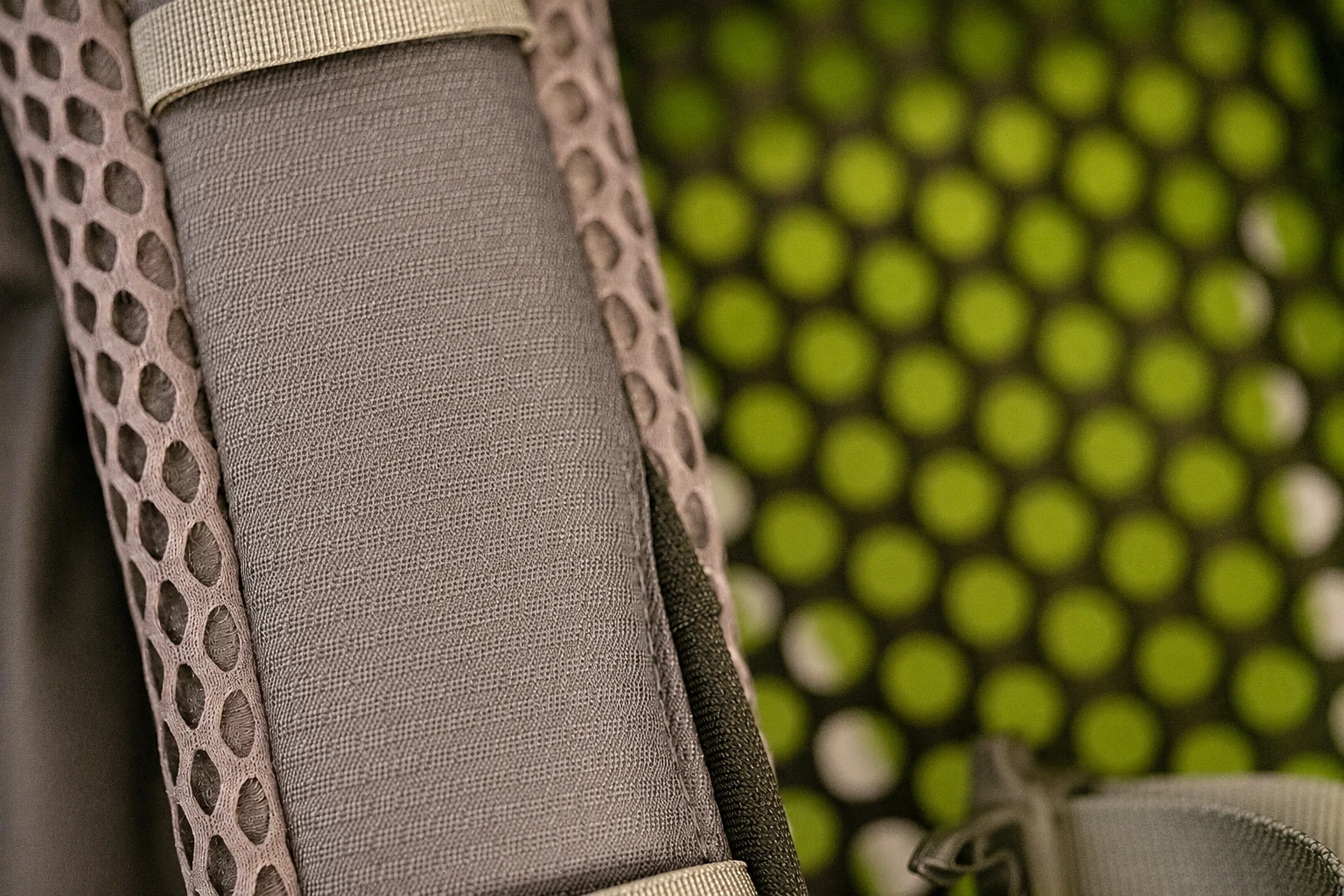
The second photograph is a close-up of another pack: a grey shoulder-strap face, mesh edges and green mesh behind it are visible. It does not show the whole pack or internal support. The comparison moves from overall layout to local contact details; it neither establishes a shared frame design nor ranks cooling performance.
A relatively continuous back face may allow surface-level access. An arrangement with overlapping layers and separated contact regions introduces additional boundaries to inspect. Establish the actual handling space on the sample rather than ranking cleaning difficulty from exterior appearance alone.
05
Consider the whole assembly when selecting lighter textiles
Mesh openings or a thin face are only part of the construction. Padding, binding, seam layers and overlapping webbing also affect the finished assembly. Material review should include whether the back can be left in its intended open drying state and whether layers remain accessible, rather than requesting breathable fabric alone.
Care methods still need to follow the finished product's instructions. Distinguish wiping, local cleaning and any other approved treatment. Do not add machine washing, heating or compulsory disassembly without an applicable basis. No drying time or material-performance measurement is reported for the photographed products.
06
Add the after-use state to the sample handover
Alongside the worn view, show loosened straps, an opened hipbelt and the intended surface-inspection state. Identify the connections that remain undisturbed. Record hidden or difficult-to-reach regions before choosing a strap-route, pad-edge or instruction change.
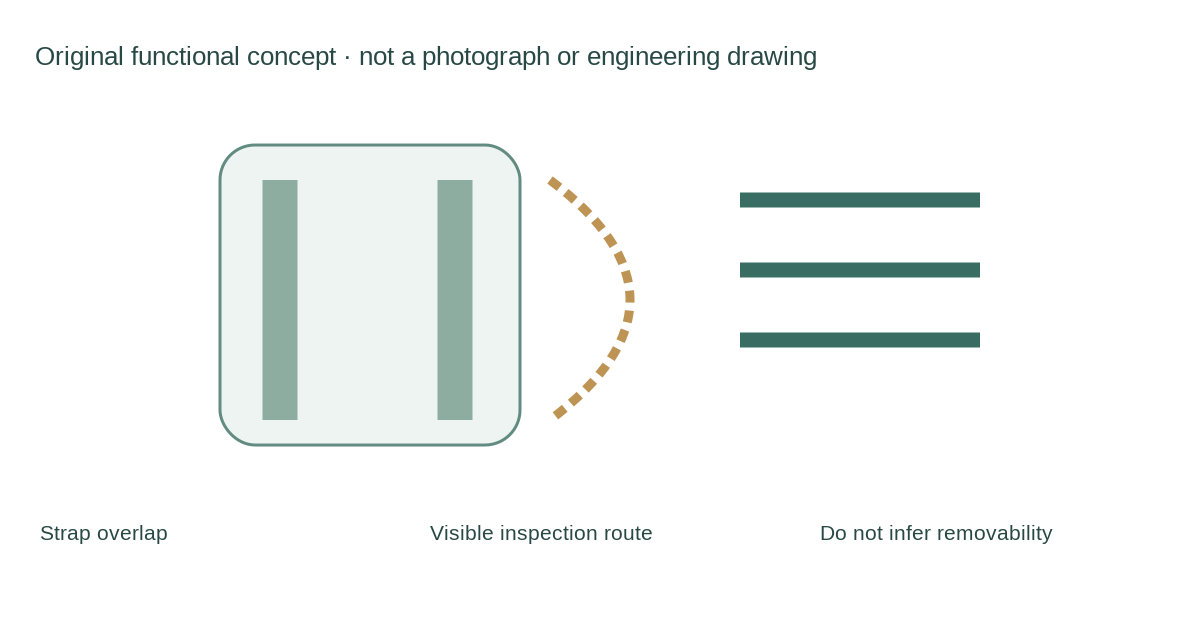
The original schematic explains sight and hand approach only; it is not a confirmed drawing of either product's hidden construction. These external packs are not JKPD manufacturing cases. The useful development outcome is a clear definition of maintenance access as part of the pack's functional layout.
Discuss your bag development project
ANSON XIE
General Manager & Founder
Quanzhou Junkai Pengda Special Equipment Co., Ltd.
Email: ansonxie@jkpdtime.com
Phone: +86 177 5095 3355
WhatsApp: +86 177 5095 3355
Factory address: Floors 2–4, Building 1, Phase I, Huixin Intelligent Manufacturing Industrial Park, Hui'an County, Quanzhou, Fujian, China