
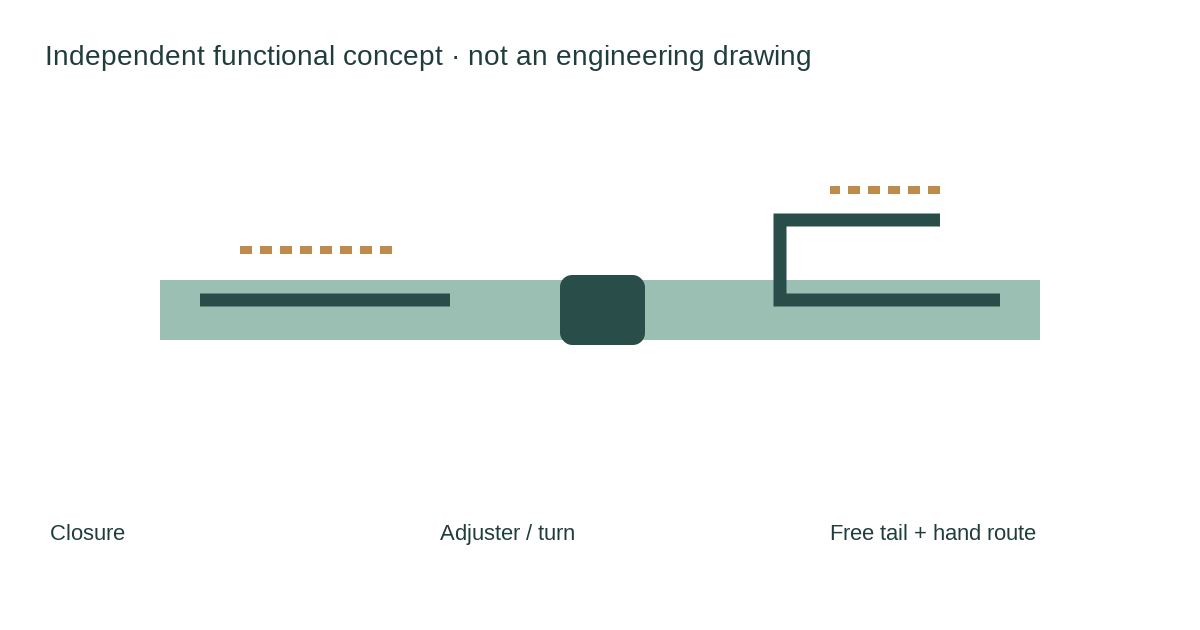
The hand movement used to tighten a belt comes from its routing. Separate the closure buckle, adjustment component and free tail, then develop the direction of pull without assuming that a return route supplies a particular force advantage.
01
What closes the belt, and what changes its length?
The front buckle closes the belt. An adjustment component beside it or on a wing changes effective webbing length. These functions can share a component or sit apart. Finding the closure still leaves the user needing to identify the correct webbing segment, pulling direction and release action. Separate these operations before developing the route.
Draw the wing, webbing and adjuster before comparing movement. The direct and return routes in the diagram are construction options, not claims about hidden anchors, allowable loading or a measured force ratio.
02
Why choose a forward pull or another direction?
Pulling a tail directly out of an adjuster and returning webbing before grasping it lead the hand towards different spaces. This can affect reaching behind the hip, approaching a belt pocket or locating the adjuster while wearing an outer layer. Begin with the intended hand movement rather than a preferred component count.
A convenient-looking return route on one belt does not establish compatibility elsewhere. Component orientation, turning points and how far the wing wraps around the body all affect operation. Do not infer a particular mechanical advantage or force ratio from appearance alone.
03
Where should the grasping area sit?
The waist closure and lower shoulder webbing can share the same working space. Check where the hand approaches the adjuster with the intended top layer on. A clear path at a standstill is not proof of one-handed operation for all wearers.
A tail resting behind the buckle may require another layer to be lifted first. Compare adjuster position, a recognisable grasping segment and a suitable parking location. Permanently stitching the free tail down can remove useful adjustment travel even if it makes the display neater.
04
What changes when the wing becomes more flexible?
A flexible wing can change shape as the user pulls, taking the adjuster with it. Local support can preserve a more defined component orientation while adding bulk or changing contact. The choice should identify where direction needs maintaining rather than request that the entire belt become thicker or thinner.
Confirm webbing and adjusters as an actual combination. A similar outline does not establish fit or friction, so approve grasp, release and repeated adjustment with the final components under agreed conditions.
05
How do pockets share the operating space?
A zipped wing pocket and a forward-pulling tail may share the same part of the belt. Pocket placement, the hand route towards the adjuster and tail parking can compete. Check them together before deciding where the pocket opening goes.
Identify the routine actions: close, tighten, loosen and retrieve the pocket item. State whether a second hand or temporary placement of another object is needed. An intentional sequence can be acceptable, but an orderly static photograph does not establish that the movement is convenient.
06
How much routing detail should the supplier receive?
Mark the fixed end, turns, adjuster and free tail separately, and identify the tightened or released state. Use an independent concept to compare alternatives. Product confirmation still requires a physical assembly or clear construction drawing instead of leaving the threading to the operator's interpretation.
The final instructions should match the approved sample. Recheck the sequence after a change of buckle, webbing width or wing layers. This keeps the discussion centred on whether the user can find, grasp and adjust the belt as intended, rather than on an unsupported claim about an extra force-saving buckle.
Related guide: Hipbelt padding coverage
Discuss your bag development project
ANSON XIE
General Manager & Founder
Quanzhou Junkai Pengda Special Equipment Co., Ltd.
Email: ansonxie@jkpdtime.com
Phone: +86 177 5095 3355
WhatsApp: +86 177 5095 3355
Factory address: Floors 2–4, Building 1, Phase I, Huixin Intelligent Manufacturing Industrial Park, Hui'an County, Quanzhou, Fujian, China