
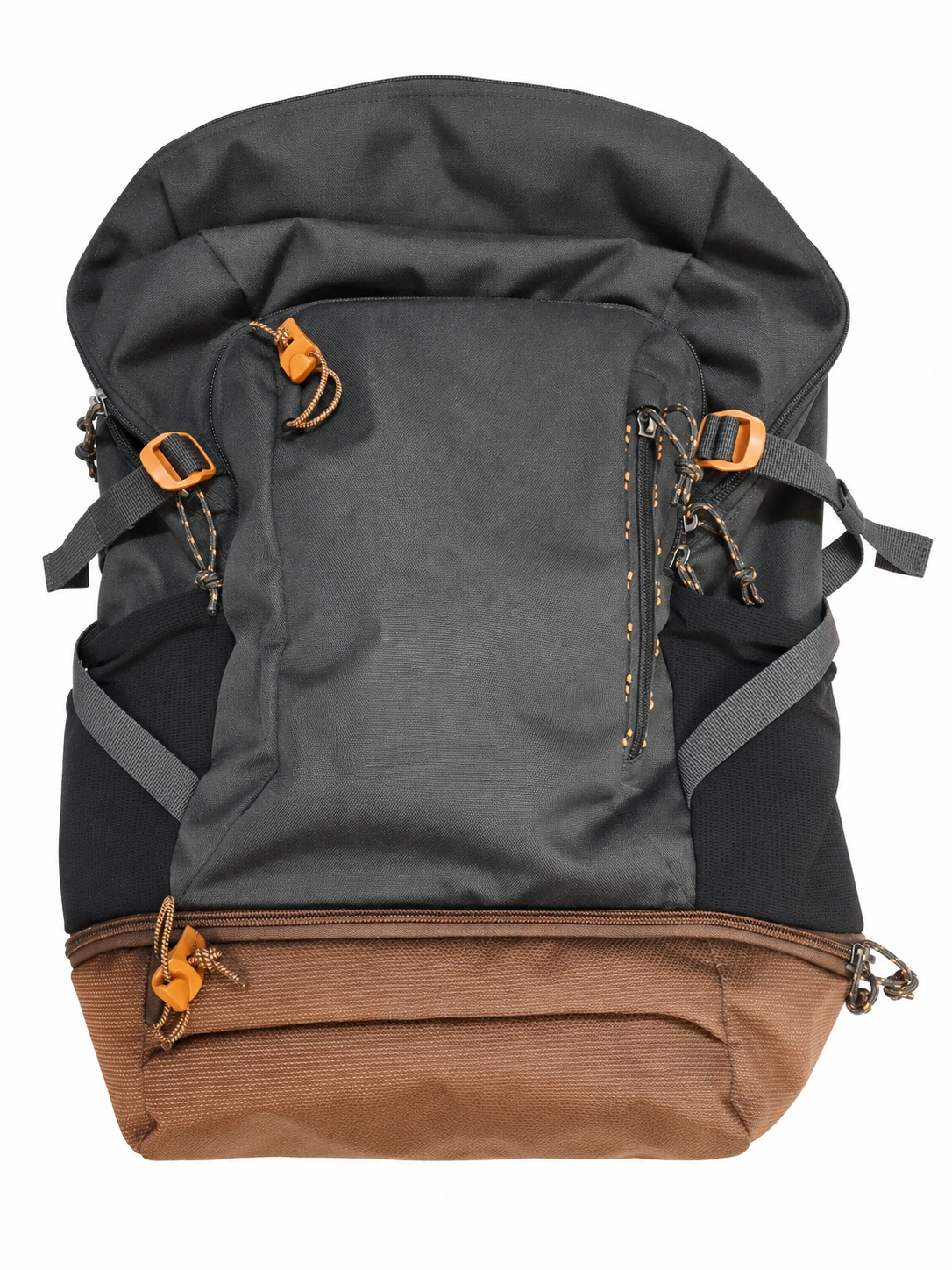
Plan twin vertical front pockets around retrieval order, zipper reach and shared depth. Review the packed main compartment before approving a hiking-daypack layout.
Photo: Fructibus · Source · CC0 1.0. Ordinary product branding/background cleaned with AI; visible structure reference only.
01
Give the two entrances distinct jobs
Front storage on a hiking daypack should help someone find a small item during a stop. Two vertical entrances can create a recognizable left-and-right arrangement, but adding openings is useful only when item categories and retrieval order are clear. Otherwise the user still has to search each pocket.
The front photograph shows two approximately vertical zippers with cord pulls and a lower horizontal pocket entrance. None is open, so the image does not establish internal separation, accessible volume or waterproofness. It is a reference for visible entrance placement, not proof of the construction behind the face.
02
Divide storage by the retrieval action
Frequency of use, whether handling needs both hands and how an item returns to storage are useful starting points. A deep pocket may still require searching. A shallow one may force an object sideways against the zipper. Define the intended items and handling action before deciding the useful pocket space.
A left-and-right layout does not automatically suit both hands. Hand approach differs when the pack is placed in front of the user, set down or accessed by a companion. Select the zipper's closed position with those states in mind. A front photograph cannot establish on-body reach.
03
Specify entrance length and containment separately
A long zipper does not describe the entire usable pocket. Curved edges, seam allowances and internal panels can restrict the space beyond it. Give the developer separate opening reference points, internal boundaries and the clearance needed to grasp the intended object. A front rendering alone leaves too much to interpretation.
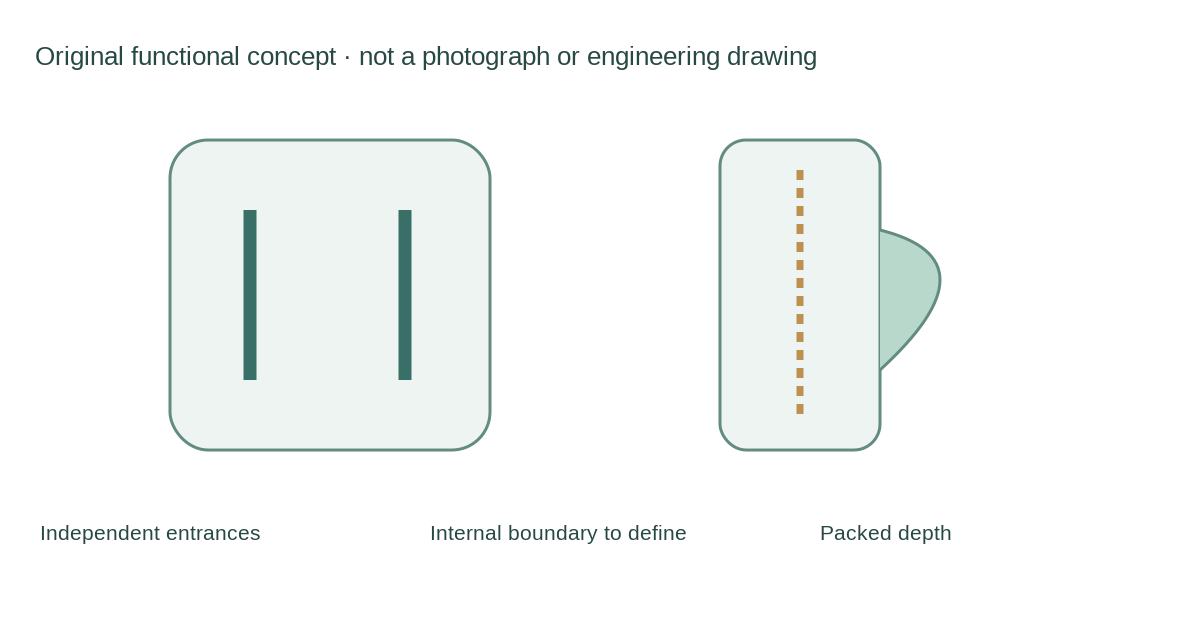
The lower horizontal entrance needs its own role. Shared volume can allow objects loaded through different openings to press against one another. Independent compartments add dividing material and construction. Neither arrangement can be confirmed from the closed exterior photograph.
04
Review the front pockets with the whole pack loaded
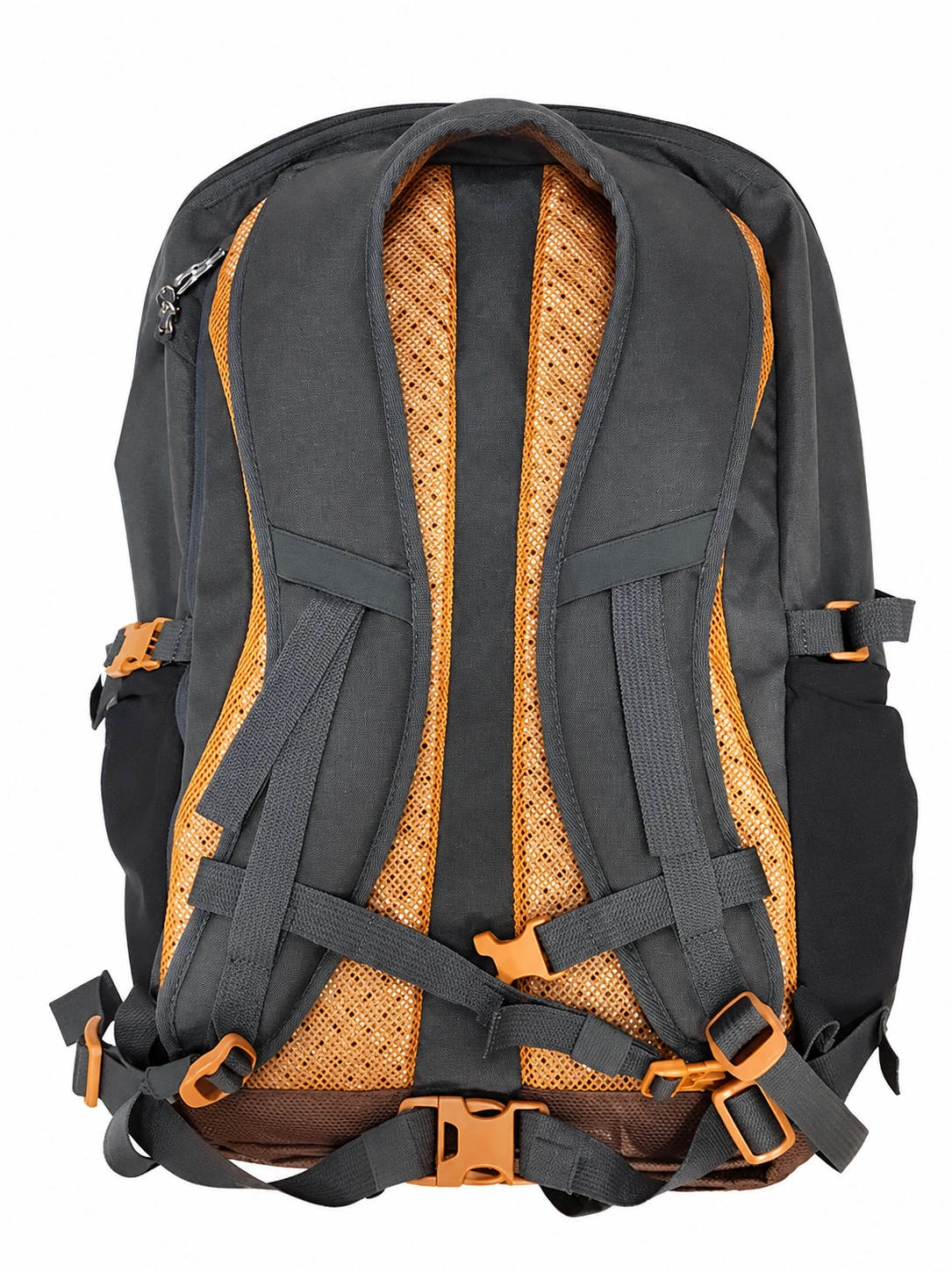
The rear photograph of the same pack shows shoulder straps, a chest connection and back-surface regions. It does not reveal the main-compartment wall, internal support or measured comfort. Pairing the views keeps the review focused on the complete pack rather than treating the front as an isolated organizer.
A thick item in a front pocket may project outward or occupy main-compartment space, depending on its internal pattern. Review retrieval after loading the main compartment with representative contents. Showing that each pocket accepts an item in an empty bag is insufficient. Any local pressure at the back also needs observation on the sample.
05
Assign materials by the finished pocket region
The exterior face, internal divider and zipper surround have different jobs. The face accommodates the intended shape; a divider separates contents; the zipper region maintains an opening after sewing. Similar appearance cannot identify material composition or performance across these layers.
Define actual layer specifications, assembly and edge finishing, then revisit the loaded shape. Removing a divider may reduce material while weakening the intended organization. Adding reinforcement can also change the clearance around the object and entrance. Neither decision is complete at fabric-swatch stage.
06
Build the sample review around finding and returning items
Use the intended objects and record the entrance used, whether another item must move and how the user recognizes the closed pocket afterward. Compare the routine before and after main-compartment loading. These are proposed development scenarios, not reported user trials or measured outcomes.
The handover should include entrance locations, an internal zoning drawing, left-and-right roles and revision records. The public photographs have ordinary product branding removed. The independent schematic explains entrances and shared depth only; it does not confirm the reference product's concealed divisions or imply JKPD designed or manufactured it.
Discuss your bag development project
ANSON XIE
General Manager & Founder
Quanzhou Junkai Pengda Special Equipment Co., Ltd.
Email: ansonxie@jkpdtime.com
Phone: +86 177 5095 3355
WhatsApp: +86 177 5095 3355
Factory address: Floors 2–4, Building 1, Phase I, Huixin Intelligent Manufacturing Industrial Park, Hui'an County, Quanzhou, Fujian, China