
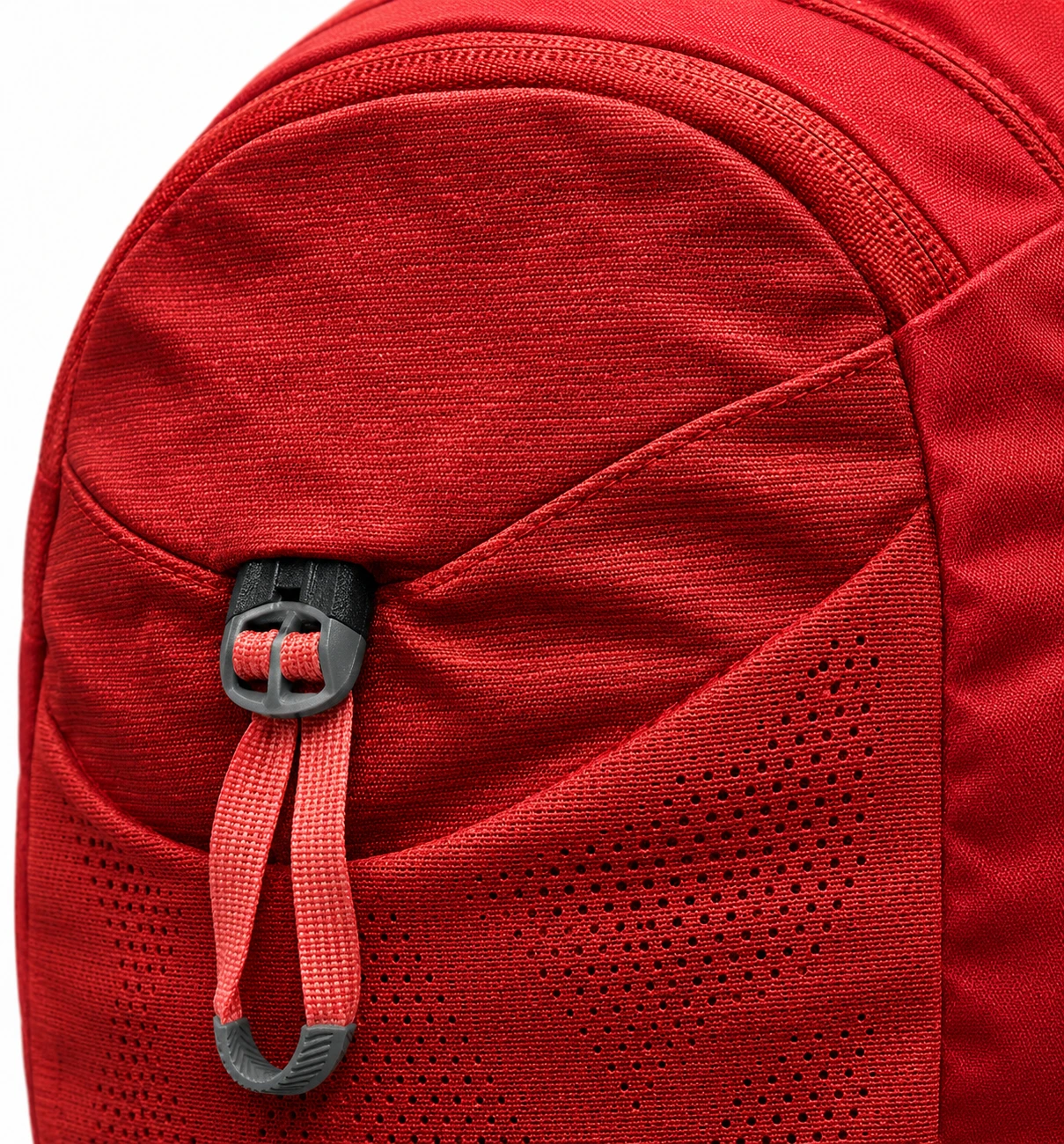
Compare front-pocket buckle and zipper layouts through opening coverage, retrieval order and main-compartment clearance. Define the contents before selecting a closure.
Photo: Matti Blume · Source · CC BY-SA 4.0. Cropped upper front-pocket detail; ordinary branding cleaned with AI. Adaptation under the same license.
01
Start with contents and the retrieval action
A hiking daypack front pocket often handles temporary storage and items retrieved at a stop. Its closure determines where the hand starts, what must release and how much of the entrance opens. A buckle and a zipper are different layout choices, not a simple quality ranking. Define item size, return frequency and independent operation before choosing the component.
The first red-pack photograph shows a front clasp-like component, hanging pull strips and the surrounding panels. The pocket is closed. Its interior divisions, actual opening shape and small-item retention cannot be established from this view. It is a reference for visible operating positions.
02
A strap closure does not describe the entire opening
A strap can locate a flap and provide a release point. Whether the intended contents remain enclosed also depends on the opening, flap and side boundaries. A fastened central buckle alone cannot demonstrate that a small object will remain inside. Define closure position separately from the containment perimeter.
The released flap needs room as well. A main zipper, external cord or adjacent pocket may occupy the same hand approach. Review release, opening, grasping and reclosing as a sequence rather than confirming only that the buckle halves connect.
03
A zipper needs a route and a grasping area
A zipper closes along its path, while passage through the entrance still depends on length, curvature and the pocket boundary behind it. Increasing zipper length does not necessarily improve grip on the object. Treat reaching the pull and grasping the contents as separate spaces.
A covering edge or adjacent layer should not hide the operating point. If a thick item distorts the pocket face, pulling harder is not a design solution. Slider appearance does not establish a locking mechanism or water resistance, and a normal closure is not a waterproof system by default.
04
Keep the two reference products separate
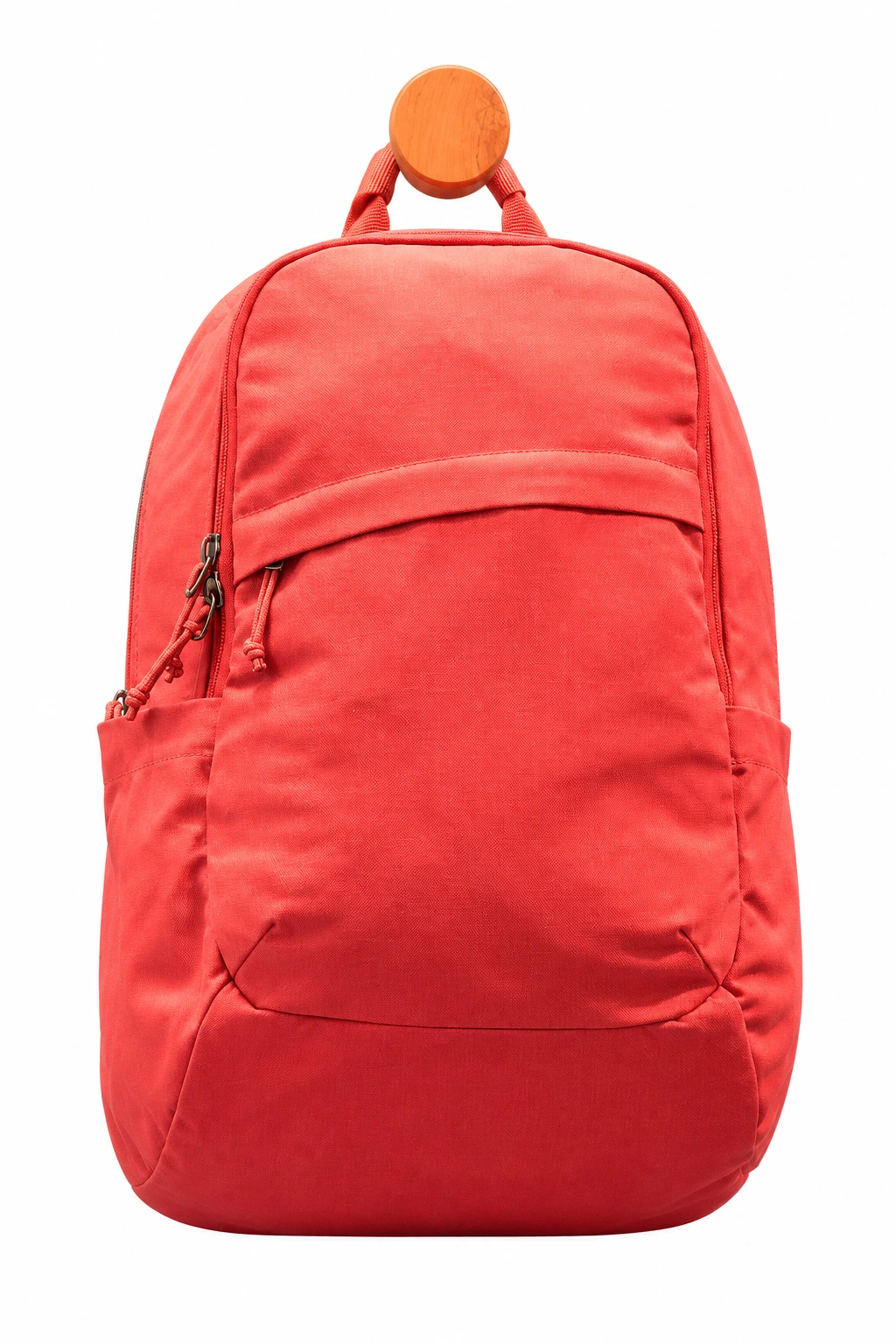
The second photograph shows another red daypack with a covered front-pocket edge and zipper pulls at its side. It is not a different angle of the first pack. The pair compares visible closure position and hand direction, not a single product's opening sequence.
Where a front pocket and main opening sit close together, distinguish their pulls and routes on the drawing and sample. Users should not need trial pulling to identify an entrance. Position, shape or another verified design detail can provide distinction without product branding or promotional text.
05
Select the face construction in its closed state
The suitability of a lighter fabric depends on contents, pocket depth, edge finishing and the closure connection. A light swatch does not replace inspection of the assembled shape. A strap anchor and a curved zipper region can require different local construction information.
Observe the entrance and panel with the intended contents before deciding on reinforcement or dividers. Extra closure steps can undermine quick retrieval even when they add apparent features. No material composition or measured performance is assigned to either photographed pack.
06
Review returning the item as carefully as removal
Begin with the closed sample and record release, grasp, return and closure. Each step needs a clear operating point. Having to rearrange the flap or move neighbouring contents after every return can matter more than the isolated buckle or zipper specification.
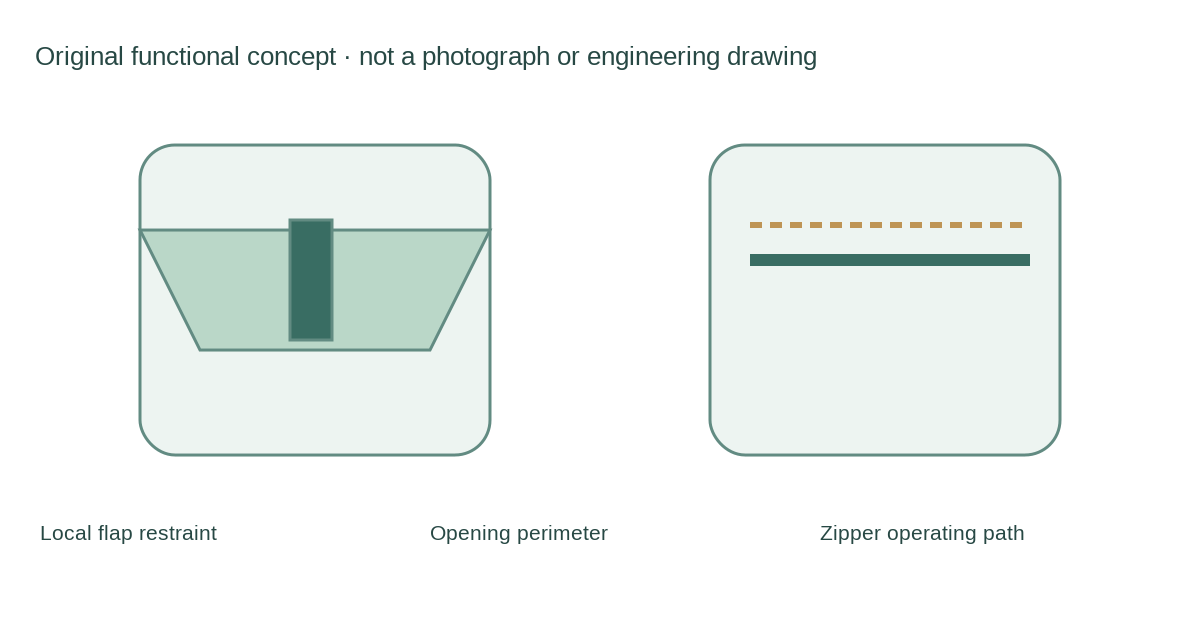
The handover should identify target contents, entrance position, interior boundaries and closed-state views. The original schematic distinguishes development tasks for the two closures; it is not a confirmed section of either product. These external examples do not establish JKPD design ownership or manufacturing experience.
Discuss your bag development project
ANSON XIE
General Manager & Founder
Quanzhou Junkai Pengda Special Equipment Co., Ltd.
Email: ansonxie@jkpdtime.com
Phone: +86 177 5095 3355
WhatsApp: +86 177 5095 3355
Factory address: Floors 2–4, Building 1, Phase I, Huixin Intelligent Manufacturing Industrial Park, Hui'an County, Quanzhou, Fujian, China