
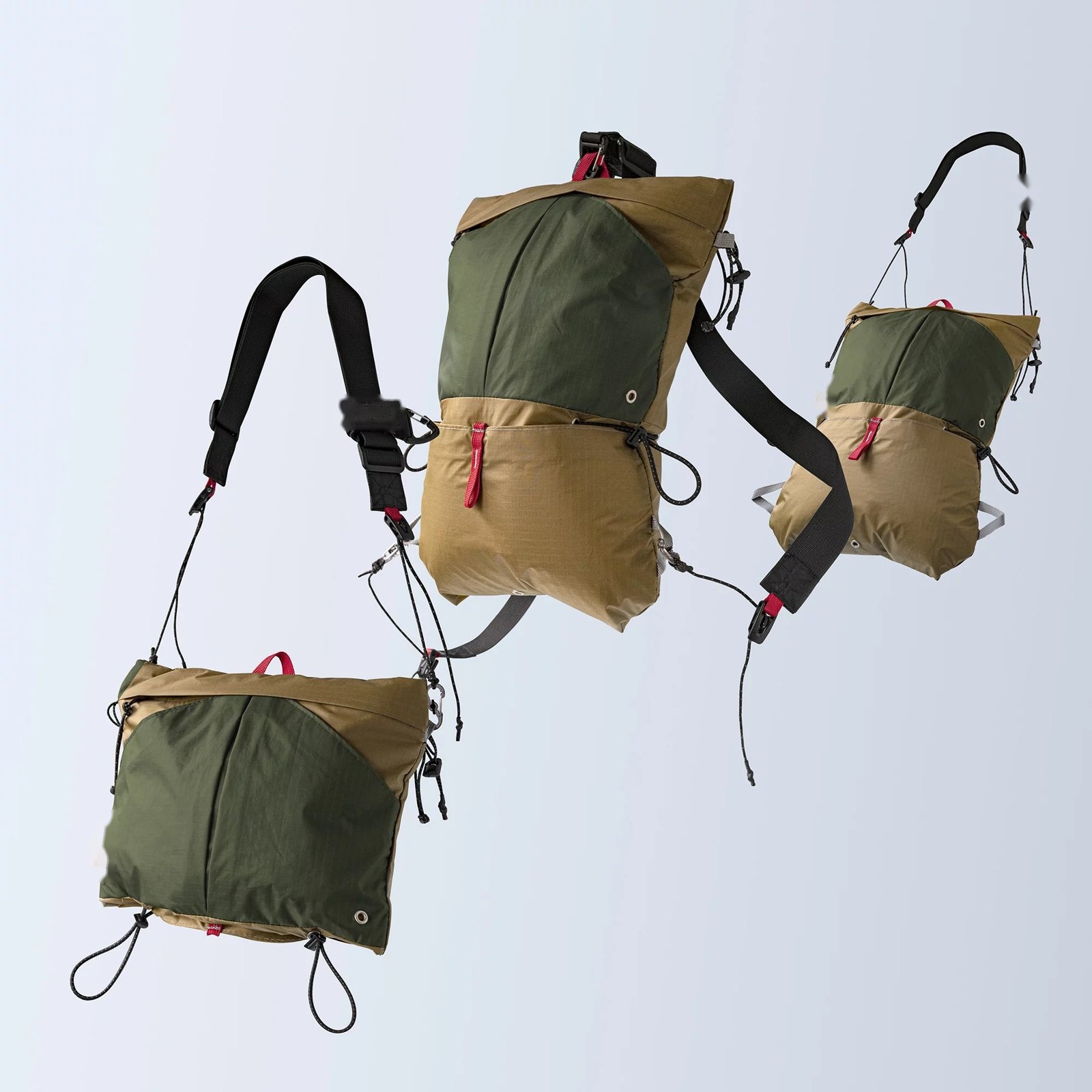
On a long hiking day, the small things cause the most friction. Your phone, snacks, sunscreen, a camera and a spare layer all need to be close at hand, but your main pack is on your back and hard to reach. A hip pack is too small. A second daypack is too much. The bag in this article tackles that gap with an unusual idea: a featherweight sling that can be expanded and re-rigged into a shoulder tote or a small backpack in seconds.
This design example shows how folding, strap routing and storage work across three carry modes. It illustrates the construction decisions a convertible-bag brief needs to resolve. The bag shown is not a JKPD product.
01
At a glance
| Feature | Convertible three-way accessory bag |
|---|---|
| Type | Convertible sling / shoulder tote / backpack |
| Capacity | 4 L as a sling; 12 L expanded as a tote or backpack (±10%) |
| Weight | 188 g (±10%) |
| Dimensions | 27 × 22 × 5 cm (sling) / 27 × 38 × 5 cm (tote or backpack) |
| Materials | Nylon, polyester cord, leather, POM |
| Main fabric | 70D nylon, 2,000 mm water column rating |
| Cord | 3 mm polyester ripstop paracord |
| Hardware | Plastic buckles with quick strap-length adjustment |
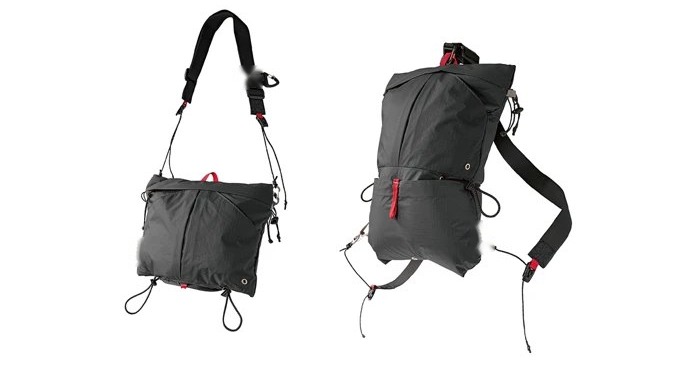
| Colours | Black, or army green / khaki two-tone |
02
Strap control and fold retention
Cord diameter and buckle position affect how the bag handles in compact mode. Compare 2 mm and 3 mm cord in the same adjuster, checking how smoothly the strap moves and whether it creeps under load. Shift the inner buckle in small increments and check that the folded layer stays put without fouling the main opening.
03
Three modes, one bag
The core idea is that one bag body and one strap system give three ways to carry.
- Sling (crossbody, 4 L). The bag is folded down to its compact size and worn across the chest or at the hip. This is the everyday mode for a phone, wallet, snacks, sunglasses and keys.
- Shoulder tote (12 L). The bag is unfolded to full height and carried on one shoulder. It now has room for a light jacket, a water bottle and lunch.
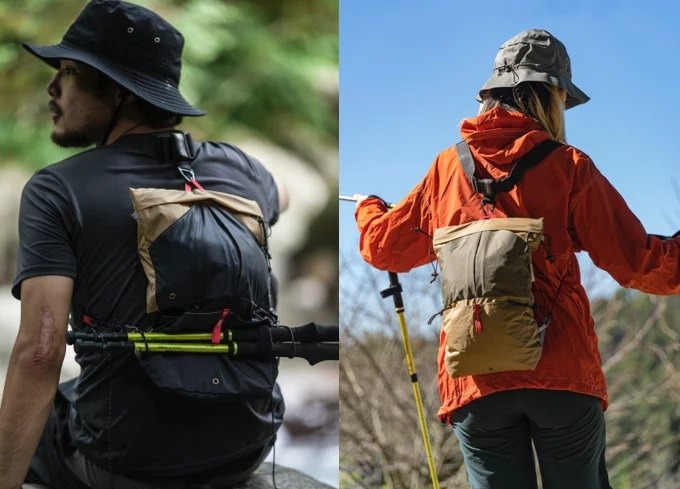
- Backpack (12 L). The strap is re-rigged so the bag sits on the back like a small daypack. This is the mode for longer walks when both hands need to be free.
Switching between modes takes seconds, without tools or detachable parts that might get lost. For hikers, this means one bag can act as a chest pouch on the trail, a tote at the campsite and a mini daypack for a short side trip.
04
Functions in detail
Expandable 4–12 L capacity
The bag body is designed to fold. At 4 L it is a slim sling about 5 cm thick that sits close to the body. Unfolded, it becomes a 12 L bag nearly twice as tall. The same bag covers what would otherwise need a sling and a small daypack.
Wet-and-dry separation
The bag has a separate storage zone at the bottom. A wet water bottle, a damp umbrella or a windbreaker can go there, kept apart from dry items such as a phone, camera or paper documents in the upper section.
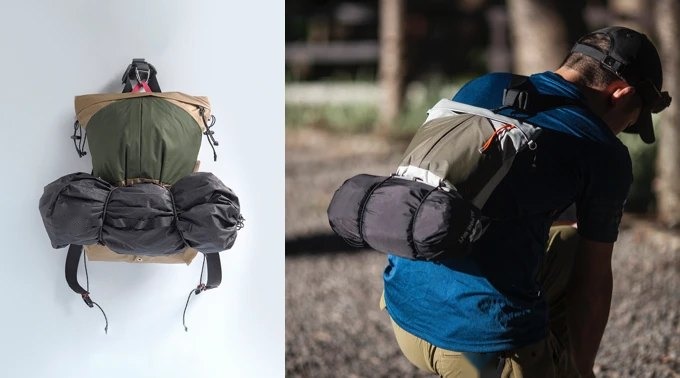
Bottom bungee for extra gear
An elastic cord on the bottom of the bag lets you strap on items that do not fit inside: a rolled jacket, a sit mat or a small sleeping mat. This expands what the bag can carry without adding size or weight.
Twin loops for a spray bottle
Two lanyard loops on the outside hold a small spray bottle, such as an alcohol or hand-sanitiser spray. They can also hold other small items on a clip.
Multi-layer interior for a camera
The bag uses a layered, three-dimensional internal space with a wide base. That makes room for a mirrorless camera, even though the bag is thin and light.
Ergonomic quick-access front pocket
A front pocket is shaped for quick access in sling mode and works for both left- and right-handed users. It is the place for a phone or snacks you reach for often.
Quick strap-adjustment buckles
A quick-adjust buckle lets the user change strap length without rethreading the whole strap. Check its adjustment range in all three modes and retest with the bag fully loaded.
Attaches to a main pack and packs into itself
The bag is small enough to attach to a main backpack and act as an inner organiser or an easy-access pouch. It is also self-packable, so it can be stuffed into its own pocket for travel.
05
Materials and hardware
The bag's weight of 188 g comes from careful material choices.
- Light nylon ripstop. A coated 70D nylon is a lightweight option. A 2,000 mm water-column rating describes the fabric, not the finished bag; seams, openings and the closure still need separate checks.
- Polyester cord. A 3 mm cord can replace part of the strap assembly. Check adjustment feel, grip and wear at every point where the cord changes direction.
- Small leather details. These are optional and should have a specific job, such as making a pull easier to grip.
- POM hardware. Acetal buckles are one option; match the adjuster to the actual strap or cord and check retention on the assembled bag.
For brands, the lesson is clear: in a small bag, the strap and hardware can be a large share of the weight. Replacing some webbing with cord and choosing efficient buckles cuts grams without weakening the fabric.
06
Who is it for?
- Day hikers and trekkers who want snacks, phone, map and sunscreen on the chest rather than in the main pack.
- Outdoor photographers who want a mirrorless camera ready to use without stopping.
- Campers who need a small bag to carry around the campsite or on a short walk from camp.
- Cyclists and travellers who want a light bag that can switch between a sling and a small backpack.
- City users who like an outdoor look and want one bag that adapts to the day.
- Ultralight hikers who count every gram and want one accessory bag to do several jobs.
07
Pain points it solves
- Essentials out of reach. A chest-mounted sling keeps small items accessible while a main pack stays on.
- Carrying two bags. One bag replaces a sling and a small daypack.
- Wet items soaking dry ones. Wet-and-dry separation keeps a wet bottle or umbrella away from electronics.
- Not enough room for a layer. Expanding to 12 L, plus the bottom bungee, makes space for a jacket or mat.
- Heavy accessories. At 188 g, it adds almost nothing to a pack's weight.
- Awkward strap adjustment. Quick-adjust buckles and the thicker 3 mm cord make length changes smoother.
08
Selling points and advantages
- Three ways to carry. Sling, shoulder tote and backpack from one bag.
- Big capacity range for its weight. 4 L to 12 L at 188 g.
- Thoughtful details. Wet-dry separation, spray-bottle loops, a camera-friendly interior and an ambidextrous front pocket.
- Easy adjustment. The buckles make changes to strap length straightforward.
- Clean, outdoor-meets-city look. Black or army green / khaki two-tone works on the trail and in town.
09
Limitations to keep in mind
- Not a waterproof bag. A 2,000 mm rated fabric resists rain, but seams and openings can let water in during long downpours.
- Light fabric needs some care. 70D nylon is light, but less abrasion-resistant than heavy pack fabrics.
- Limited structure. A thin, soft bag will not carry heavy loads comfortably as a backpack. It is designed for light essentials.
10
What brands can learn from this bag
- Solve one everyday problem very well. The bag focuses on keeping essentials at hand and making a small bag grow when needed.
- Make conversion fast and simple. No detachable modules, no tools; just fold, unfold and re-rig the strap.
- Use cord and hardware to save weight. Straps and buckles matter as much as fabric in a small bag.
- Design for specific items. Spray-bottle loops, a camera-friendly base and a bottle zone show the user's real kit was considered.
- Review small changes in the loaded sample. Cord diameter and buckle placement can change adjustment feel and fold retention.
11
Building a convertible accessory bag with JKPD
Quanzhou Junkaipengda Special Equipment Co., Ltd. (JKPD) is a textile bag manufacturer in Hui'an County, Quanzhou, Fujian, China, producing outdoor, business, leisure, student and tactical bags and pet harnesses for overseas brands on an OEM/ODM basis. Our factory holds ISO 9001, ISO 14001 and ISO 45001 certification.
A convertible sling or 3-way bag needs a precise brief, because folding, strap routing and hardware placement all have to work together. Useful inputs include:
- Target capacity in each mode and target total weight.
- The carry modes required and how the user switches between them.
- Main fabric, denier, coating and water-column target; any lining or wet-dry zone.
- Strap system: webbing, cord or both; buckle and adjuster suppliers.
- Pocket list, attachment loops and bungee points.
- Colourways and any trims such as leather or reflective details.
Our standard terms for a new style:
- MOQ: 500 pcs per style.
- Price: quoted per style, based on materials and construction.
- Sampling fee: USD 300 per style.
- Lead time: usually 60–120 days, depending on order quantity.
We develop each client's own design and do not copy other brands' patented mechanisms, logos or protected features.
Discuss your bag development project
ANSON XIE
General Manager & Founder
Quanzhou Junkai Pengda Special Equipment Co., Ltd.
Email: ansonxie@jkpdtime.com
Phone: +86 177 5095 3355
WhatsApp: +86 177 5095 3355
Factory address: Floors 2–4, Building 1, Phase I, Huixin Intelligent Manufacturing Industrial Park, Hui'an County, Quanzhou, Fujian, China