
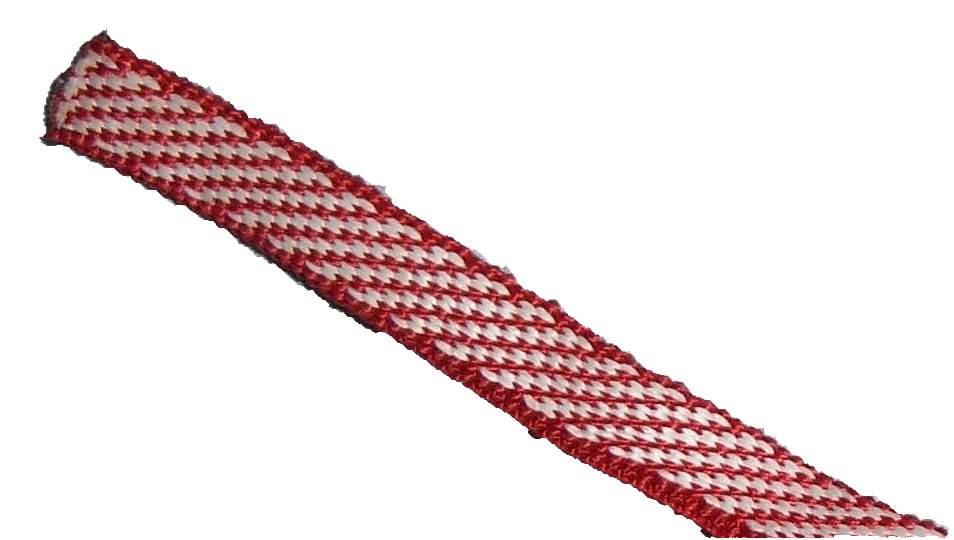
Photo: DarthLarwa. Public domain (author dedication) · Original source. Unmodified for this article. The image remains under its stated license; no endorsement or JKPD material use is implied.


01
What does the Dyneema name actually specify?
Dyneema is a brand, while UHMWPE identifies a polymer class. A purchasing specification should preserve that distinction and identify the actual yarn grade. The manufacturer’s science explanation describes powder production, dissolution, gel spinning and a subsequent drawing stage that further aligns molecules.
That manufacturing route explains why the fiber is more specific than an ordinary polyethylene label. It does not establish the strength of an unidentified roll of webbing. Request the yarn designation, traceable supply information and the weaver’s article number before comparing offers.
A useful material declaration separates brand-fiber identity, constituent proportions, warp and weft allocation, and finishing. If a quotation says only “Dyneema strap,” return it for clarification before making a weight-saving decision.
02
How is woven webbing different from DCF?
The photograph shows a small woven strip whose uploader identifies it as partially containing Dyneema. Red and white interlaced yarns and the strip edges are visible. Their colors do not identify individual fiber types, proportions or yarn grades, and the photograph supplies no breaking-force evidence.
Narrow woven webbing and a finished composite fabric require different specifications. Dyneema’s manufacturer describes several routes from fiber to fabric, including weaving and bonding, as well as DCF. A report for a wide composite sheet therefore cannot qualify a narrow woven strap.
For a bag project, name the task first: adjustment, closure, carrying or retention. The photographed item comes from another equipment category; neither its original application nor any assumed load rating transfers to the proposed bag.
03
Why does fiber strength not settle connection behavior?
Yarn strength, webbing breaking force and finished-connection behavior answer different questions. Weaving creates a defined width, thickness, yarn arrangement and edge. Passing that material through an adjuster introduces another contact geometry and a route along which movement must be controlled.
Compare length change under the agreed use load, movement through the buckle and recovery after unloading. For a strap that remains tensioned, request sustained-load information for the proposed grade and construction. Low extension should never be rewritten as zero creep.
Estimate weight from mass per meter and the required functional length. Then include overlaps and reinforcement in the comparison. Additional layers may change the benefit suggested by a bare-material sample; treat that as a sampling question rather than a guaranteed saving.
04
What needs confirmation before cutting or sewing?
Thermal processing needs article-specific advice. Bally Ribbon Mills publishes UHMWPE fiber reference information with an explicit warning that values depend on manufacturer and yarn type. A fiber melting reference is not a hot-cutting setting or a production pressing window.
Ask the webbing supplier for cutting, end-finishing and sewing recommendations. Evaluate the actual material stack for hardened edges, local shrinkage, fraying and damage. Record the needle, thread, stitch spacing and overlap used in the trial, without treating an unqualified recipe as universal.
For bonding, obtain written information about the surface, preparation, adhesive and cure conditions. Chemical resistance of a fiber does not establish adhesive compatibility. A finish or an additional constituent can also change the interface, so confirm the proposed joint rather than relying on the brand name.
05
Which evidence makes a strength claim useful?
Start by defining the failure behind “tear resistant.” Longitudinal rupture, damage at an edge, movement through an adjuster and failure at a sewn attachment are different events. An undefined marketing term cannot establish acceptance requirements for all of them.
The public ASTM D6775 listing addresses breaking strength and elongation of webbing, tape and braided materials. D6770-24 identifies a separate webbing abrasion method. These references help frame a discussion with a laboratory; they do not mean the proposed product has passed either test.
Request reports linked to the exact article, width, color and finish. Record the sample condition and acceptance basis. Separately document whether an assembled connection fails in the webbing, sewing thread, surrounding fabric or hardware, because each outcome requires a different response.
06
Related manufacturer video
Related video:The opportunities and characteristics of Dyneema® Woven Fabrics · Dyneema®
Supplementary viewing only. The video does not certify the illustrated material or the proposed bag assembly. Use current article-specific documentation for approval.
07
What should go into the purchase inquiry?
Include the application, identified brand fiber and other constituents, webbing article, width and thickness tolerances, mass per meter, color, finish and proposed hardware. Add the load and environmental conditions that need validation. Mark missing values as unresolved rather than inferring them from a photograph.
Keep supplier documentation, incoming-sample identity and connection results as separate records. A yarn change, a different weaving source or a new finish calls for review of the affected requirements. Continued use of the Dyneema name alone does not establish equivalence to an approved article.
For ordinary bags, evaluate a clearly defined functional location before expanding the material’s use. This development discussion does not establish suitability for life-safety equipment, and it makes no claim that JKPD has adopted or supplies the illustrated material.
Related reading: backpack webbing development.
Share the application, candidate material articles and available records through the JKPD project inquiry page.
Discuss your bag development project
ANSON XIE
General Manager & Founder
Quanzhou Junkai Pengda Special Equipment Co., Ltd.
Email: ansonxie@jkpdtime.com
Phone: +86 177 5095 3355
WhatsApp: +86 177 5095 3355
Factory address: Floors 2–4, Building 1, Phase I, Huixin Intelligent Manufacturing Industrial Park, Hui'an County, Quanzhou, Fujian, China