
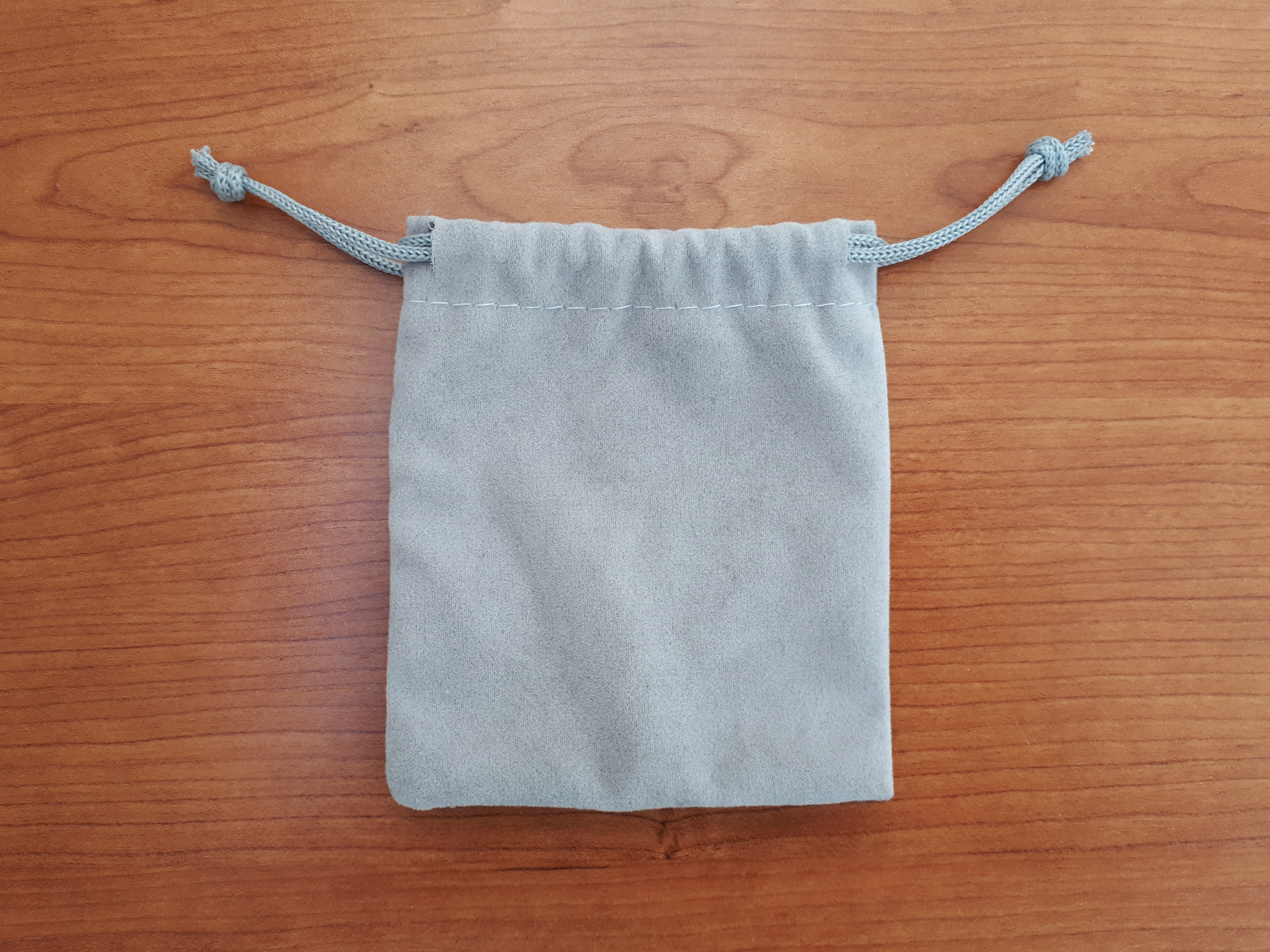
Photo: Fructibus. CC0 1.0 · Original source. Unmodified for this article. The photograph remains under its stated license; no endorsement, specific material grade or JKPD use is implied.

01
Define what must pass through the opening
A drawstring closure needs to do more than gather fabric. List the intended contents and insertion orientation, then specify the effective opening in use, the gathered appearance and whether the purpose is simply dust storage. Flat bag width is not automatically the usable mouth opening.
An ordinary gathered closure may retain a central gap. Drawing it tight does not establish sealing or waterproofness. Check small parts for possible escape, and review the actual loading action for shoe covers, equipment storage or internal pouches. This article addresses casing development; it does not define the drawcord as a load-carrying shoulder-strap construction.
02
Check usable clearance after sewing
Casing cut width includes folds and seam allowances. The space left for cord movement after assembly is the usable channel. Record stitch position, folded layers and seam intersections rather than finishing the review with a cord-diameter-plus-allowance note on a flat pattern.
A BERNINA WeAllSew tutorial provides a construction example involving a sewn casing. It is one construction route, not a universal bag dimension. The photograph shows a grey bag mouth, a horizontal stitch line and cord ends on both sides. It locates the channel visually without establishing its internal layers or measured clearance.
Fructibus · CC0 1.0 · Source · Unmodified. External object, not a JKPD product.
03
Treat cord and casing as a combination
Round cord, flat tape and cords with different stiffness can behave differently in the same casing. Prototype with the final candidate and record its physical specification, surface condition and supplier article. A convenient thin temporary cord is a poor basis for approving the pattern.
When two cords share a passage, inspect clearance with the actual threading arrangement. If a cord lock is included, review its compatibility with the cord and the opening after release. Without a particular sample and use condition, there is no justified universal channel-width ratio. The relevant comparison is between complete candidate combinations, not isolated cord diameters or fabric swatches.
04
Inspect exits and seam intersections first
Where folds, seam allowances or lining converge near an exit, check for stitching that closes the passage, loose edges entering it and local layers consuming clearance. Record the location of a catch instead of describing the entire bag simply as too tight.
Finish the opening edge while preserving a usable exit. A local coupon can establish threading access, followed by confirmation in the assembled bag. If one side consistently pulls harder, compare end construction and allowance direction before replacing the cord with a smoother option. A material substitution may mask a local assembly problem that later returns in production.
05
Separate threading, opening and gathering
Successful threading establishes assembly access, not smooth use. Review whether cord ends can be inserted, whether the mouth opens fully, whether loading requires spreading it with both hands, and whether gathering produces unexpected local bulk or excessive tails.
Load the intended item to expose opening restrictions that an empty sample may hide. In a lined design, check whether the inner opening follows the outer mouth or creates a second restriction. Empty, filled and intended-care conditions may all belong in the comparison. The project should specify the actual sequence and acceptance criteria rather than treating a single successful pull as an operating validation.
06
Revise the sample by fault location
Keep the sample and its record together
If the channel feels tight along its entire route, compare finished clearance with the actual cord arrangement. If only the exit catches, inspect short ends and intersections first. If the mouth will not open sufficiently, review cord length, routing and terminal positions. Tail length and knots need approval in both the open and gathered states.
Keep pattern revision, fabric and cord articles, finished casing dimensions, stitch location and defect-location photographs for each round. Adjust a variable with a stated reason, then repeat the loading action. Enlarging the entire bag is not a useful default response to every local cord restriction.
07
Provide a complete sampling package
Give the development partner the intended contents, closure purpose, flat and operating-state requirements, actual fabric and cord samples, casing and exit construction, terminal treatment, appearance criteria and review sequence. Request open and gathered views plus exit close-ups, rather than a front photograph alone.
Ask how finished clearance is measured, how passage is maintained at intersections, and whether the assembly is rechecked with production cord. These questions connect the quotation to a specific construction. Release should follow the agreed physical sample and its records. This guide deliberately avoids prescribing sewing dimensions that have not been validated with the selected materials.
Share your application, candidate components and sample requirements through the JKPD project inquiry page.
Discuss your bag development project
ANSON XIE
General Manager & Founder
Quanzhou Junkai Pengda Special Equipment Co., Ltd.
Email: ansonxie@jkpdtime.com
Phone: +86 177 5095 3355
WhatsApp: +86 177 5095 3355
Factory address: Floors 2–4, Building 1, Phase I, Huixin Intelligent Manufacturing Industrial Park, Hui'an County, Quanzhou, Fujian, China