
A document carry bag should give visible reference material and complete folders clearly defined places. A clear pocket, an exterior zipped pocket and the main compartment can serve different tasks. Develop those tasks around actual documents and an access sequence rather than treating pocket count as the measure of usefulness.
Development priorities: include sleeves and bindings in document dimensions; distinguish identification from removal; pack complete folders; review both closed carrying and opened viewing conditions.
01
Measure the document assembly
Provide the folder, binder or protective sleeve used in practice. Paper size describes the sheet, not the full outline after borders, binding hardware and projecting tabs are added. Depth and protrusions can change both opening and compartment requirements.
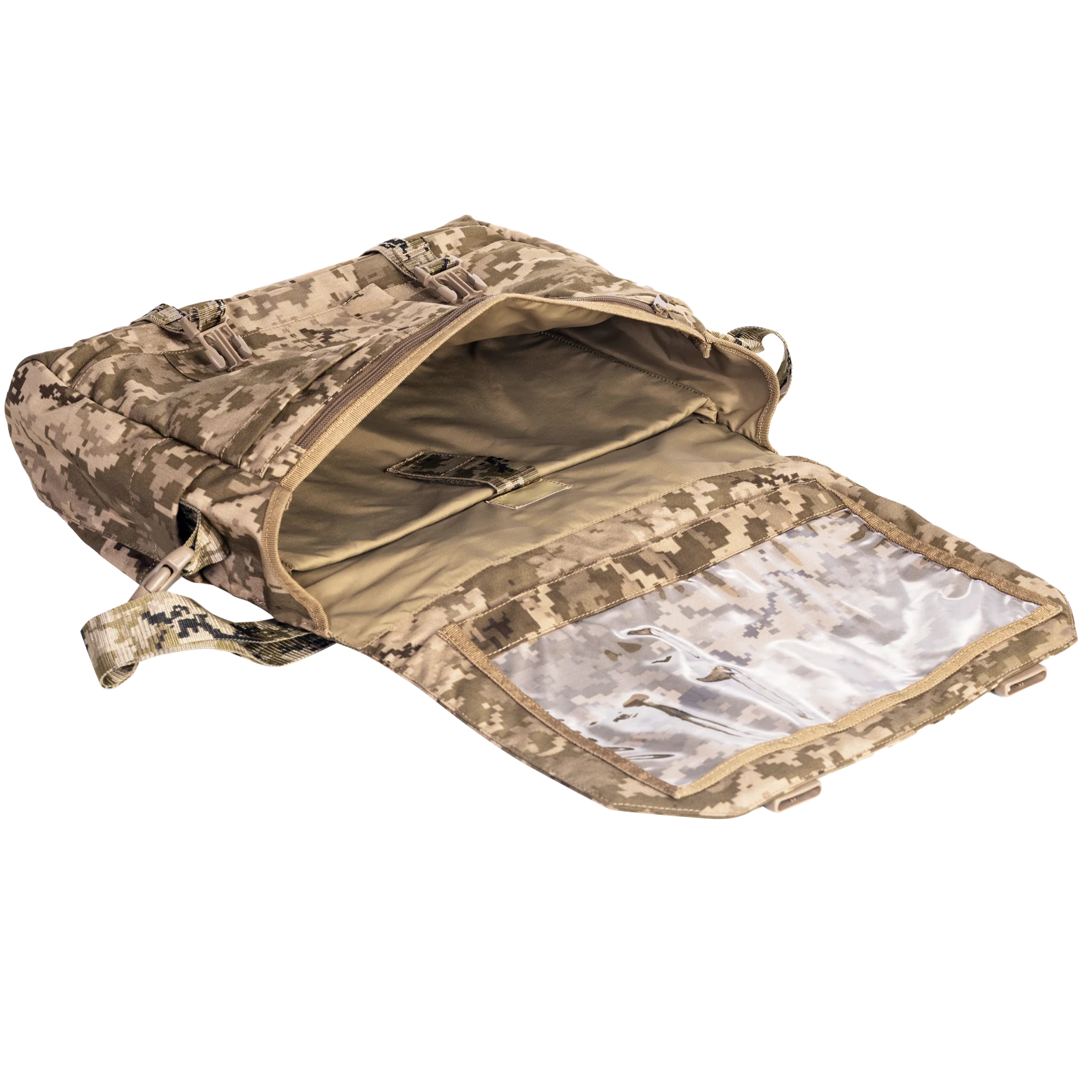
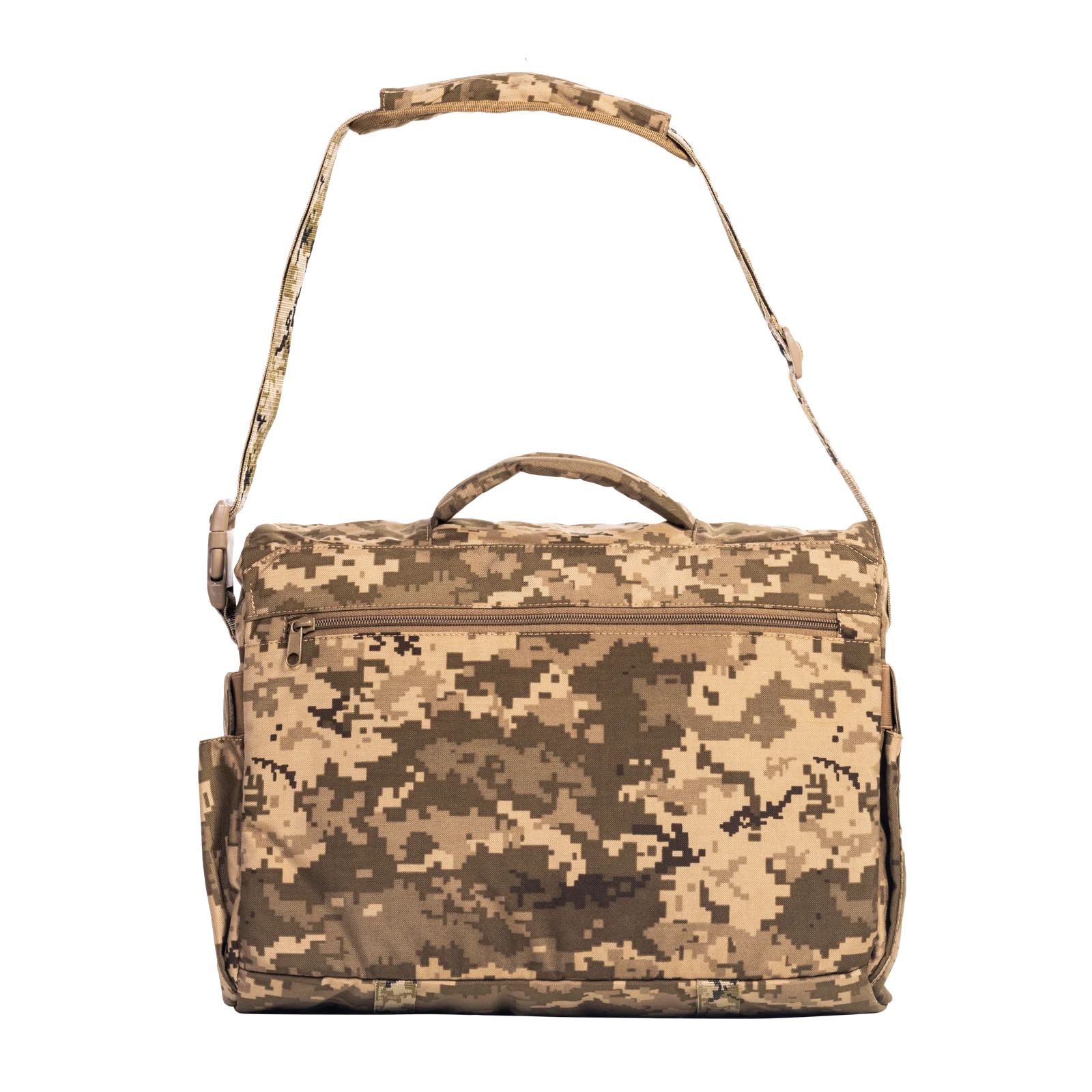
The retained photographs show an opened interior and the opposite exterior face. No document is shown inside. They do not confirm compatibility with a particular laptop or paper format, or establish the number of folders that can be carried.
For sampling, identify the complete item and its orientation. If several folder types are intended, list them separately. An approval based on one thin sleeve should not silently become approval for a thicker binder with a similar paper size.
02
Give the clear pocket a specific purpose
A clear pocket may help identify reference material, while in-pocket reading also depends on text size, viewing angle, reflections and page orientation. Define which task matters. Being able to see a sheet is different from being able to read its contents comfortably.
The opened image shows a clear pocket panel, surrounding binding and lining on the opposite side. It establishes the visible layout, not the polymer type, flex durability or water protection. Use the intended page layout if reading through the panel is a requirement.
If identification is the main task, review labels and insertion access. If the contents need changing regularly, observe the full exchange sequence. The best arrangement depends on which action must be convenient, not simply on how much transparent surface appears in a product photograph.
03
Allow complete folders to pass through the opening
Begin with a complete folder, then close the bag, change its carrying orientation and remove the folder again. Watch corners, binding edges and projecting tabs. Placing one loose sheet flat in the compartment does not evaluate that sequence.
If other objects share the main compartment, use the entire planned packing list. Determine whether those objects must be removed before the folder can come out. When interference occurs, consider item allocation and access order before increasing the thickness of the whole bag.
Record the specific contact point on the sample. A request to move a seam away from a binder corner is more actionable than a general request for a larger bag. Keep the object orientation consistent when comparing revisions.
04
Separate opened viewing from closed carrying
Material intended for viewing on a table may belong in a different position from small items needed during a transfer. Define how the bag rests, how much space the opened flap uses and which way the folder exits. Then inspect whether internal retention obstructs fingers or document corners.
These images do not demonstrate standing access or a particular worn workflow. If either is required, evaluate the corresponding physical arrangement. Avoid turning a plausible use idea into an unsupported claim about the illustrated sample.
05
Keep the exterior pocket’s task clear
A horizontal zipper is visible on the opposite exterior face. The image does not reveal full pocket depth. Use the intended pens, booklet or other objects to confirm fit and observe whether a packed pocket projects into the main compartment.
External access and internal document storage may share space. Reviewing them together can reveal pressure or obstruction when a folder is removed. This is a proposed review, not a test result reported for the product shown.
A shorter packing list can also make the task clearer. Before adding another divider, identify which items need separation and why. An extra layer should solve an observed organization problem rather than simply increase the feature count.
06
Specify materials without guessing from appearance
Keep the approved sample identifiable
Confirm the clear sheet, lining and shell separately, including references, surface condition and seam treatment. A photograph cannot identify the clear panel as PVC or TPU. A camouflage pattern establishes no abrasion rating.
After a material change, recheck opening shape, edges and document contact. Hand over actual document photographs, sleeved dimensions, compartment contents, packed conditions and the sample version. Existing background treatment in the company photography has been retained; no new image editing was performed.
For further independent construction topics, visit the JKPD blog.
Related: Laptop compartment development. See the photographed product reference.
Discuss your bag development project
ANSON XIE
General Manager & Founder
Quanzhou Junkai Pengda Special Equipment Co., Ltd.
Email: ansonxie@jkpdtime.com
Phone: +86 177 5095 3355
WhatsApp: +86 177 5095 3355
Factory address: Floors 2–4, Building 1, Phase I, Huixin Intelligent Manufacturing Industrial Park, Hui'an County, Quanzhou, Fujian, China