
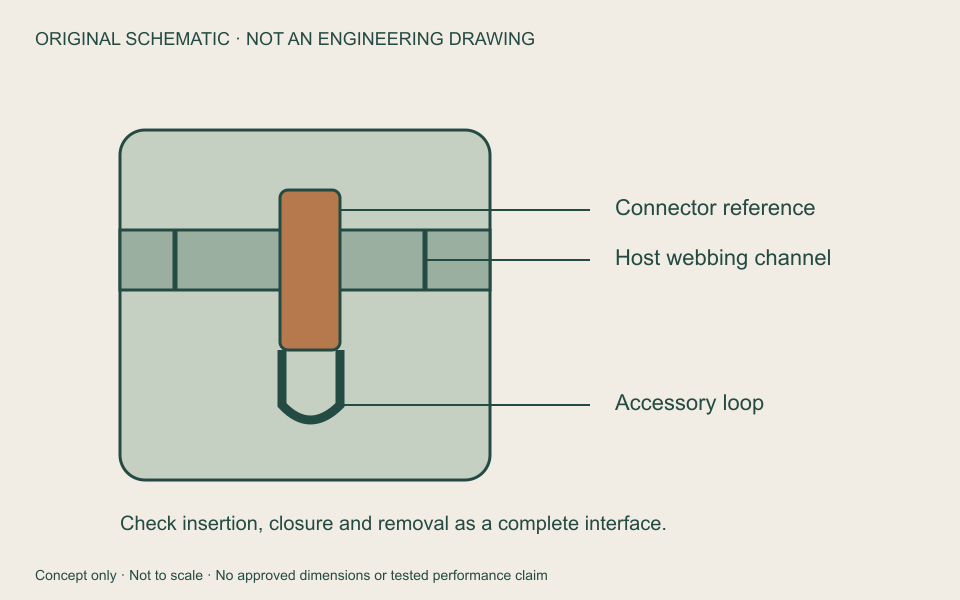
Review a detachable loop with its target bag webbing, installation area, component orientation, closed state and intended use.
01
Define the loop’s task
Specify the reference item and its states during use, storage and removal. A loop may serve as a small accessory interface, but the project must define its role. Tactical or detachable wording does not establish load capability.
Distinguish decoration, retrieval assistance and a specified accessory connection. This article addresses ordinary bag accessories and provides no design for supporting a person, climbing or rescue. Keep unconfirmed functions out of product copy.
02
Document the host webbing and connector together
Record host-webbing location, accessible installation region and the actual material combination, then identify the connector and folded layers. Matching nominal width does not establish complete fit. Review the finished stack and operating space on the sample.
Do not turn one DIY example’s dimensions and fold count into a universal method. Sample against the selected component interface and project requirements. The original schematic shows host-webbing channel, connector and loop relationships without specifying part dimensions or stitching.
03
Review the complete installation-to-removal sequence
Install in the specified orientation, check whether closure can be observed or otherwise confirmed, then attach and remove the reference item before removing the loop. Record any need to bend the bag, lift webbing or move another attachment. Front alignment does not establish completed closure.
Photograph open and closed states and the reverse where needed. Images record position and sequence but do not establish retention performance from static appearance.
04
Check adjacent attachments and openings
At the intended location, operate zippers, bag openings, handles and adjacent accessories. Record orientation and occupied area both empty and with the reference item. If movement or rotation is allowed, define the permitted states; otherwise identify retention requirements to verify.
Repeat installation and removal after layer-stack or connector changes instead of checking appearance alone. Record difficulty closing and investigate the sample rather than assigning a thickness cause from a photograph.
05
Approve the specific combination
Retain bag revision, webbing combination, connector reference, loop orientation, contents and operating photographs. Agree conditions, cycles or other evaluation methods and acceptance criteria where retention or repeated use matters. Component information alone is not a result for the whole sewn assembly.
Approval applies to the configuration reviewed. Recheck similar-looking replacements so buyers can identify the approved interface rather than relying on matching loop appearance.
Share material references and sample requirements through the JKPD inquiry page.
Discuss your bag development project
ANSON XIE
General Manager & Founder
Quanzhou Junkai Pengda Special Equipment Co., Ltd.
Email: ansonxie@jkpdtime.com
Phone: +86 177 5095 3355
WhatsApp: +86 177 5095 3355
Factory address: Floors 2–4, Building 1, Phase I, Huixin Intelligent Manufacturing Industrial Park, Hui'an County, Quanzhou, Fujian, China