
Two entrances in a chest storage panel need separate jobs. Decide which items belong in the outer compartment and which justify an additional zippered pocket. More layers do not automatically reduce searching. If their entrances interfere, retrieving one item can require disturbing another group of contents.
Review outer-only retrieval separately from opening both layers and closing them again. The photographs establish visible opening relationships, not on-bike retrieval, one-handed operation or protective performance.
01
Define the operating condition
A chest location changes which surface the user can see. It does not establish where the hands and body will be during an opening action. Define whether the intended operation occurs after stopping, while standing or with the panel removed and laid down. Use that condition to select opening direction and puller position.
For development, separate the worn position from the actual access check. Work with the bicycle stopped or put the harness flat on a stable surface; the photographs do not show retrieval while riding.
02
Give the outer compartment a clear task
Arrange the outer space around the project’s frequently retrieved items, such as a wrapped small item or a cleaning cloth. Supply actual references and their storage directions. Check whether opening the compartment reveals an accessible grasping position, rather than only establishing how many objects it can contain.
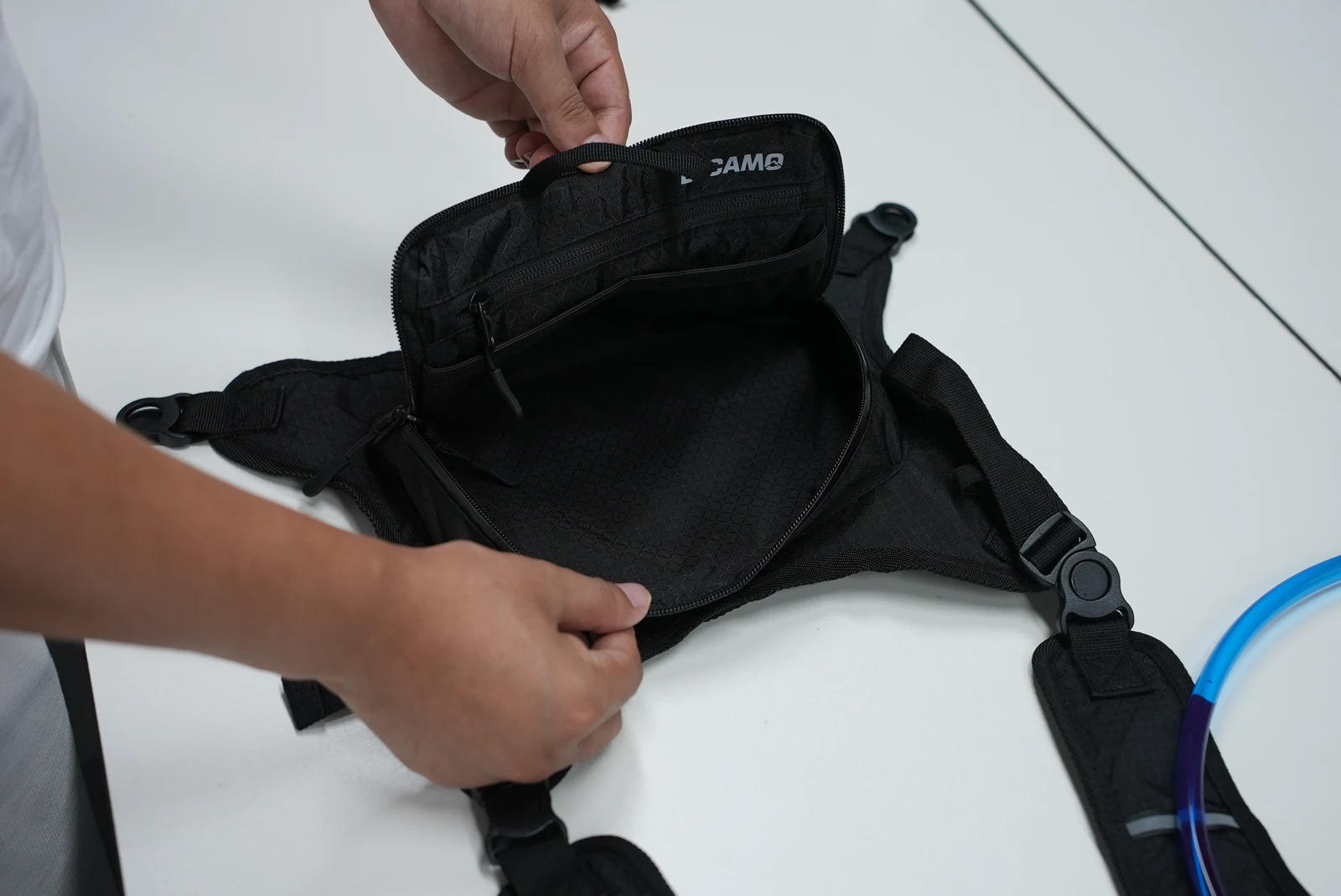
The first operation photograph shows the outer compartment open and the upper panel held up. It supports discussion of the opening direction and hand-support position. No contents are visible, so the arrangement is not presented as a completed loading or retention demonstration.
03
Make the inner zipper earn its extra action
An additional opening should provide a defined storage benefit. It may separate a group of items, but if every outer-compartment retrieval disturbs the inner pocket, the layering may not serve its intended routine. Compare how often each group is accessed before setting the inner pocket’s extent and entrance direction.
The Osprey Siskin/Salida manufacturer manual distinguishes main-compartment organization from a dedicated small-item pocket. It is another example of assigning different storage tasks. Its construction differs from this chest panel, and its dimensions, materials and protective descriptions are not transferred here.
04
Keep both entrances operable together
Open the outer compartment to its intended angle, then approach the inner zipper. Observe whether the slider travels through a bend or requires another hand to lift the panel farther. If the entrance lies near a fold, relocating it may be more useful than simply lengthening the zipper.
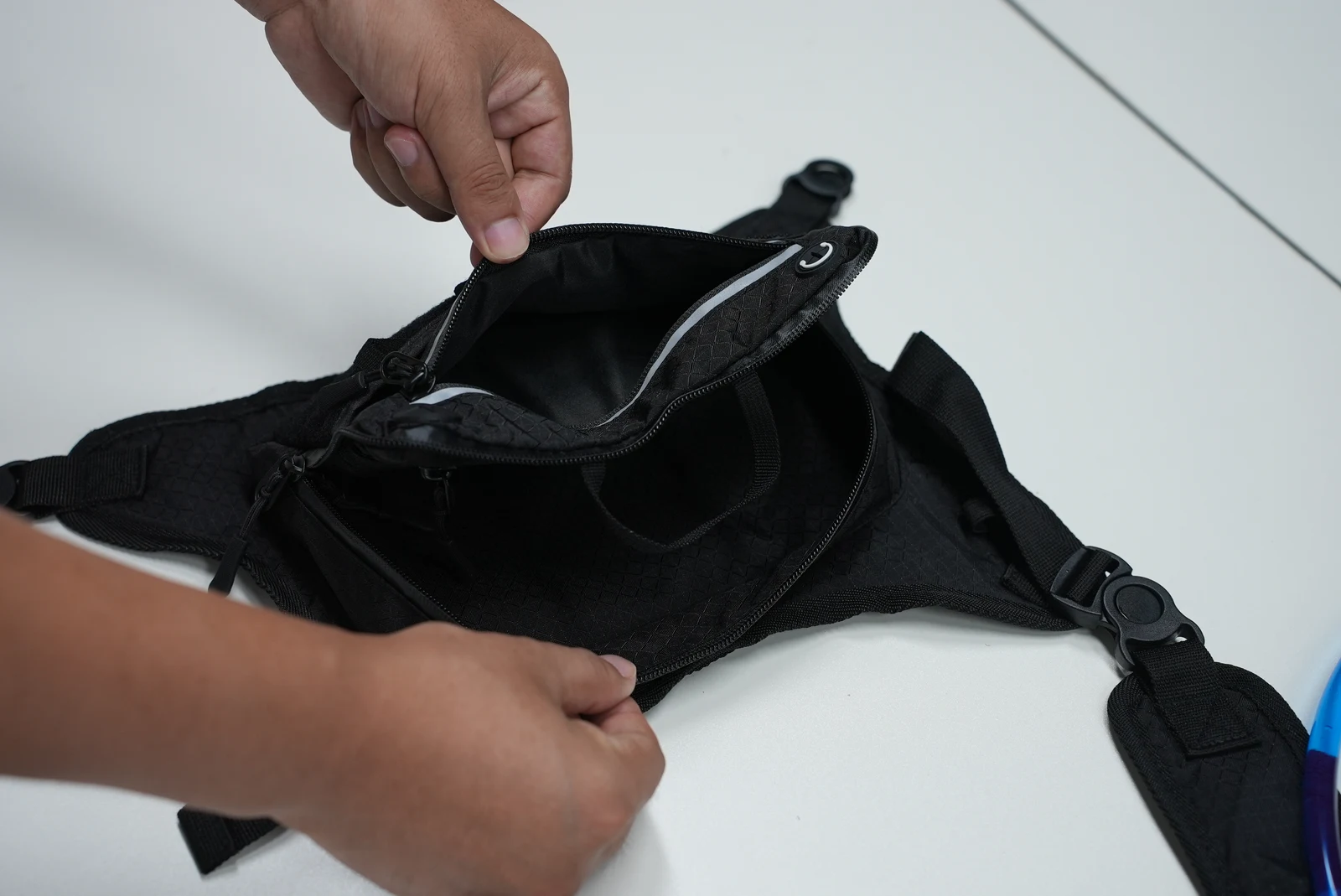
The second operation photograph shows fingers opening another entrance within the raised panel. It provides a reference for the relationship of the two layers. It does not expose the entire closing sequence or demonstrate that the same action is achievable while the panel is worn.
05
Define a recognizable closing order
A layered arrangement needs a clear way to return to its closed state. If the inner pocket closes first, keep its puller and contents in the intended location before bringing the outer panel back. They should not be left between the layers. Consider everyday replacement of contents as well as a neatly prepared photographic display.
On the sample, load both layers as intended and complete the closing sequence. Observe the resulting thickness and whether multiple pullers collect in the same area. If the outer compartment only closes by pressing objects inward, revisit the distribution of contents or the allocated space first.
06
Hand over the relationship between layers
Record what the approved sample must show
Document outer contents, inner contents, opening directions, puller positions and reclosure order together. After changing the zipper, lining or pocket depth, revisit the same sequence. Approval of an attractive open view alone leaves those interactions unspecified.
The original corporate photographs describe visible construction. The text contains independent development proposals, without reporting material composition, testing or personal cycling experience. See the JKPD blog for related layout questions.
Discuss your bag development project
ANSON XIE
General Manager & Founder
Quanzhou Junkai Pengda Special Equipment Co., Ltd.
Email: ansonxie@jkpdtime.com
Phone: +86 177 5095 3355
WhatsApp: +86 177 5095 3355
Factory address: Floors 2–4, Building 1, Phase I, Huixin Intelligent Manufacturing Industrial Park, Hui'an County, Quanzhou, Fujian, China