
Review flat packing, partial access and reclosing as different states. Map opening restraints, retention and zipper clearance on the assembled sample.
01
Define the opening states
Clamshell describes an opening arrangement. The Thule guide to backpack opening types explains it as opening a backpack like a suitcase. The term does not specify how the lid stops or how contents remain positioned when the bag is opened.
A development brief should describe flat packing, partial retrieval and reclosing separately. These movements may require different retention or restraint arrangements. Approving only that the zipper reaches its end leaves the everyday access condition unresolved. Begin with the intended user actions, then decide whether the bag needs an unrestricted opening, a fixed restraint or a releasable restraint.
02
Compare partial opening with flat packing
A restraint that limits lid movement may suit partial access while obstructing flat packing. If the design uses a releasable connection, define when it remains engaged, when it releases and where the released part rests. The user should not need to improvise those transitions every time.
Avoid assigning a universal ideal opening angle without evidence. Review the intended objects and supporting surface first. Then establish the acceptable range on the sample and describe the measurement reference. A shared reference is more useful than a remembered visual impression, especially when a later sample changes the lid thickness or compartment depth.
03
Map the restraint and adjacent components
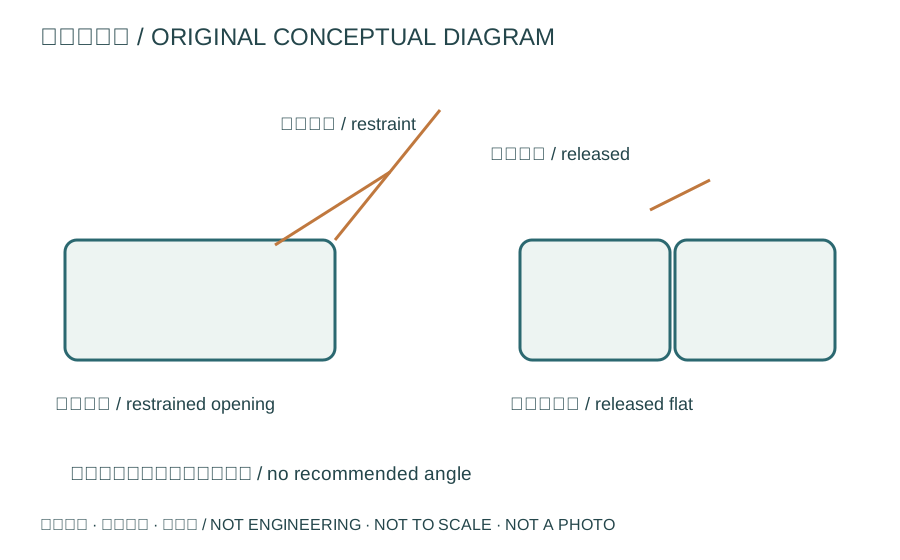
The original diagram contrasts a restrained partial opening with a released flat-opening concept. It identifies the body, lid and connection relationship. It specifies no material, engineering dimension or load capacity. Use it as a discussion aid before reviewing the assembled construction.
On the actual sample drawing, locate each attachment relative to zipper ends, binding and inner pockets. Observe whether the intended connection limits the lid or whether neighbouring lining and pockets become tensioned first. Similar visible opening positions can hide different attachment arrangements. Record the complete construction rather than approving only a front-facing photograph of the open bag.
Original conceptual diagram; not engineering, not to scale, not a photograph or product/test evidence.
04
Separate lid restraint from contents retention
Stopping the lid does not automatically keep the contents in place. Review lid pockets, main-compartment items and removable organisers separately in the partial-open state. Identify which internal closures the intended procedure requires users to fasten before opening the outer bag.
If an internal mesh cover or strap forms part of the proposal, record its operation in the sequence. Do not hide extra steps during a demonstration by preparing the sample beforehand without explanation. A clear procedure lets the buyer judge whether the arrangement suits the product. The diagram provides no evidence of drop prevention or protection against damage to stored objects.
05
Follow both routes back to closure
When returning from a fully open state, check whether restraint material folds into the zipper path. Review contact between loaded lid pockets and the main compartment. Note whether the two sides require different rearrangement before they can close normally. An empty sample cannot expose every conflict.
Repeat both the partial-access route and the flat-packing route with the agreed packing list. Record objects that must be repositioned. Do not use force on the zipper or sustained pressure on the lid to conceal a fit problem. The closure review should demonstrate the intended routine, not a carefully assisted movement that a user would struggle to reproduce.
06
Keep handling claims outside the opening demonstration
An opening restraint and a carry handle perform different tasks. If the project expects users to move a loaded bag through the lid or restraint, specify that use separately. Include the attachments and relevant layers in a validation plan that matches the requirement.
Routine opening observation can identify pulling, folding and interference. It cannot supply a load rating. Agree how repeated opening, component replacement and connection inspection will be evaluated. Avoid turning one successful demonstration into a durability statement. Where no such handling function is intended, keep the description focused on controlling the opening rather than implying a lifting capability.
07
Turn the review into a development record
Keep the reviewed combination traceable
Document bag orientation, packing list, opening states, restraint revision and the sequence for internal retention components. Photograph partial opening, flat packing and normal closure. Mark any performance question that still requires validation so the record remains clear about what has actually been approved.
Changes to inner pockets, lining thickness or attachment location can affect the earlier opening review. Ask the supplier to repeat the same conditions on the revised sample. The final approval should identify a construction and a reproducible set of actions. That provides a practical basis for correction without treating every bag described as clamshell as functionally identical. Keep that record with the approved sample.
Related development guidance: Review the connected construction.
Discuss your bag development project
ANSON XIE
General Manager & Founder
Quanzhou Junkai Pengda Special Equipment Co., Ltd.
Email: ansonxie@jkpdtime.com
Phone: +86 177 5095 3355
WhatsApp: +86 177 5095 3355
Factory address: Floors 2–4, Building 1, Phase I, Huixin Intelligent Manufacturing Industrial Park, Hui'an County, Quanzhou, Fujian, China